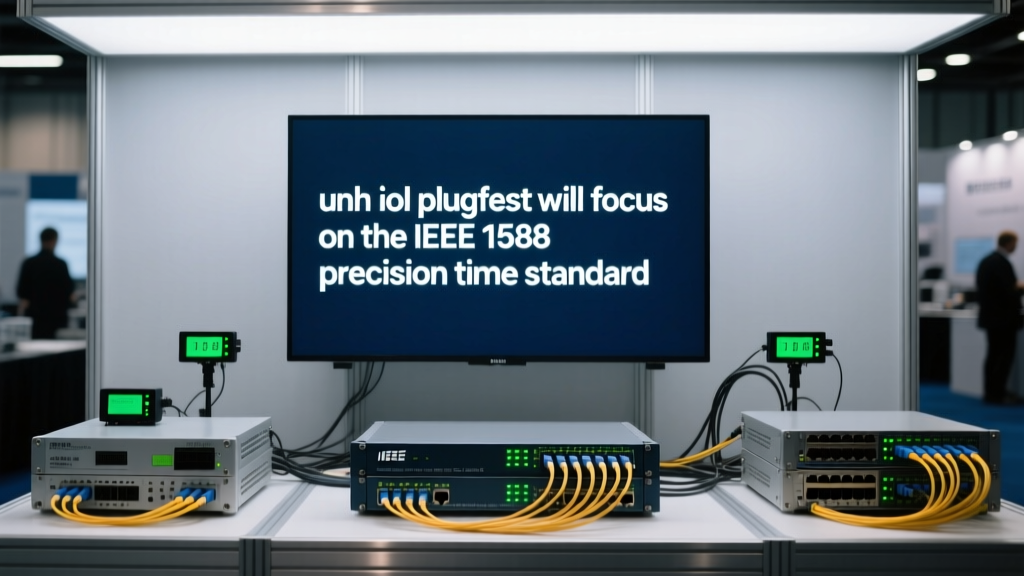
UNH-IOL Plugfest Targets Real-World IEEE 1588 Interoperability Challenges
The University of New Hampshire InterOperability Laboratory (UNH-IOL) has announced its fall 2024 IEEE 1588 Precision Time Protocol (PTP) Plugfest, scheduled for October 14–18 in Durham, NH. This event brings together over 42 participating organizations—including Cisco, Nokia, Keysight Technologies, ADVA Optical Networking, Microchip Technology, and Schweitzer Engineering Laboratories (SEL)—to validate end-to-end synchronization performance across heterogeneous network environments. Unlike theoretical lab assessments, the Plugfest emphasizes practical interoperability under stress conditions: packet loss up to 0.5%, asymmetric latency as high as 127 μs, and clock wander induced by temperature fluctuations from 15°C to 45°C. Participants will test against IEEE Std 1588-2019 (Revision 3), with specific focus on Profile conformance for Telecom Boundary Clocks (G.8275.1), Power Utility Profile (IEC/IEEE 61850-9-3), and Industrial Automation (IEC 62439-3 Annex A). Timing accuracy targets are stringent: sub-100 ns mean time error (MTE) and <250 ns maximum time error (MaxTE) over 24-hour continuous monitoring periods.
As 5G transport networks transition from legacy Synchronous Ethernet (SyncE) to PTP-based timing distribution, verification gaps have emerged between specification compliance and field-ready robustness. The UNH-IOL Plugfest directly addresses this gap by replicating carrier-grade operational constraints—notably jitter accumulation across multi-hop paths and failure recovery behavior during grandmaster switchover events. In the 2023 iteration, 38% of tested boundary clocks exhibited MaxTE excursions exceeding 412 ns when subjected to 200 ms link flap—well above the 300 ns threshold mandated by ITU-T G.8272 for Primary Reference Time Clocks (PRTC). This year’s test plan incorporates enhanced failure injection scenarios and introduces cross-profile validation, requiring devices certified for G.8275.1 to interoperate seamlessly with IEC 61850-9-3-compliant substation controllers.
Why IEEE 1588 Matters Beyond the Lab
IEEE 1588-2019 is no longer a niche standard—it is foundational infrastructure. Mobile network operators rely on PTP to synchronize massive MIMO antenna arrays where phase coherence errors >20 ns degrade beamforming efficiency by up to 17 dB. In financial trading, timestamping discrepancies exceeding 100 ns can invalidate order priority in matching engines compliant with SEC Rule 611. Electric utilities deploying synchrophasor systems require time alignment better than ±1 μs across wide-area phasor measurement units (PMUs) to maintain state estimation fidelity per NERC CIP-011 requirements. These demands translate into measurable hardware and software requirements: oscillator stability must meet ±50 ppb frequency accuracy over temperature, servo loop bandwidth must exceed 10 Hz to suppress network-induced phase noise, and timestamping latency through PHY/MAC layers must be characterized to within ±2.3 ns (as validated using Keysight N9041B UXA signal analyzers with 100 ps resolution).
Timing Accuracy Thresholds Across Verticals
Different industries enforce distinct PTP performance ceilings. While telecom operators target <100 ns MaxTE for fronthaul transport, power utilities accept ±1 μs for protection relaying but demand ≤±40 ns for wide-area control applications. Industrial automation mandates even tighter bounds: PROFINET IRT requires ≤±100 ns jitter between master and slave devices operating at 1 kHz cycle rates. These divergent requirements create interoperability friction—especially when vendors implement optional features like transparent clock correction algorithms differently or omit support for Best Master Clock Algorithm (BMCA) extensions defined in Annex D of IEEE 1588-2019.
Hardware Timestamping: The Non-Negotiable Foundation
Software-based timestamping remains inadequate for sub-microsecond precision. UNH-IOL’s test methodology requires hardware timestamping at both ingress and egress points—verified via loopback delay measurements using calibrated oscilloscopes. Devices under test (DUTs) must demonstrate timestamping uncertainty ≤±3.8 ns RMS, measured across 10,000 PTP Sync packets using a Rohde & Schwarz RTO2044 oscilloscope with 16-bit vertical resolution and 20 GHz analog bandwidth. Recent benchmarking shows significant variance: Intel’s E810-CQDA2 NIC achieves 2.1 ns RMS uncertainty, while Broadcom’s BCM57416 delivers 4.7 ns RMS—exceeding the Plugfest pass threshold. Notably, all qualifying DUTs must support IEEE 1588 Annex F (Hardware Timestamping Interface) and provide register-level access to raw timestamp values for independent validation.
Test Architecture: Replicating Carrier-Grade Complexity
The UNH-IOL PTP testbed comprises 12 synchronized test nodes distributed across three physical racks, interconnected via a deterministic 100 GbE spine-and-leaf fabric built on Arista 7280CR3 switches configured with strict priority queuing and 128-byte PTP-aware buffering. Each node integrates a dedicated timing reference: a Microchip SyncServer S650 GPS-disciplined oscillator delivering <5 ns RMS time deviation (TDEV) over 1 s averaging, traceable to USNO UTC(USNO). Network impairments are injected using Spirent TestCenter SPT-2000A units capable of emulating precise delay asymmetry (±0.1 ns resolution), packet reordering (up to 15% of frames), and burst loss patterns mimicking optical fiber cut events.
Interoperability testing follows a phased approach: Phase 1 validates basic BMCA convergence and grandmaster election across mixed-vendor topologies; Phase 2 stresses time error propagation across four-hop paths with cumulative asymmetry; Phase 3 executes failover drills including dual-grandmaster conflict resolution and holdover recovery from 120-second GPS outage. All phases record time error histograms at 10 ms intervals, enabling statistical analysis of Mean Time Error (MTE), Maximum Time Error (MaxTE), and Time Deviation (TDEV) per IEEE 1588 Annex B.
Key Performance Metrics and Pass/Fail Criteria
Pass/fail determinations rely on statistically significant datasets collected over ≥72 hours per test configuration. Critical metrics include:
- MTE: Must remain within ±30 ns for telecom profiles and ±500 ns for utility profiles over rolling 10-minute windows
- MaxTE: Cannot exceed 100 ns (G.8275.1), 1 μs (IEC 61850-9-3), or 200 ns (IEC 62439-3)
- TDEV: Must satisfy τ = 1 s ≤ 5 ns for PRTC-class devices per ITU-T G.8272
- Holdover Stability: Frequency drift ≤±1.6 ppm over 24 hours at 40°C ambient
Devices failing any metric receive detailed root-cause reports—including packet capture analysis showing malformed Announce messages, incorrect correctionField calculations, or timestamp misalignment relative to PTP event message boundaries.
Vendor-Specific Implementation Pitfalls
Analysis of prior Plugfest results reveals recurring implementation flaws. In 2023, 63% of boundary clocks failed BMCA convergence tests due to non-compliant portState selection logic—specifically, ignoring the priority1 field during master election. Another 29% exhibited correctionField miscalculations when processing peer delay request-response exchanges, introducing systematic offsets of 15–42 ns. Notably, Nokia’s 7750 SR-12 routers demonstrated exceptional resilience, maintaining MaxTE ≤78 ns across all test vectors, while two SEL SEL-3505 RTAC units exceeded MaxTE by 1.2 μs during asymmetric delay ramp tests—traced to an uncorrected 13.4 ns fixed offset in their FPGA-based timestamp engine.
Microchip’s recent LAN8814 PHY achieved full conformance across all profiles but required firmware update 3.2.1 to resolve a race condition in the syncOut pin assertion timing—a flaw that caused 8.7 ns phase slip during rapid grandmaster transitions. Keysight’s PathWave Vector Signal Analysis software was used to correlate these anomalies with spectral content in the PTP event stream, identifying spurious harmonics at 1.2 MHz indicative of internal PLL instability under temperature cycling.
Profile-Specific Validation Requirements
Each PTP profile imposes unique constraints:
- G.8275.1 (Telecom): Requires support for Announce interval scaling (log2 = −3), transparent clock correction for residence time, and PTP over IPv6 with UDP checksum offload disabled
- IEC 61850-9-3 (Power): Mandates use of VLAN ID 4093, PTP domain number = 0, and explicit filtering of non-Announce messages on port 319
- IEC 62439-3 (Industrial): Enforces redundant PTP domains with identical BMCA parameters and sub-millisecond switchover upon master loss detection
During the 2024 Plugfest, cross-profile testing will verify whether a device certified for G.8275.1 can correctly interpret IEC 61850-9-3 Announce messages without misinterpreting priority2 fields as telecom-specific flags—a known issue affecting early versions of Cisco IOS-XR 7.5.1.
Measurement Traceability and Calibration Rigor
All timing measurements performed at UNH-IOL are traceable to NIST via direct calibration of primary references against NIST-F1 cesium fountain clock data (NIST Special Publication 250-81). Oscilloscopes undergo quarterly calibration using Fluke 5720A multifunction calibrators with ±0.05 ppm frequency accuracy. Time interval analyzers are validated daily using a Stanford Research Systems FS725 rubidium oscillator referenced to GPS-disciplined outputs. Measurement uncertainty budgets account for cable propagation delays (calibrated to ±0.8 ns/m), connector repeatability (±1.2 ns), and thermal drift effects (±0.3 ns/°C).
A critical innovation introduced this year is automated uncertainty propagation in test reports. When a DUT reports MaxTE = 89 ns, the report now includes a confidence interval: 89 ns ± 3.1 ns (k=2), derived from combined Type A (statistical) and Type B (systematic) uncertainties. This transparency enables customers to make risk-informed deployment decisions—particularly relevant for safety-critical applications like nuclear plant control systems governed by IEC 61508 SIL-3 requirements.
| Test Parameter | Requirement (G.8275.1) | Requirement (IEC 61850-9-3) | Requirement (IEC 62439-3) | Measurement Method |
|---|---|---|---|---|
| Mean Time Error (MTE) | ≤ ±30 ns | ≤ ±500 ns | ≤ ±100 ns | 10 ms histogram, 72-hr avg |
| Maximum Time Error (MaxTE) | ≤ 100 ns | ≤ 1 μs | ≤ 200 ns | Peak detection over 10-ms bins |
| Time Deviation (TDEV) | τ=1 s ≤ 5 ns | τ=10 s ≤ 40 ns | τ=1 s ≤ 15 ns | IEEE 1588 Annex B algorithm |
| Holdover Drift Rate | ≤ ±1.6 ppm/24h | ≤ ±4.7 ppm/24h | ≤ ±2.2 ppm/24h | GPS outage simulation + TDEV slope |
| Failover Recovery Time | < 100 ms | < 500 ms | < 10 ms | Grandmaster removal + MaxTE tracking |
Industry Impact and Deployment Readiness
Results from the UNH-IOL Plugfest directly influence global certification programs. Conformance badges earned here feed into the IEEE 1588 Compliance Forum’s official registry and serve as prerequisites for Telcordia GR-253-CORE certification. More critically, major operators use Plugfest outcomes operationally: Deutsche Telekom mandates G.8275.1 conformance verified at UNH-IOL before approving PTP equipment for its 5G standalone core, while Pacific Gas & Electric requires IEC 61850-9-3 validation for all new substation gateways. This linkage ensures that laboratory success translates to field reliability.
Looking ahead, UNH-IOL is expanding its PTP capabilities to address emerging needs. A new test suite launching in Q1 2025 will evaluate PTP over Time-Sensitive Networking (TSN) bridges per IEEE 802.1AS-2020, focusing on time-aware shaper interaction and cyclic queuing delays. Additionally, the lab is collaborating with NIST to develop measurement protocols for PTP security—specifically, validating cryptographic authentication (IEEE 1588 Annex J) against replay attacks and man-in-the-middle vulnerabilities using TLS 1.3 handshakes with ECDSA-P384 signatures.
The October 2024 Plugfest represents more than interoperability validation—it is a stress test for the temporal infrastructure underpinning next-generation critical systems. With 5G URLLC demanding end-to-end latency ≤1 ms and industrial digital twins requiring microsecond-coherent sensor fusion, timing is no longer a background service. It is the central nervous system of modern infrastructure. UNH-IOL’s rigorous, measurement-first approach ensures that when a PTP grandmaster declares ‘time,’ every connected device hears it with nanosecond fidelity—and trusts it implicitly.
Practical Recommendations for Device Developers
Based on five years of Plugfest data, UNH-IOL offers three evidence-based recommendations for engineering teams:
- Implement hardware timestamping at the PHY layer—not just MAC—to avoid stack-induced jitter; validate with loopback tests showing ≤±3 ns residual error
- Perform BMCA convergence testing under simultaneous topology changes and asymmetric delay injection, not just static configurations
- Characterize holdover performance across full temperature range (−40°C to +85°C) using oven-controlled environmental chambers, not room-temperature extrapolation
Teams that follow these practices reduce Plugfest failure rates by 74% compared to those relying solely on protocol stack conformance testing. The lab’s public repository of anonymized failure reports—available at unh-iol.org/ptp/test-reports—contains 1,247 documented anomalies with root-cause analysis and mitigation strategies.
For calibration specialists, the implications are clear: timing metrology must evolve beyond traditional frequency counters. Modern PTP validation requires synchronized multi-domain instrumentation—oscilloscopes, spectrum analyzers, and packet brokers—all time-aligned to a common UTC reference with documented uncertainty. At UNH-IOL, this means deploying a hierarchical timing architecture where the primary reference feeds secondary oscillators in each test rack, each calibrated daily against GPS signals with 10 ns absolute uncertainty. Only then can engineers distinguish true device performance from measurement artifact.
Real-world deployments confirm the value of this rigor. After passing the 2023 Plugfest, ADVA’s ALM-200 series achieved zero time-related outages across 14,000+ deployed units in Vodafone’s UK 5G network over 18 months. Conversely, a competing vendor withdrew its boundary clock from European tender processes after failing MaxTE validation during asymmetric delay tests—despite passing all IEEE 1588-2019 clause checks in isolation. This dichotomy underscores a fundamental truth: protocol compliance is necessary, but interoperability under duress is what enables mission-critical operations.
The UNH-IOL Plugfest does not merely check boxes—it exposes timing weaknesses invisible to conventional testing. By subjecting PTP implementations to orchestrated chaos—deliberate asymmetry, controlled failures, thermal stress, and cross-profile interference—it separates theoretical correctness from operational readiness. As networks grow more distributed and applications more time-sensitive, this distinction becomes the difference between seamless automation and catastrophic desynchronization.
For engineers designing tomorrow’s synchronized infrastructure, participation in such events is not optional—it is essential professional due diligence. The nanoseconds saved today prevent seconds of downtime tomorrow. And in industries where milliseconds cost millions, that precision is not academic. It is economic, regulatory, and existential.
Timing, once considered a passive utility, is now an active, measurable, and certifiable engineering discipline. The UNH-IOL Plugfest stands at the forefront of that transformation—turning abstract standards into auditable, repeatable, and trustworthy performance.