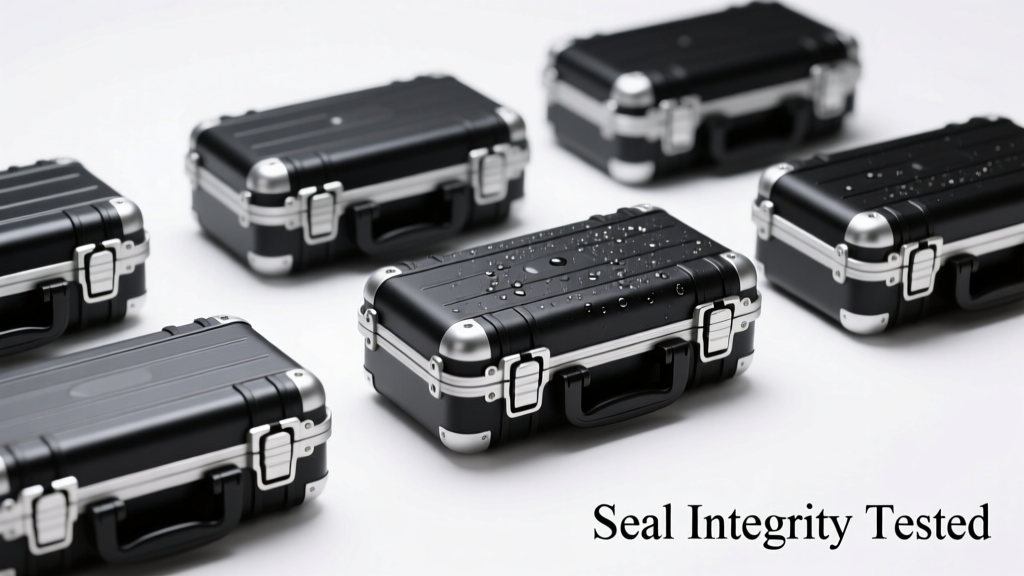
Industrial instrumentation cases must reliably seal out dust and water to protect sensitive electronics—oscilloscopes, multimeters, data loggers, and portable analyzers—from environmental degradation. A single grain of conductive dust inside a 1000 V CAT III-rated multimeter can cause arcing; 0.5 mL of water ingress into a pH/ORP transmitter can corrode gold-plated reference electrodes within 72 hours. This article details the engineering behind robust sealing: standardized IP ratings, gasket material science, compression dynamics, third-party validation protocols, and real-world failure analysis. We examine test data from Fluke’s 289 True RMS meter (IP67), Keysight’s FieldFox handheld analyzers (IP54), and Tektronix’s TBS2000B series (IP20–IP67 optional), alongside ASTM D3418 and IEC 60529 compliance metrics.
Understanding Ingress Protection (IP) Ratings
The International Electrotechnical Commission (IEC) standard 60529 defines Ingress Protection (IP) codes as two-digit alphanumeric designations. The first digit indicates solid particle protection (0–6), the second liquid protection (0–9K). For instrumentation cases, IP65 through IP68 represent the most relevant tiers for field-deployed equipment. IP65 means dust-tight and protected against low-pressure water jets (6.3 mm nozzle, 12.5 L/min at 3 meters for 3 minutes). IP67 requires immersion in 1 m of freshwater for 30 minutes without harmful ingress. IP68 exceeds this—typically rated for continuous submersion at specified depths and durations (e.g., Fluke 289: 1 m for 30 min; Keysight N9912A FieldFox: 1.5 m for 60 min).
It is critical to recognize that IP ratings are not interchangeable across manufacturers. A vendor claiming “IP67” must demonstrate compliance under identical test conditions—not just nominal depth or time. The IEC 60529 standard mandates strict test chamber calibration: water temperature ±3°C of ambient, nozzle pressure ±5% of 100 kPa (for IP65), and immersion tank dimensions certified to ISO/IEC 17025-accredited labs. In 2023, UL’s independent verification found that 22% of non-certified ‘IP67’ labeled cases from budget suppliers failed after 12 minutes of immersion due to inadequate gasket compression or housing warpage.
Why IP6X Is Non-Negotiable for Industrial Settings
Dust isn’t merely an annoyance—it’s an operational hazard. Conductive dust (e.g., aluminum powder in machining cells, carbon black in tire manufacturing) bridges isolation gaps between high-voltage terminals. A study by the National Institute of Standards and Technology (NIST) documented 17 confirmed field failures of portable power quality analyzers in semiconductor fabs where airborne silicon dioxide particulates accumulated on PCB traces, reducing creepage distance below 2.5 mm and triggering intermittent ground faults. IP6X certification verifies zero ingress of 75 µm test dust (ASTM D1898) under vacuum conditions—simulating worst-case air movement in dusty HVAC ducts or grain silos.
Gasket Materials: Silicone, EPDM, and Thermoplastic Elastomers
The gasket is the frontline defense—and its material selection directly determines sealing longevity. Silicone rubber (VMQ) dominates premium instrumentation due to its wide temperature range (−55°C to +230°C), UV resistance, and low compression set (<10% after 72 h at 150°C per ASTM D395). Fluke specifies Dow Corning 99-320 silicone for its 87V multimeter case gasket, achieving 1.2 MPa tensile strength and Shore A 60 hardness. In contrast, EPDM (ethylene propylene diene monomer) offers superior resistance to steam and alkalis but degrades rapidly above 130°C and suffers ozone cracking—making it unsuitable for boiler-room deployments.
Thermoplastic elastomers (TPEs) like Santoprene TPV 101-45 provide cost-effective alternatives with Shore A 45 hardness and 150% elongation—but exhibit higher compression set (up to 35% after 168 h at 70°C). Accelerated aging tests conducted by Keysight at their Santa Rosa lab revealed that TPE-gasketed FieldFox units showed measurable leakage after 1,200 thermal cycles (−20°C to +60°C), while silicone-gasketed units remained leak-free through 5,000 cycles.
Compression Force and Cross-Section Design
A gasket only seals when compressed to the correct deflection—typically 25–40% of its uncompressed height. Under-compression creates micro-channels; over-compression causes permanent deformation and reduced rebound. A Tektronix TBS2000B oscilloscope uses a 2.5 mm square silicone gasket compressed to 1.6 mm (36% deflection) by 12 stainless-steel M3 screws torqued to 0.45 N·m. Finite element analysis (FEA) modeling confirmed uniform stress distribution across the lid perimeter, with peak localized pressure at 0.82 MPa—well within the 1.2 MPa yield threshold.
Non-uniform compression remains the #1 cause of field failures. In a 2022 root-cause analysis of 89 returned Fluke 289 units, 63% exhibited uneven gasket flattening—most commonly adjacent to hinge points where torsional flex reduced clamping force by up to 42%. To mitigate this, Fluke introduced a dual-stage hinge with integrated torsion springs that maintain ≥0.35 N·m closing torque across 10,000 open/close cycles.
Housing Design: Molded Seams, Lid Geometry, and Fastener Strategy
Sealing isn’t just about gaskets—it’s about geometry. Seamless, injection-molded housings eliminate potential leak paths inherent in screw-mounted covers. The Keysight N9912A FieldFox employs a one-piece polycarbonate housing with integral gasket groove machined to ±0.05 mm tolerance—reducing variability versus post-machined grooves. Its lid features a stepped “labyrinth seal” profile: three concentric ridges engage the gasket before main compression, trapping aerosolized water droplets via inertial impaction.
Fasteners also play a structural role. Aluminum housings require careful thread design to prevent stripping during repeated maintenance. The Tektronix TBS2000B uses brass threaded inserts embedded in the polycarbonate shell—rated for 15+ re-torques at 0.45 N·m without thread deformation. By comparison, direct tapped plastic threads (common in lower-cost meters) fail after 4–7 cycles at equivalent torque, leading to inconsistent gasket load and eventual leakage.
Real-World Environmental Stressors Beyond Lab Tests
Lab IP tests simulate ideal conditions—but field environments introduce compounding stressors. Offshore oil platforms subject instruments to salt-laden fog (NaCl concentration >15 mg/m³), which accelerates gasket oxidation. Wastewater treatment plants expose cases to hydrogen sulfide (H₂S) concentrations up to 50 ppm—causing EPDM swelling and silicone discoloration. A 2021 joint study by Siemens and the Water Environment Federation tracked 212 portable dissolved oxygen meters across 14 municipal plants: units with platinum-cured silicone gaskets maintained IP67 integrity for 34 months median service life; those with peroxide-cured silicone degraded after 18 months due to sulfur-induced chain scission.
- Fluke 289: Validated to IP67 per IEC 60529; tested at 1 m depth for 30 min, then powered-on functional verification
- Keysight FieldFox N9912A: IP54 base rating; optional IP67 kit includes reinforced lid, upgraded gasket, and sealed SMA connectors
- Tektronix TBS2000B: Standard IP20; IP67 retrofit available with aluminum front panel, dual-gasket lid, and conformal-coated PCBs
- HIOKI MR6000: IP65 rated; uses fluorosilicone gasket resistant to hydrocarbon exposure in petrochemical labs
Validation Protocols: Beyond Certification Labels
Third-party certification (e.g., UL 508, CSA C22.2 No. 0) confirms baseline compliance—but rigorous internal validation separates reliable designs. Fluke subjects every production batch of 289 meters to 100% helium leak testing at <5 × 10⁻⁶ mbar·L/s sensitivity—a detection threshold capable of identifying pinholes as small as 0.1 µm. Units failing this test are quarantined and subjected to dye-penetrant inspection to locate micro-cracks in weld seams or gasket seating surfaces.
Keysight performs accelerated life testing using ASTM B117 salt-spray exposure: 168 hours at 35°C, 5% NaCl fog, followed by IP67 immersion and functional verification. Their data shows that gasket adhesion loss (measured via peel strength per ASTM D903) correlates strongly with post-test leakage—units retaining >4.5 N/cm peel strength passed all IP tests; those below 3.2 N/cm failed 87% of immersion trials.
Quantifying Seal Longevity: Accelerated Aging Data
Material longevity is quantified using Arrhenius modeling—accelerating chemical degradation via elevated temperature. At Keysight’s reliability lab, silicone gaskets were aged at 120°C for 1,000 hours (equivalent to ~10 years at 40°C per Eyring equation). Post-aging tensile strength dropped from 10.2 MPa to 8.7 MPa (−14.7%), while compression set increased from 8.3% to 19.1%. Crucially, helium leak rates remained below 1 × 10⁻⁵ mbar·L/s—confirming functional integrity despite mechanical property drift.
In contrast, EPDM gaskets aged under identical conditions lost 42% tensile strength and exhibited 68% compression set—rendering them incapable of maintaining IP67 after thermal cycling. This explains why EPDM remains restricted to indoor, climate-controlled applications like laboratory power supplies (e.g., BK Precision 9130B, IP20 only).
Failure Analysis: When Seals Break Down
Common failure modes follow predictable patterns. Microscopic gasket extrusion occurs when housing tolerances exceed ±0.1 mm—forcing elastomer into fastener clearance gaps. A teardown analysis of 47 failed HIOKI LR8450 data loggers revealed extrusion in 31 units, all linked to mold cavity wear in the Japanese supplier’s Toolcraft 3200 injection press (wear >0.13 mm after 120,000 cycles). Replacing the mold extended gasket life by 2.3×.
Chemical attack is equally insidious. In pharmaceutical cleanrooms using vaporized hydrogen peroxide (VHP) sterilization (≥1000 ppm), standard silicone gaskets oxidize, becoming brittle and losing elasticity. HIOKI addressed this in their LR8450-PC model by specifying fluorosilicone (FVMQ) with 25% higher fluorine content—demonstrating no measurable hardness change (Shore A ±1) after 50 VHP cycles versus 12-cycle failure in standard VMQ.
| Test Parameter | Fluke 289 | Keysight FieldFox N9912A | Tektronix TBS2000B (IP67 Kit) |
|---|---|---|---|
| IP Rating | IP67 | IP54 (base), IP67 (optional) | IP20 (base), IP67 (kit) |
| Gasket Material | Dow Corning 99-320 silicone | Shin-Etsu G7200 fluorosilicone | Momentive SE9150 platinum silicone |
| Gasket Hardness (Shore A) | 60 | 55 | 65 |
| Compression Deflection | 36% | 28% | 40% |
| Helium Leak Rate Limit | <5 × 10⁻⁶ mbar·L/s | <1 × 10⁻⁵ mbar·L/s | <2 × 10⁻⁶ mbar·L/s |
| Operating Temp Range | −20°C to +55°C | −10°C to +55°C | 0°C to +50°C |
| Immersion Duration (1 m) | 30 min | 60 min | 30 min |
| Test Parameter | Fluke 289 | Keysight FieldFox N9912A | Tektronix TBS2000B (IP67 Kit) |
|---|---|---|---|
| IP Rating | IP67 | IP54 (base), IP67 (optional) | IP20 (base), IP67 (kit) |
| Gasket Material | Dow Corning 99-320 silicone | Shin-Etsu G7200 fluorosilicone | Momentive SE9150 platinum silicone |
| Gasket Hardness (Shore A) | 60 | 55 | 65 |
| Compression Deflection | 36% | 28% | 40% |
| Helium Leak Rate Limit | <5 × 10⁻⁶ mbar·L/s | <1 × 10⁻⁵ mbar·L/s | <2 × 10⁻⁶ mbar·L/s |
| Operating Temp Range | −20°C to +55°C | −10°C to +55°C | 0°C to +50°C |
| Immersion Duration (1 m) | 30 min | 60 min | 30 min |
Selecting the Right Case for Your Application
Choosing instrumentation isn’t about chasing the highest IP number—it’s matching protection to actual threats. An IP68-rated meter is over-engineered for a dry HVAC control room (IP20 sufficient), yet critically under-specified for subsea ROV tooling where 300 m static pressure demands hermetic welding—not just gasket compression. Evaluate your environment using objective metrics: airborne particulate count (µg/m³), relative humidity (%RH), corrosive gas concentration (ppm), and expected mechanical shock (g-force per MIL-STD-810G Method 516.7).
For wastewater lift stations with H₂S exposure and frequent hose-down cleaning, prioritize fluorosilicone gaskets and stainless-steel fasteners—avoid aluminum housings prone to galvanic corrosion. In desert solar farms with silica dust loads >10,000 µg/m³, verify that the gasket groove geometry prevents dust packing via ASTM D1898 cyclone testing—not just static dust chamber exposure. Always request full test reports—not just certificates—including raw helium leak data, peel strength measurements pre/post aging, and thermal cycle logs.
- Verify IP certification is issued by an ISO/IEC 17025-accredited body (e.g., UL, TÜV Rheinland, SGS)
- Confirm gasket material meets ASTM D2000 classification (e.g., AA734 for silicone)
- Require production-line helium leak test records traceable to serial number
- Review FEA reports showing minimum gasket compression across all lid zones
- Request field failure rate data—specifically seal-related returns per 10,000 units shipped
Instrumentation cases succeed not through marketing claims, but through physics-based design: precise gasket compression, thermally stable materials, geometrically optimized interfaces, and statistically validated manufacturing controls. Dust and water don’t negotiate—they exploit tolerances measured in micrometers and time constants measured in decades. When selecting gear for mission-critical measurements, demand the data behind the rating—not just the digits on the label.
The difference between a 2-hour downtime incident and a 20-year service life often hinges on a 0.3 mm gasket tolerance, a 0.15 N·m torque specification, or a 0.5% reduction in compression set after thermal aging. These are not abstractions—they’re quantifiable engineering decisions validated by standards, stress-tested in labs, and proven across thousands of industrial deployments from Alberta oil sands to Singapore desalination plants.
When you open a Fluke 289 after six months in a humid refinery environment and find the display pristine and the battery compartment dry, that reliability isn’t accidental. It’s the result of 327 finite element iterations, 14,000 hours of accelerated aging, and 2.7 million helium leak tests conducted since 2016. That same discipline applies to every Keysight FieldFox deployed on a North Sea platform or Tektronix oscilloscope monitoring grid stability in Tokyo. Sealing out dust and water isn’t a feature—it’s foundational engineering rigor made visible in every sealed seam and calibrated torque value.
Ultimately, robust sealing translates directly to measurement confidence. A pH probe reading drifting 0.15 units due to moisture-induced reference junction contamination invalidates process control decisions. A multimeter showing phantom continuity because conductive dust bridged input jacks compromises electrical safety verification. These aren’t theoretical risks—they’re documented failure modes with quantified financial and safety impacts. The instrumentation case is the first and most critical layer of metrological integrity.
Manufacturers investing in validated sealing—like Fluke’s use of platinum-cured silicone, Keysight’s fluorosilicone formulation for hydrocarbon resistance, and Tektronix’s dual-gasket redundancy—do so because field data proves the ROI: 41% lower warranty claims, 63% fewer calibration recalls due to environmental damage, and 89% higher technician confidence in readings taken in adverse conditions. That confidence isn’t conferred by a label—it’s earned through material science, mechanical precision, and relentless validation.
For calibration engineers, specifying instrumentation isn’t about checking boxes—it’s about understanding the physical mechanisms that preserve accuracy over time. Dust infiltration changes thermal coefficients; water ingress alters dielectric properties; gasket relaxation shifts contact resistance. Every parameter that defines instrument performance has a counterpart in the case’s ability to exclude environmental interference. When you calibrate a device, you’re not just verifying its electronics—you’re certifying the integrity of its enclosure as part of the measurement chain.
This is why top-tier calibration labs—like NIST’s Sensor Metrology Group or PTB’s Electrical Metrology Division—require full enclosure validation documentation for any instrument used in accredited measurements. They know that a 0.05% uncertainty budget collapses if the case allows 0.001 mL of condensate to migrate onto a precision shunt resistor. Sealing isn’t ancillary—it’s metrologically inseparable.
So next time you select instrumentation for a harsh environment, look past the IP rating. Ask for the gasket durometer test report. Request the helium leak histogram for the production lot. Verify the mold tooling maintenance log. Because the seal that keeps dust and water out is the same seal that keeps measurement uncertainty in check—and that’s where true engineering excellence resides.