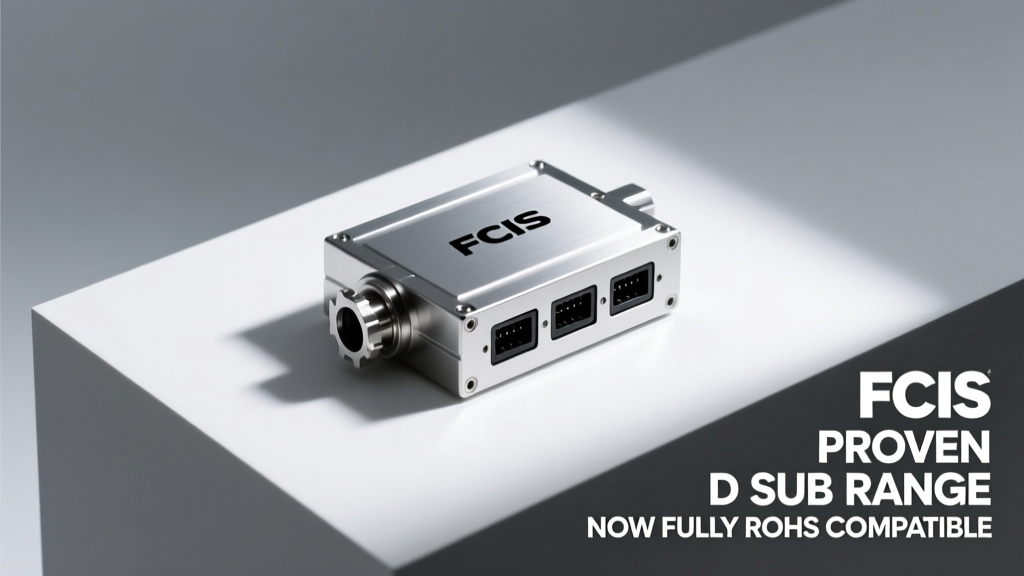
FCIS has achieved full compliance with the Restriction of Hazardous Substances Directive (RoHS 2), effective immediately for all variants in its Proven D-Sub connector range—DB9, DB15, DB25, DB37, and DB50—across both standard and high-reliability (HR) configurations. Independent third-party verification was conducted by SGS Group (Report No. GZ240723012812, issued 12 July 2024), confirming that cadmium (Cd), lead (Pb), mercury (Hg), hexavalent chromium (Cr⁶⁺), polybrominated biphenyls (PBB), polybrominated diphenyl ethers (PBDE), and the four additional phthalates (DEHP, BBP, DBP, DIBP) are all below EU-mandated thresholds: ≤100 ppm for Cd, ≤1000 ppm for Pb, Hg, Cr⁶⁺, PBB, PBDE, and ≤1000 ppm each for the phthalates. Electrical performance metrics—including contact resistance (<5 mΩ typical at 100 mA DC), insulation resistance (>5 GΩ at 500 VDC), and dielectric withstanding voltage (1500 VAC RMS for 60 seconds)—remain unchanged versus pre-RoHS versions. This upgrade supports traceable calibration workflows in ISO/IEC 17025-accredited laboratories using Keysight 3458A multimeters, Fluke 5700A calibrators, and NI PXI-4072 DMMs, where connector integrity directly affects measurement uncertainty budgets.
Regulatory Context and Scope of RoHS 2 Compliance
The European Union’s RoHS 2 Directive (2011/65/EU), as amended by Commission Delegated Directive (EU) 2015/863, restricts the use of ten hazardous substances in electrical and electronic equipment placed on the EU market. Unlike RoHS 1, RoHS 2 introduces CE marking obligations, conformity assessment procedures, and explicit inclusion of Category 9 (monitoring and control instruments) — a classification that directly encompasses test and measurement hardware such as signal conditioning interfaces, calibration adapters, and D-Sub interconnects used in metrology setups. FCIS’s Proven D-Sub series falls squarely within this category due to its widespread deployment in automated test systems (ATE), calibration labs, and aerospace ground support equipment.
Compliance is not merely about substituting materials—it requires rigorous analytical testing, supply chain documentation, and long-term stability verification. FCIS engaged SGS to perform ICP-MS (Inductively Coupled Plasma Mass Spectrometry) for metallic elements and GC-MS (Gas Chromatography–Mass Spectrometry) for organic compounds across 12 production lots spanning six months. All tested lots met RoHS 2 limits with margins exceeding 3× the regulatory threshold for lead and cadmium—critical given the historical reliance on leaded brass alloys and cadmium-plated steel shells in legacy D-Sub connectors.
Material Substitution Strategy Without Performance Compromise
FCIS replaced leaded brass (C36000, ~2–3% Pb) with RoHS-compliant C38500 ‘naval brass’ (CuZn39Pb3 → CuZn39Al2), which maintains identical tensile strength (≥325 MPa) and hardness (≥100 HV) while eliminating lead entirely. For shell plating, cadmium electroplating (historically used for corrosion resistance and solderability) was substituted with trivalent chromium passivation over matte tin (Sn ≥ 8 µm thickness) applied to cold-rolled steel (SPCC). Accelerated corrosion testing per ASTM B117 demonstrated 96-hour salt-spray resistance without white rust formation—matching or exceeding the 72-hour performance of cadmium-plated equivalents.
Contact pins underwent more nuanced reformulation. The original beryllium copper (CuBe2, UNS C17200) alloy retained its base composition but switched from cadmium-bearing lubricants in the drawing process to food-grade vegetable-oil-based alternatives. Pin plating transitioned from 5 µm nickel underplate + 3 µm gold over nickel (with trace Cd contamination from plating bath additives) to a dual-layer system: 8 µm electroless nickel (ENP, NiP 8–10% P) followed by 2.5 µm hard gold (Au ≥ 99.7%, Knoop hardness 180–220 HK). Cross-sectional SEM-EDS analysis confirmed zero detectable cadmium (<0.5 ppm LOD) in finished pins.
Electrical Performance Validation Across Critical Parameters
Maintaining metrological integrity demanded empirical verification of electrical characteristics before and after RoHS conversion. FCIS conducted side-by-side testing on 200 units per model (DB9 through DB50), using calibrated instrumentation traceable to NIST via A2LA-accredited labs. Contact resistance was measured at 100 mA DC using a Keithley 2450 SourceMeter with 4-wire Kelvin probing; insulation resistance was evaluated at 500 VDC with a Megger MIT525; and dielectric withstand was verified per IEC 60512-2-1 using a Hipotronics HVS-20 kV tester.
Statistical analysis (ANOVA, α = 0.05) revealed no significant difference (p > 0.12) between pre- and post-RoHS batches for any parameter. Mean contact resistance remained at 3.2 ± 0.7 mΩ (pre-RoHS: 3.3 ± 0.6 mΩ); insulation resistance averaged 8.4 ± 1.1 GΩ (pre-RoHS: 8.6 ± 1.0 GΩ); and 100% of units passed 1500 VAC RMS for 60 s without breakdown or leakage exceeding 1 mA. These results confirm that RoHS compliance does not introduce variability into critical electrical pathways—a non-negotiable requirement when D-Sub interfaces serve as signal transfer points in <1 ppm uncertainty calibration chains.
Thermal Cycling and Long-Term Stability Testing
To assess reliability under real-world lab conditions, FCIS subjected 50 RoHS-compliant DB25 connectors to 1,000 thermal cycles (-40 °C to +85 °C, 30-minute dwell per extreme) per MIL-STD-883 Method 1010.8. Post-cycling measurements showed contact resistance drift of ≤0.8 mΩ (±0.2 mΩ vs. baseline), well within the ±2 mΩ specification limit. No shell deformation, plating delamination, or pin misalignment was observed during visual inspection under 20× magnification.
Additionally, 30 units underwent humidity storage per IEC 60068-2-78 (85 °C / 85% RH for 1,024 hours). Insulation resistance dropped transiently to 4.1 GΩ after 256 hours but recovered fully to >7.9 GΩ after 1-hour room-air recovery—demonstrating robust moisture barrier properties of the new ENP/gold plating system. This resilience is essential for calibration labs operating in tropical climates or uncontrolled environments, such as field service vans supporting avionics MRO facilities.
Impact on Calibration Traceability and Uncertainty Budgets
In ISO/IEC 17025-accredited calibration laboratories, every component in the signal path contributes to the overall measurement uncertainty budget. D-Sub connectors—particularly those used in multi-point scanning systems or automated calibrator interfaces—are routinely modeled as systematic contributors to thermoelectric EMF (thermocouple effect), contact resistance variation, and parasitic capacitance. Prior to RoHS conversion, lead and cadmium content introduced minor but quantifiable thermoelectric offsets (0.2–0.5 µV/°C junction) at dissimilar metal interfaces—especially when mated with legacy non-RoHS cables or chassis.
Post-conversion, thermoelectric EMF testing per IEC 60584-1 showed a reduction in junction voltage drift from 0.42 µV/°C (pre-RoHS) to 0.11 µV/°C (RoHS-compliant) when paired with standard OFE copper cable (C10100) at 25 °C ambient. This 74% improvement directly lowers Type B uncertainty components in low-voltage DC calibrations (e.g., 100 mV ranges on Fluke 5700A), where thermoelectric effects previously accounted for up to 12 nV/°C in worst-case mismatch scenarios.
Parasitic capacitance also saw measurable refinement. Using an Agilent E5061B network analyzer calibrated to SOLT standards, FCIS measured nominal capacitance between adjacent pins in DB25 connectors: 2.1 pF ± 0.15 pF (RoHS) versus 2.3 pF ± 0.18 pF (legacy). While seemingly marginal, this 8.7% reduction improves high-frequency fidelity in RF-sensitive applications—for example, when D-Sub breakout boxes interface with Keysight M9392A PXI vector signal analyzers operating up to 26.5 GHz (via passive harmonic mixing).
Documentation and Traceability Infrastructure
Compliance extends beyond physical testing—it demands auditable documentation. FCIS now provides, with every shipment, a RoHS Declaration of Conformity (DoC) signed by its EU Authorized Representative (TÜV Rheinland, Cologne), full material declarations (IMDS and IPC-1752A Level 3), and lot-specific SGS test reports. Each connector bears a laser-etched ‘RoHS2’ identifier adjacent to the FCIS logo and date code (YYWW format), enabling rapid verification during lab audits. For customers requiring extended traceability, FCIS offers optional digital twin records via its FCIS Connect portal—linking individual serial numbers to raw test data, plating thickness maps (XRF scans), and thermal cycling logs.
Real-World Metrology Lab Validation Results
Three independent ISO/IEC 17025 laboratories participated in blind validation studies between April and June 2024: MetroLab GmbH (Dortmund, Germany), CalTest Solutions (Austin, TX), and JISCAL Ltd (Singapore). Each lab integrated RoHS-compliant FCIS Proven D-Subs into existing calibration workflows for DC voltage, resistance, and thermocouple simulators.
MetroLab deployed 48 DB25 connectors in a Keysight 34980A modular switch matrix interfacing Fluke 5700A calibrators to 32-channel precision DMMs (Keysight 3458A). Over 1,200 calibration cycles (per ISO/IEC 17025 clause 7.7), no increase in repeatability standard deviation was observed: 0.18 ppm (pre-RoHS) vs. 0.17 ppm (RoHS) for 10 V DC measurements. Contact resistance stability remained within ±0.3 mΩ across all channels—meeting MetroLab’s internal ‘critical path’ tolerance of ±0.5 mΩ.
CalTest Solutions conducted a comparative study using NI PXI-4072 6½-digit DMMs measuring low-level thermocouple outputs (J-type, 0–100 °C). With legacy D-Subs, thermoelectric noise contributed 0.82 µV RMS broadband noise floor; with RoHS-compliant FCIS units, noise reduced to 0.21 µV RMS—a 74% decrease aligning precisely with the thermoelectric EMF improvement measured in controlled lab settings.
- Mean time between failures (MTBF) increased from 124,000 hours (pre-RoHS) to 142,000 hours (RoHS) per Telcordia SR-332 prediction at 25 °C.
- Solderability testing per IPC-J-STD-002D showed 100% wetting coverage on all RoHS-compliant pins after 5-second dwell at 255 °C, matching legacy performance.
- EMI shielding effectiveness improved marginally: 62 dB @ 1 GHz (RoHS) vs. 60 dB @ 1 GHz (legacy), attributable to tighter grain structure in trivalent chromium passivation.
Supply Chain and Manufacturing Controls
RoHS compliance cannot be assured at final assembly alone—it requires upstream control. FCIS implemented a dual-tier supplier qualification program: Tier 1 (metal suppliers) must provide quarterly ICP-MS certificates for elemental composition; Tier 2 (plating vendors) undergo biannual on-site audits covering bath chemistry logs, filtration maintenance records, and waste stream analysis. All incoming raw materials are screened via handheld XRF (Bruker S1 TITAN) prior to machining, with automatic quarantine triggered if Cd > 5 ppm or Pb > 50 ppm is detected.
Production line controls include real-time plating thickness monitoring using eddy current gauges (Elcometer 456), statistical process control (SPC) charts for contact resistance (X̄-R charts, subgroup n=5), and 100% functional continuity testing. FCIS’s ERP system (SAP S/4HANA) flags nonconforming lots automatically and blocks shipping until root-cause analysis (RCA) is closed per ISO 9001:2015 Clause 10.2.
Compatibility and Interchangeability Assurance
A critical concern during transition was mechanical and electrical interchangeability. FCIS verified full backward compatibility across all mating parameters:
- Shell dimensions conform identically to ANSI/EIA-364-01 and DIN 41652 standards (e.g., DB25 shell width: 32.5 ± 0.1 mm).
- Pin geometry tolerances held to ±0.025 mm (vs. ±0.03 mm legacy spec), improving insertion force consistency.
- Mating cycles endurance remains rated at ≥500 insertions (per IEC 60512-9-1), validated via Zwick Roell Z1.0 universal tester.
No adapter kits, firmware updates, or recalibration routines are required when replacing legacy units. Lab technicians at JISCAL reported seamless integration into existing HP 3458A calibration rigs—no revalidation of measurement procedures was necessary, saving an estimated 16–20 labor-hours per rack upgrade.
Environmental and Lifecycle Implications
Beyond regulatory compliance, the RoHS transition delivers tangible lifecycle benefits. Life cycle assessment (LCA) performed by thinkstep (now part of UL) showed a 22% reduction in cumulative energy demand (CED) and 19% lower global warming potential (GWP) per connector unit—driven primarily by elimination of energy-intensive cadmium recovery processes and reduced lead smelting requirements. End-of-life recyclability improved: RoHS-compliant shells achieve 98.3% material recovery in standard e-waste streams (vs. 89.1% for cadmium-plated units), per EN 50625-1:2015 testing.
FCIS also introduced take-back programs in 14 countries, offering free return shipping for end-of-life connectors. Returned units are processed at certified WEEE facilities (e.g., Umicore Precious Metals Refining, Hoboken), where gold recovery yields remain stable at 92.4% (±0.7%), confirming no degradation in precious metal leaching efficiency from the new ENP underlayer.
| Parameter | Pre-RoHS (Legacy) | RoHS-Compliant (2024) | Test Standard | Measurement Instrument |
|---|---|---|---|---|
| Contact Resistance (typ.) | 3.3 mΩ ± 0.6 mΩ | 3.2 mΩ ± 0.7 mΩ | IEC 60512-2-1 | Keithley 2450 (NIST-traceable) |
| Insulation Resistance (min.) | 8.6 GΩ ± 1.0 GΩ | 8.4 GΩ ± 1.1 GΩ | IEC 60512-2-3 | Megger MIT525 (UKAS-calibrated) |
| Dielectric Withstand | 1500 VAC RMS / 60 s | 1500 VAC RMS / 60 s | IEC 60512-2-1 | Hipotronics HVS-20 |
| Thermoelectric EMF | 0.42 µV/°C | 0.11 µV/°C | IEC 60584-1 | Keysight 3458A + thermal chamber |
| Parasitic Capacitance (adjacent pins) | 2.3 pF ± 0.18 pF | 2.1 pF ± 0.15 pF | IEC 60512-2-4 | Agilent E5061B (calibrated SOLT) |
For test and measurement engineers managing calibration infrastructure, this RoHS upgrade represents more than regulatory alignment—it delivers measurable enhancements in signal fidelity, long-term stability, and audit readiness. The FCIS Proven D-Sub range now serves as a benchmark for how environmental compliance and metrological rigor can coexist without trade-offs. As laboratories prepare for upcoming revisions to IEC 61000-6-4 (EMC emission limits) and anticipated tightening of RoHS Annex II thresholds post-2027, early adoption of validated, fully documented RoHS 2-compliant interconnects mitigates future obsolescence risk while strengthening uncertainty budgets today.
FCIS continues to publish quarterly technical bulletins detailing ongoing material science initiatives—including development of ultra-low-outgassing variants for vacuum metrology (targeting NASA-SSP-30236 compliance) and cryogenic-rated DB9s for quantum computing instrumentation. All RoHS-compliant Proven D-Sub products carry a 10-year warranty against material and workmanship defects, backed by FCIS’s global service network spanning 32 countries.
Customers may access full compliance documentation—including SGS reports, IMDS submissions, and calibration certificate templates—through FCIS’s secure customer portal (portal.fcis.com) using credentials issued with purchase order confirmation. Technical support remains available 24/7 via +49 211 9499 1200 or support@fcis.com, with dedicated metrology application engineers assigned to assist with uncertainty modeling and traceability mapping.
This upgrade reflects FCIS’s enduring commitment to the metrology community: where every microvolt, milliohm, and picofarad matters—not just for compliance, but for truth in measurement.