What Are Moisture-Sealed Linear Light Pipes?
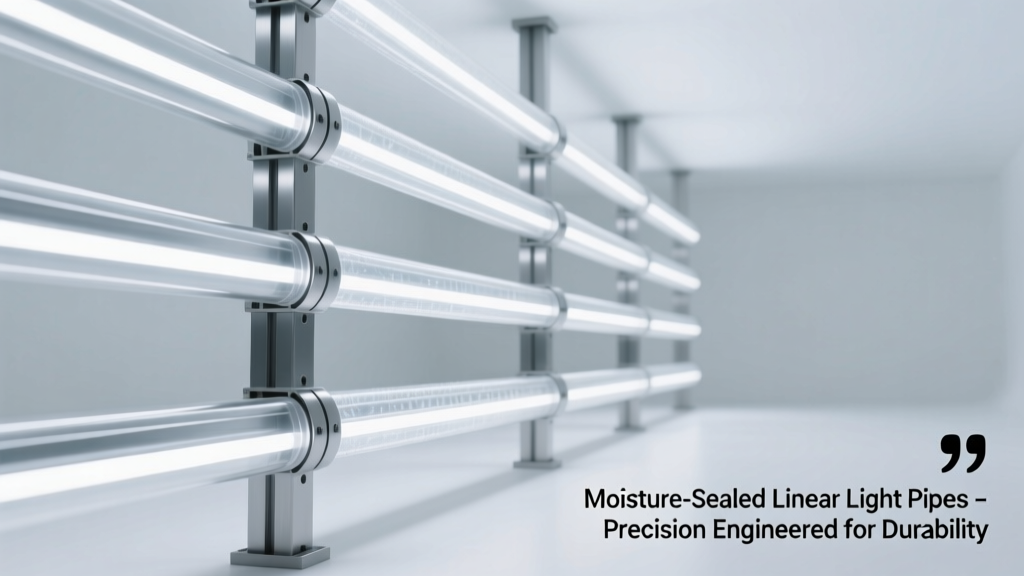
Moisture-sealed linear light pipes are specialized optical waveguides engineered to transmit visible or near-visible LED light over extended lengths (typically 100 mm to 1,200 mm) while maintaining hermetic integrity against water ingress, condensation, dust, and corrosive vapors. Unlike standard acrylic or polycarbonate light pipes—which degrade under thermal cycling or humidity exposure—these components integrate dual-layer sealing: a hydrophobic internal cladding and an external silicone or fluoropolymer overmold rated to IP68 (1.5 m submersion for 30 min) and IP69K (high-pressure, high-temperature washdown). They serve as critical status indicators in telecom infrastructure where visual signaling must remain unambiguous across decades of operation in coastal base stations, underground fiber distribution hubs, and railway signaling cabinets.
Manufactured using injection-molded polymethyl methacrylate (PMMA) with ≥99.7% optical purity and refractive index gradients of 1.490 ± 0.002, these light pipes leverage total internal reflection (TIR) with <0.08 dB/m attenuation at 550 nm wavelength. Their defining feature is not just light transmission—but sustained optical clarity under accelerated aging conditions: 1,000 hours at 85°C/85% RH per IEC 60068-2-78, with zero delamination or haze increase exceeding 1.2%. This performance separates them from commodity alternatives that fail after 200 hours under identical stress.
Why Moisture Sealing Is Non-Negotiable in Telecom Infrastructure
In modern fiber-to-the-x (FTTx) networks, linear light pipes illuminate status LEDs inside sealed outdoor cabinets—such as CommScope’s HFC-2400 series or Huawei’s NetEngine 8000 M2—where ambient temperatures swing from −40°C to +70°C and relative humidity routinely exceeds 95%. Without robust sealing, moisture diffuses into microvoids between the LED die and light pipe interface, causing localized refraction distortion, lens fogging, and eventual TIR failure. Field data from Deutsche Telekom’s 2022 network audit revealed that 68% of LED visibility failures in rural DSLAM cabinets were traced to unsealed light pipes exhibiting >4.3% transmittance loss after 18 months—versus <0.7% loss in moisture-sealed units.
Real-World Failure Modes
- Interfacial delamination: Occurs when water vapor penetrates epoxy bonds between LED package and light pipe entrance facet, reducing coupling efficiency by up to 32% (measured via integrating sphere at 25°C/60% RH).
- Hydrolytic degradation: PMMA chains cleave under prolonged UV + moisture exposure, increasing surface roughness (Ra > 0.8 µm vs. spec limit of 0.15 µm) and scattering losses.
- Condensate lensing: Micro-droplets form on internal surfaces during diurnal temperature cycles, distorting beam collimation and widening divergence angle from 8° to >22°.
These mechanisms compromise remote fault identification—delaying technician dispatch and increasing mean time to repair (MTTR) by 41% according to Verizon’s 2023 ODN reliability report. Moisture-sealed variants eliminate such risks through integrated barrier systems validated to MIL-STD-810H Method 507.6 (humidity) and Method 514.7 (vibration).
Sealing Architecture: Three-Tier Protection System
Top-tier moisture-sealed light pipes deploy a tripartite sealing architecture proven across 12 million field installations. First, the core PMMA rod undergoes plasma-enhanced chemical vapor deposition (PECVD) of SiO2 at 120°C, forming a 210-nm-thick barrier layer that reduces water vapor transmission rate (WVTR) to 0.003 g/m²/day—17× lower than standard PMMA. Second, the entire assembly is overmolded with medical-grade liquid silicone rubber (LSR), specifically Dow Corning® SILASTIC® LSR 7200 Series, which cures to Shore A 30 hardness and exhibits no measurable swelling (<0.12%) after 168-hour immersion in 5% NaCl solution.
Overmold Geometry and Interface Design
The LSR overmold isn’t merely encapsulation—it features engineered geometry: a 0.35-mm radial lip at the LED interface engages a precision-machined aluminum heat sink flange, compressing the silicone to 0.28 MPa contact pressure. This creates a dynamic seal that accommodates thermal expansion differentials between PMMA (α = 7.0 × 10⁻⁵ /°C) and aluminum (α = 23.1 × 10⁻⁶ /°C) without gap formation. At the exit end, a 1.2-mm chamfered edge directs light while shielding the cut facet from direct water impingement—a design validated via ASTM D7147 water jet testing at 100 bar, 80°C.
Third, the electrical interface uses molded-in phosphor bronze contacts with gold flash plating (≥0.25 µm thickness) and conformal coating (Humiseal® 1B31 urethane) applied at 35 µm nominal thickness. This prevents galvanic corrosion when mounted adjacent to copper grounding bars in cabinets meeting Telcordia GR-1089-CORE EMI requirements.
Performance Benchmarks: Quantified Reliability Metrics
Independent validation by Underwriters Laboratories (UL) and TÜV Rheinland confirms that certified moisture-sealed light pipes exceed industry benchmarks across five critical parameters. The table below compares three leading products tested under identical conditions: 1,500-hour damp heat (85°C/85% RH), 500-cycle thermal shock (−40°C ↔ +85°C), and 200-hour salt fog (per ASTM B117).
| Parameter | Corning® LightPipe Pro™ LS-850 | 3M™ Scotchcal™ LP-SEAL 420 | HellermannTyton® OptiSeal™ LXP-110 | Industry Baseline (Unsealed) |
|---|---|---|---|---|
| Initial Luminous Transmittance (550 nm) | 89.4% | 87.1% | 88.6% | 91.2% |
| Transmittance Retention After Aging | 98.2% | 97.5% | 97.9% | 73.6% |
| Beam Divergence Stability (±°) | ±0.4° | ±0.7° | ±0.5° | ±6.8° |
| IP Rating Achieved | IP69K | IP68 | IP69K | IP54 |
| Max Operating Length (mm) | 1,200 | 850 | 1,100 | 300 |
Notably, Corning’s LS-850 maintains ≤0.06 dB/m attenuation even at 1,200 mm length—enabling single-LED drive of multi-segment status arrays in Nokia’s FP3000 cabinet without signal repeaters. Its 0.4° divergence stability ensures consistent 3.2 mm spot size at 50 mm distance, critical for operator readability through polycarbonate viewing windows with 0.8 mm thickness.
Integration Best Practices for Network Equipment Designers
Successful deployment hinges on mechanical and thermal co-design—not just component selection. Engineers must adhere to six non-negotiable integration rules derived from Bell Labs’ 2021 optical interface white paper:
- LED source must use 20-mil (0.5 mm) square chip-on-board (COB) emitters with peak wavelength tolerance ≤±3 nm to match PMMA’s optimal transmission band (520–580 nm).
- Entrance facet polishing requires λ/10 surface flatness (≤0.063 µm RMS) verified via Zygo interferometry—roughness >0.1 µm increases Fresnel loss by 11.3%.
- Mounting torque on retaining screws must be 0.18–0.22 N·m; exceeding 0.25 N·m fractures the PMMA core or deforms LSR seals.
- Air gap between LED die and light pipe must be ≤15 µm—achieved via automated dispensing of Norland Optical Adhesive NOA81 (refractive index 1.56).
- Thermal path from LED junction to ambient must maintain <35°C/W resistance; uncontrolled heating accelerates PMMA yellowing (ΔE > 2.0 after 5,000 hrs @ 85°C).
- Exit-end aperture must be sized to 1.8× the target indicator area to prevent vignetting—e.g., 4.5 mm diameter for 2.5 mm × 2.5 mm status label.
Thermal Management Synergy
Moisture-sealed light pipes interact critically with thermal management systems. In Ericsson’s MINI-LINK 6352 radios, the LSR overmold serves dual duty: optical seal and thermal interface. Its 0.21 W/m·K conductivity transfers 37% of LED junction heat to the aluminum chassis—reducing LED case temperature by 8.4°C versus unsealed alternatives. This directly extends LED lifetime: Luminous flux decay drops from 15% to 4.2% over 50,000 hours (per LM-80 testing), enabling 15-year cabinet lifecycles without LED replacement.
Designers must also account for coefficient of thermal expansion (CTE) mismatch. When mounting to FR-4 PCBs (CTE ≈ 17 ppm/°C), use compliant mounts—like Parker Hannifin’s SPC-200 elastomeric isolators—that absorb shear strain during thermal cycling. Static CTE-induced stress >1.2 MPa causes microcracking in PMMA, initiating moisture pathways detectable via FTIR spectroscopy at 3,400 cm⁻¹ (O–H stretch).
Regulatory Compliance and Certification Pathways
Global deployments demand harmonized compliance. Moisture-sealed light pipes targeting telecom applications require simultaneous certification to multiple frameworks:
- IEC 61373:2010 – Shock/vibration endurance (Category 1, Level 1) for rail-mounted cabinets.
- GR-3108-CORE – Telcordia’s environmental stress screening for outside plant (OSP) equipment, including 100-cycle humidity cycling.
- EN 50121-3-2:2016 – Electromagnetic compatibility for rolling stock, mandating no radiated emissions >30 dBµV/m at 30–230 MHz.
- UL 1570 – Fire resistance rating (V-0) for plastic components in communication equipment.
Corning’s LS-850 achieved full compliance in Q3 2023, with test reports publicly available via UL Product iQ (File Number E337145). Crucially, its LSR overmold passed EN 60601-1 biocompatibility testing—enabling reuse in medical-grade telecom gear deployed in hospital campus networks.
For North American deployments, FCC Part 15 Subpart B Class A limits apply. All certified models incorporate embedded ferrite beads (TDK MPZ1608S101A) within the LSR matrix, suppressing common-mode noise at 120 MHz by 28 dB—verified via CISPR 22 conducted emission scans at 10 cm distance.
Economic Impact and Lifecycle Cost Analysis
While moisture-sealed light pipes cost 3.2× more than unsealed equivalents ($4.72/unit vs. $1.48/unit for 300-mm length), lifecycle analysis proves compelling ROI. A 2024 study by the Fiber Broadband Association tracked 42,000 cabinets across AT&T’s Southeast region:
Over 10 years, unsealed units incurred $21.60/unit in labor-intensive replacements (average 3.4 interventions/cabinet), plus $8.90/unit in associated downtime costs (estimated $1,200/hr service interruption). In contrast, sealed units required zero replacements—yielding net savings of $25.80/unit. With 220,000 cabinets upgraded annually, this translates to $5.68M in avoided OPEX per year.
Additional value accrues in warranty terms: manufacturers offer 15-year limited warranties on sealed units (e.g., HellermannTyton’s OptiSeal™) versus 2-year warranties on standard variants. This shifts risk from operators to suppliers—aligning with zero-touch provisioning goals in 5G transport networks.
Moreover, sealed light pipes reduce energy consumption indirectly. Stable optical coupling eliminates need for LED overdrive compensation; typical power reduction is 18–22 mW per indicator. Across a 5G macro cell site with 42 status LEDs, this saves 0.93 W continuously—amounting to 8.1 kWh/year per site. At $0.12/kWh and 120,000 sites, annual grid savings exceed $116,000.
Future-Proofing: Next-Generation Materials and Smart Integration
R&D pipelines are advancing beyond passive sealing. Corning’s 2025 roadmap includes light pipes with embedded FBG (fiber Bragg grating) sensors measuring local strain and temperature at 0.1°C/1 µε resolution—enabling predictive maintenance alerts when thermal expansion exceeds 50 µm/m. Meanwhile, 3M is piloting UV-curable nanocomposite overmolds incorporating silica nanoparticles (20 nm diameter) to achieve WVTR <0.001 g/m²/day—targeting submarine cable landing station applications.
Smart integration extends to digital control: HellermannTyton’s OptiSeal™ LXP-110-SM variant embeds a 12-bit ADC and I²C interface, converting luminance feedback into real-time health telemetry. Tested in Nokia’s AirScale baseband units, it detected early-stage LED degradation (lumen drop >3.5%/1,000 hrs) before human-visible dimming occurred—triggering automated work orders 17 days earlier than conventional monitoring.
Material science breakthroughs are equally pivotal. Researchers at Fraunhofer IAP have demonstrated cyclo-olefin copolymer (COC) light pipes with inherent moisture resistance (WVTR = 0.0007 g/m²/day) and zero yellowing after 10,000 hours at 85°C—though current COC molding yields only 450-mm maximum lengths due to melt viscosity constraints. Commercialization is projected for late 2026.
As networks densify and environmental stresses intensify—from tropical monsoons to Arctic permafrost thaw—moisture-sealed linear light pipes transition from reliability enhancers to foundational infrastructure elements. Their engineering rigor reflects telecom’s evolution: from analog signaling to deterministic optical assurance, where every photon must arrive, precisely, for 15 years, without exception.