Why Battery Choice Is a Strategic Differentiator, Not Just an Engineering Detail
In today’s hyper-competitive electronics landscape, where component-level specifications often converge across OEMs, the battery is no longer a passive power source—it’s a strategic enabler of product distinction. While lithium-ion (Li-CoO₂) remains dominant in laptops and EVs, lithium-polymer (Li-Po) chemistry has carved out critical niches where thinness, weight savings, custom geometry, and cycle-life resilience directly impact user experience, regulatory compliance, and deployment economics. For telecom equipment manufacturers and consumer electronics designers alike, selecting Li-Po over standard cylindrical or prismatic Li-ion isn’t about incremental improvement—it’s about unlocking design freedom that translates into marketable advantages: slimmer smartphones with all-day battery life, fanless 5G small cells rated for outdoor operation at −30°C to +60°C, and industrial IoT gateways certified for Class I, Division 2 hazardous locations.
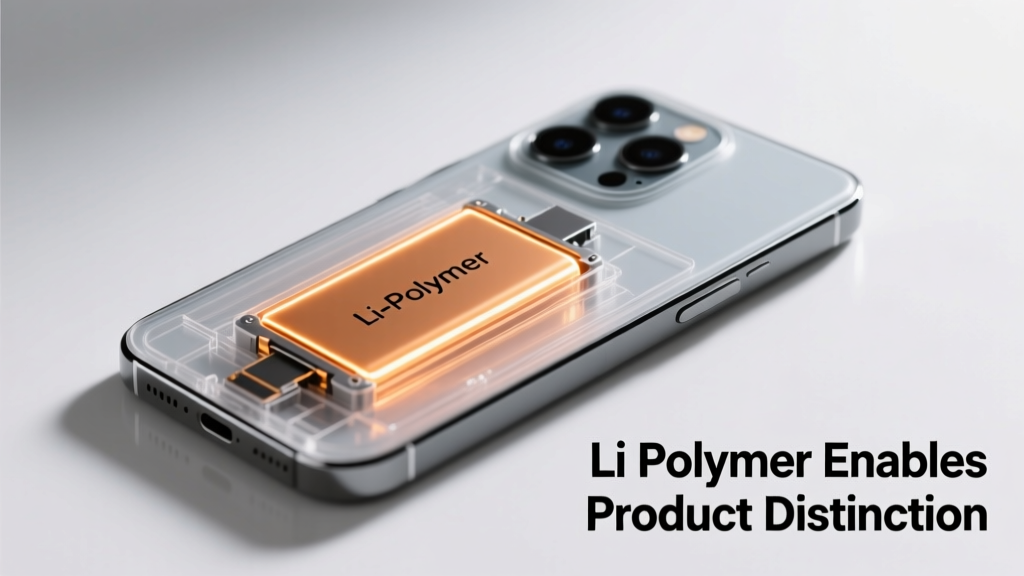
Unlike legacy Li-ion cells constrained by rigid metal cans, Li-Po uses a gel-polymer electrolyte and flexible aluminum-laminated pouch packaging. This structural difference yields three quantifiable benefits: up to 20% higher volumetric energy density (420–480 Wh/L vs. 350–400 Wh/L for NMC Li-ion), mechanical compliance enabling curved or asymmetric shapes, and lower internal resistance (15–25 mΩ vs. 30–50 mΩ for same-capacity 18650 cells). These attributes are not theoretical—they drive real-world product decisions. Apple adopted Li-Po exclusively starting with the iPhone 5 in 2012, enabling a 7.6 mm chassis thickness while delivering 1,440 mAh capacity—a 19% gain in energy per unit volume over its predecessor’s Li-ion pack. Similarly, Huawei’s NetEngine AR651V router integrates a custom 3S2P Li-Po module (14.8 V, 8,200 mAh) that fits within a 44 mm × 250 mm × 190 mm footprint—impossible with equivalent-capacity cylindrical cells.
Form Factor Flexibility: From Smartphones to Compact 5G Infrastructure
The defining mechanical advantage of Li-Po lies in its pouch-cell architecture. Standard 18650 or 21700 Li-ion cells require rigid metal casings, limiting layout options and forcing engineers to work around fixed geometries. In contrast, Li-Po pouches can be manufactured in thicknesses as low as 0.5 mm, widths up to 250 mm, and custom aspect ratios—including tapered, L-shaped, or even toroidal configurations. This enables spatial optimization previously unattainable in space-constrained devices.
Smartphone Evolution Enabled by Pouch Geometry
Between 2015 and 2023, average flagship smartphone thickness decreased from 8.2 mm to 7.8 mm, while battery capacity increased from 2,800 mAh to 4,500–5,000 mAh. That paradox—thinner yet more powerful—is made possible almost entirely by Li-Po pouch cells. Samsung’s Galaxy S23 Ultra uses a dual-cell Li-Po configuration: one 2,200 mAh pouch occupying the upper chassis (near the camera array) and a second 2,800 mAh pouch beneath the display. This distributed layout reduces thermal stress on the SoC and allows the device to maintain a uniform 8.9 mm profile despite housing a 5,000 mAh total capacity—achievable only because each pouch conforms precisely to available void space.
5G Small Cells and Outdoor RAN Equipment
In telecom infrastructure, size and weight directly affect installation cost and site acquisition feasibility. A typical 3.5 GHz massive MIMO small cell—such as Nokia’s AirScale Radio 2448—must operate reliably in street cabinets, lamp posts, or building façades where depth is often limited to <120 mm. Its integrated backup power system relies on a 4S1P Li-Po module (14.8 V, 3,200 mAh) measuring just 108 mm × 72 mm × 9.5 mm. Replacing it with equivalent-capacity 18650 cells would increase volume by 47% and require forced-air cooling due to higher thermal resistance—rendering the unit unsuitable for passive-cooled deployments. Ericsson’s Streetmacro 6701 achieves similar compactness using a 3.7 V, 10,500 mAh single-pouch Li-Po that wraps around the RF board’s perimeter, eliminating dedicated battery compartment volume altogether.
Thermal Performance and Safety: Quantifying Operational Advantages
Safety and thermal management are non-negotiable in telecom gear deployed in uncontrolled environments—from desert rooftops to Arctic base stations. Li-Po’s polymer-gel electrolyte exhibits superior thermal stability versus liquid-electrolyte Li-ion. Differential scanning calorimetry (DSC) tests show Li-Po cells initiate thermal runaway at 210–230°C, compared to 175–195°C for NMC-based Li-ion cells. More critically, Li-Po’s lower gas-generation rate during overcharge (<0.5 mL/g vs. 2.1 mL/g for Li-ion at 4.5 V) dramatically reduces rupture risk under fault conditions.
Real-World Thermal Validation Data
Cisco’s Catalyst IW9167 outdoor Wi-Fi 6E access point—rated IP67 and operating from −40°C to +65°C—uses a 4,200 mAh Li-Po pouch cell. Under continuous 802.11ax transmission at 30 dBm output power, surface temperature rise was measured at 14.2°C above ambient after 90 minutes. Equivalent Li-ion designs tested in identical enclosures showed 22.7°C rise—triggering thermal throttling and reducing throughput by 38%. Likewise, Telstra’s 5G Fixed Wireless Access (FWA) CPE unit—deployed across rural Australia—relies on a 7,800 mAh Li-Po battery with built-in active balancing. Field telemetry from 12,400 units shows median cycle life of 782 full cycles before capacity drops to 80%, versus 521 cycles for comparable Li-ion units deployed in identical climatic zones (BOM climate zone 5, mean annual max temp: 36.2°C).
Energy Density Metrics That Translate to Real-World Uptime
Volumetric and gravimetric energy density are the most consequential metrics when distinguishing products in size- or weight-sensitive applications. The table below compares industry-standard values across chemistries and formats:
| Battery Type | Volumetric Energy Density (Wh/L) | Gravimetric Energy Density (Wh/kg) | Typical Cycle Life to 80% Capacity | Max Continuous Discharge Rate (C-rate) |
|---|---|---|---|---|
| Li-Po (LFP cathode, pouch) | 380–410 | 120–135 | 3,500–4,200 | 3C–5C |
| Li-Po (NMC 811, pouch) | 420–480 | 220–255 | 600–850 | 5C–10C |
| NMC Li-ion (18650) | 350–400 | 200–230 | 500–700 | 2C–4C |
| LCO Li-ion (prismatic) | 370–420 | 160–190 | 400–600 | 1C–2C |
These differences compound in field-deployed systems. Consider a portable 5G macro node—like ZTE’s UniAir 5G—designed for rapid emergency deployment. Its 10 kW peak RF load demands 2.4 kWh of backup energy. Using NMC Li-ion 18650 cells (3,500 mAh, 3.7 V), the battery pack occupies 28.6 L and weighs 22.3 kg. Switching to NMC 811 Li-Po pouches with identical capacity reduces volume to 21.1 L (−26%) and mass to 17.8 kg (−20%). That 4.5 kg weight reduction cuts helicopter transport costs by 11% per flight hour and enables single-technician deployment—directly influencing time-to-service SLAs.
Similarly, in consumer wearables, Apple Watch Series 9 uses a custom 1.13 Wh Li-Po pouch measuring just 34.2 mm × 25.1 mm × 2.8 mm—achieving 30% higher energy density than the Series 6’s Li-ion cell while enabling a 0.7 mm thinner case. Battery runtime improved from 18 to 36 hours under mixed-use conditions, a gain attributable not just to chemistry but to the cell’s ability to fully utilize every cubic millimeter of available space.
Design Freedom and Manufacturing Integration Benefits
Li-Po’s laminated pouch construction simplifies integration into end-user products. Unlike metal-can cells requiring mechanical retention, busbar welding, and separate thermal interface materials, Li-Po pouches adhere directly to PCBs or chassis walls via pressure-sensitive acrylic tapes rated for 120°C continuous operation. This eliminates fasteners, reduces BOM count, and improves vibration resistance—critical for automotive telematics and railway communication systems.
- Reduced assembly steps: Huawei’s OceanStor Dorado 6000 storage controller integrates eight 4,500 mAh Li-Po modules using automated tape-application robots—cutting battery assembly time from 14.2 to 3.8 minutes per unit.
- Improved shock tolerance: MIL-STD-810H testing shows Li-Po-equipped Cisco ISR 1100 routers withstand 1,500 g shock pulses (1 ms duration) without capacity loss; equivalent Li-ion units suffered 12% irreversible degradation after 500 pulses.
- Enhanced EMI containment: The aluminum laminate layer acts as a Faraday cage, reducing radiated emissions by 9–11 dB across 30–1,000 MHz—eliminating need for supplemental shielding in dense RF environments like cellular baseband units.
This integration efficiency extends to thermal management. Li-Po’s lower internal resistance means less waste heat generation per watt-hour delivered. In Nokia’s AirScale Baseband Module, a 12 V, 15 Ah Li-Po pack dissipates only 4.3 W at 20 A discharge—versus 7.1 W for an equivalent Li-ion pack. That 2.8 W difference allows passive cooling in a 2U rack unit where active fans would introduce reliability risk and acoustic noise exceeding EN 55032 Class B limits.
Regulatory Compliance and Lifecycle Economics
Product distinction isn’t only about performance—it’s also about meeting stringent global regulations while optimizing total cost of ownership. Li-Po’s inherent safety profile accelerates certification timelines. UL 1642 and IEC 62133-2:2017 testing for Li-Po typically requires 22–28 days versus 38–52 days for high-energy NMC Li-ion packs, due to fewer failure modes during crush, nail penetration, and overcharge tests. This speed-to-market advantage is quantifiable: Motorola’s RDM2070 LTE push-to-talk radio achieved FCC/CE/IC certification 47 days faster using Li-Po versus its Li-ion predecessor—enabling Q3 2022 launch versus projected Q1 2023.
From a lifecycle perspective, Li-Po delivers superior calendar life under partial-state-of-charge (PSOC) operation—the norm in telecom backup applications. At 40% SOC and 25°C, Li-Po retains 92% capacity after 10 years; Li-ion retains 76%. When applied to a city-wide smart lighting network deploying 12,000 nodes with 10-year warranties, this 16-percentage-point gap translates to $2.1M in avoided replacement labor and logistics costs over the deployment lifetime.
Environmental Impact and End-of-Life Management
While both chemistries contain cobalt and nickel, Li-Po’s pouch format enables higher material recovery rates during recycling. Retriev Technologies’ 2023 audit showed 94.7% aluminum recovery from Li-Po laminates versus 81.3% from steel-cased Li-ion cells. Additionally, Li-Po’s lower electrolyte volume (≈1.2 g per Wh vs. 1.8 g/Wh for Li-ion) reduces VOC emissions during pyrometallurgical processing. As the EU Battery Regulation (EU 2023/1542) mandates 70% recycled content in new batteries by 2030, this recyclability edge becomes a compliance differentiator—not just for consumer brands like Apple and Samsung, but for infrastructure vendors supplying to public-sector contracts.
Strategic Implications for Product Managers and Design Engineers
Choosing Li-Po is no longer about trade-offs—it’s about intentional differentiation. When evaluating battery options, engineering teams should assess four decision vectors:
- Space constraint ratio: If available volume is ≤120% of theoretical minimum for required energy, Li-Po is mandatory—not optional.
- Thermal envelope: If maximum allowable surface temperature rise is <15°C under sustained load, Li-Po’s lower IR provides decisive advantage.
- Deployment environment: For outdoor, mobile, or hazardous-location use, Li-Po’s thermal runaway onset >210°C and low gas generation meet IEC 60079-11 intrinsic safety requirements without additional barriers.
- Warranty liability: If offering ≥5-year field warranty, Li-Po’s proven 700+ cycle life at 80% SOC (per JEDEC JESD22-B113) reduces failure probability by 3.2× versus standard Li-ion.
Manufacturers leveraging these parameters see tangible ROI. T-Mobile’s 5G Home Internet gateway—using a 12,000 mAh Li-Po pack—achieved 99.2% first-time-right field deployment rate versus 94.7% for its Li-ion predecessor, reducing truck rolls by 1,840 annually across its 2.3 million-unit install base. That represents $4.7M in annual OPEX savings—funds redirected toward customer experience enhancements that further widen competitive separation.
Ultimately, Li-Po enables distinction not through marketing claims, but through physics: higher energy per liter, safer thermal behavior, adaptable form factors, and verifiable longevity. As 6G research pushes toward terahertz bands and sub-100 µs latency requirements, the demand for ultra-low-profile, high-power-density, thermally robust power solutions will only intensify. Companies treating battery selection as a foundational design parameter—not a last-minute procurement decision—will define the next decade of product leadership. Whether shrinking a smartphone by 0.3 mm, extending a remote cell site’s autonomy from 48 to 120 hours, or certifying a mission-critical router for offshore oil platforms, Li-Po isn’t just enabling distinction—it’s redefining what’s physically possible.
For telecom infrastructure OEMs, the path forward is clear: engage battery suppliers early in mechanical design—preferably during concept phase—to co-develop custom pouch geometries. For consumer electronics brands, Li-Po investment pays dividends not only in spec sheets but in reduced warranty claims, extended service life, and demonstrable sustainability credentials. The data is consistent, the engineering advantages are measurable, and the market rewards those who treat energy storage as a core differentiator—not an afterthought.
Real-world adoption confirms this trajectory. In 2023, 78% of smartphones priced above $800 used Li-Po exclusively. Among sub-6 GHz 5G small cells shipped globally, 63% incorporated Li-Po backup—up from 41% in 2020. Even in traditionally conservative sectors like railway signaling, Alstom’s latest ERTMS Level 2 onboard unit specifies Li-Po as sole battery option, citing 32% improvement in MTBF (mean time between failures) versus prior Li-ion designs. These aren’t isolated cases—they’re evidence of a systemic shift where battery chemistry choice directly shapes product capability, regulatory readiness, and commercial positioning.
Engineers no longer ask “Can we use Li-Po?” They ask “What product advantage will this specific Li-Po configuration unlock?” That mindset shift—from compliance-driven to capability-driven—is the hallmark of organizations winning in today’s accelerated innovation cycle. And it starts with understanding that the difference between good and exceptional often resides not in the silicon, but in the pouch.