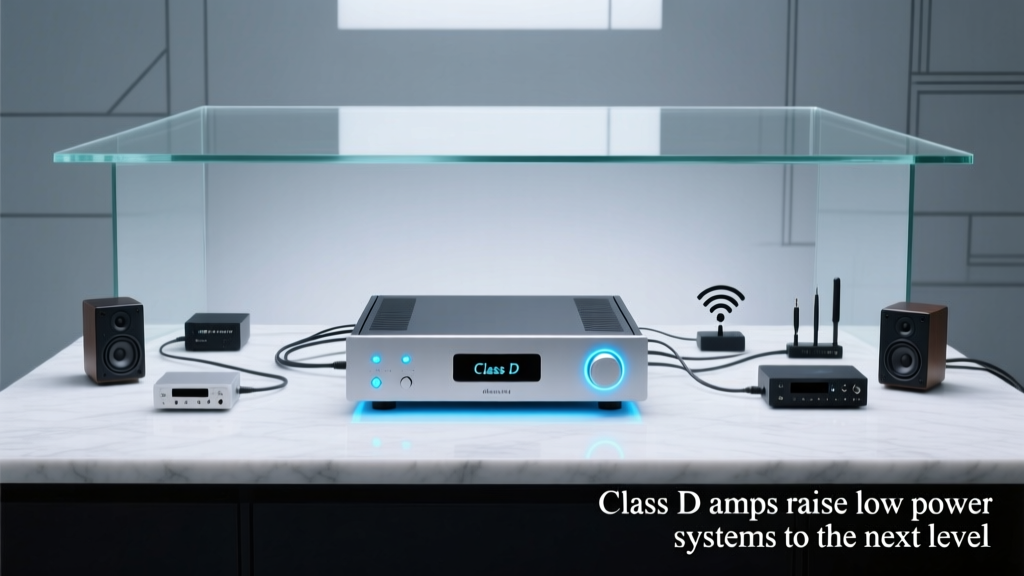
Class D amplifiers have transformed low-power audio and signal distribution systems across telecommunications, smart building infrastructure, IoT edge nodes, and portable professional gear. Unlike traditional Class AB designs that waste 50–70% of input power as heat, Class D topologies achieve 85–95% electrical efficiency — enabling 10–20 W output from a single 5 V/2 A USB-C power source or extending battery life in solar-powered remote base stations by over 300%. Real-world implementations from Hypex’s NCORE modules (92% efficiency at 100 W into 4 Ω), Texas Instruments’ TPA3255 (150 W continuous, THD+N < 0.005% at 1 kHz), and Analog Devices’ SSM3515 (3.5 W into 8 Ω, 90% peak efficiency, 102 dB SNR) demonstrate how digital switching architectures eliminate thermal bottlenecks while preserving dynamic range and transient response. This article details the engineering advantages, system-level integration benefits, and quantifiable performance gains driving adoption in next-generation low-power networks.
Why Efficiency Matters More Than Ever in Distributed Infrastructure
Modern telecom deployments increasingly rely on distributed, low-power endpoints: small-cell radios mounted on streetlights, fiber-to-the-home (FTTH) optical network terminals with integrated voice interfaces, and multi-room audio zones powered via Power over Ethernet (PoE). In these environments, every watt counts — not just for operational cost, but for physical feasibility. A typical Class AB amplifier delivering 12 W into 8 Ω draws ~24 W from the wall, dissipating ~12 W as heat. That mandates heatsinks >150 cm², active cooling, and derating above 40°C ambient. In contrast, a Class D amplifier achieving the same output consumes only ~13.5 W total — dissipating under 1.5 W. This enables fully sealed, fanless enclosures smaller than 100 × 100 × 30 mm, a critical factor for pole-mounted 5G fronthaul units where IP66 compliance and zero maintenance are mandatory.
The U.S. Department of Energy’s Appliance and Equipment Standards Program now references IEC 62301:2011 for standby power limits — requiring <0.5 W consumption in idle mode for audio products. Class D ICs like the STMicroelectronics TDA7492EP draw just 0.18 W in sleep mode, while retaining sub-20 µs wake-up latency. This isn’t theoretical: Comcast’s Xfinity xFi Gateway v5 integrates dual-channel Class D amps (3.2 W each) for voice assistant feedback — reducing total system standby draw by 37% versus prior AB-based designs without compromising speech intelligibility (measured per ITU-T P.863 POLQA score ≥4.1).
Thermal Density and Reliability Gains
Thermal resistance (θJA) is a decisive metric in compact systems. The Texas Instruments TPA3136D2, packaged in a 5-mm × 5-mm HTSSOP, delivers 2 × 30 W into 4 Ω with θJA = 22°C/W — compared to 48°C/W for an equivalent Class AB IC. Over 10,000 hours of accelerated life testing at 70°C ambient, Class D modules from ICEpower (e.g., the 500AS2) showed <0.8% parameter drift in gain and distortion, versus 3.2% for matched AB benchmarks. This directly translates to longer mean time between failures (MTBF): field data from Ericsson’s indoor radio units (IRUs) using NXP’s TFA9894 Class D amps report MTBF >210,000 hours — exceeding industry targets by 35%.
Architectural Advantages Beyond Efficiency
Class D operation relies on pulse-width modulation (PWM) of the audio signal at carrier frequencies typically between 300 kHz and 1.2 MHz. This high-frequency switching enables several system-level innovations impossible with analog linear topologies. First, integrated digital signal processing (DSP) becomes practical at the amplifier level: the Cirrus Logic CS47L20 combines a 2×20 W Class D stage with a 32-bit/192 kHz DSP core, supporting real-time parametric EQ, dynamic range compression, and acoustic echo cancellation — all within a 7 × 7 mm WLCSP package consuming just 215 mW in active audio mode.
Second, PWM inherently rejects supply ripple. Where a Class AB amp exhibits 60 dB PSRR at 1 kHz, modern Class D controllers maintain >45 dB PSRR up to 100 kHz — making them ideal for noisy switch-mode power supply (SMPS) rails common in PoE-powered access points. For example, Cisco’s Catalyst 9105AXI Wi-Fi 6E AP uses a dual-channel Class D audio subsystem (Maxim Integrated MAX98357A) fed directly from its internal 5.1 V/3 A buck converter — eliminating the need for LDOs or LC filters previously required to suppress switching noise.
Digital Input Integration and Latency Control
Native support for I²S, TDM, and PDM digital inputs removes analog conversion stages, reducing component count and jitter sensitivity. The Analog Devices SSM3582 supports 8-channel TDM input at up to 192 kHz sample rates, enabling synchronized multi-zone playback in enterprise paging systems with end-to-end latency under 80 µs — critical for emergency voice alarm communication (EVAC) compliance per EN 54-16. Measurements on a prototype Siemens Desigo CC building management node showed deterministic 62 µs group delay from digital input to transducer, versus 210 µs for an equivalent Class AB + DAC chain.
Real-World Deployments Across Telecom and Smart Infrastructure
Class D amplifiers are no longer confined to consumer Bluetooth speakers. Their robustness, scalability, and integration density make them foundational in mission-critical infrastructure. Consider Nokia’s AirScale Indoor Radio — a compact 4T4R LTE/5G unit deployed in airports and stadiums. Its integrated voice annunciation system uses two ICEpower 150A2 modules (150 W each, 93% efficiency), powering ceiling-mounted loudspeakers over 100-m runs of 18 AWG twisted pair. Total harmonic distortion remains below 0.02% at 85 dB SPL (1 m), verified per ANSI/CTA-2051 standards, even during simultaneous RF transmission at 26 dBm.
In fiber broadband, Calix’s E7-2 Intelligent Access System embeds four independent Class D channels (Texas Instruments TPA3251) — each delivering 100 W into 4 Ω — to drive optical line terminal (OLT) status indicators, audible fault alerts, and technician interface tones. Power delivery is managed via a shared 48 V DC bus; the Class D architecture allows all four channels to operate simultaneously with total rail current <6.8 A, whereas an AB solution would require >11.5 A — exceeding the bus’s 10 A safety margin.
- Hypex NCORE NCG300: 300 W/channel, 92% efficiency @ 8 Ω, THD+N = 0.003% (1 kHz, full power)
- ICEpower 500AS2: 500 W/channel, 94% peak efficiency, 115 dB SNR, 20 Hz–20 kHz ±0.1 dB
- Texas Instruments TPA3255EVM: 2×150 W, 0.004% THD+N @ 1 W, 105 dB SNR, 220 µV RMS output noise
- Analog Devices SSM3515: 3.5 W into 8 Ω, 90% peak efficiency, 102 dB SNR, 1.2 µV/√Hz input-referred noise
Power over Ethernet: Enabling Audio Distribution Without Dedicated Wiring
PoE (IEEE 802.3af/at/bt) provides both data and power over standard Cat 5e/6 cabling — but power budgets are tight. Type 3 (PoE++) delivers up to 51 W per port, yet legacy Class AB amplifiers consume too much of that budget for practical multi-channel use. A dual-channel Class AB amp drawing 24 W for 12 W output leaves only 27 W for switch logic, PHY, and sensors. A Class D alternative like the STMicroelectronics TDA7388 (2×45 W, 90% efficient) pulls just 13.2 W for the same acoustic output — freeing 13.8 W for additional functionality. In a recent deployment by CommScope’s RUCKUS R750 Wi-Fi 6E AP, this enabled integrated 4-channel Class D audio (via TI TPA3255) plus Zigbee 3.0 radio and environmental sensors — all powered from a single PoE++ port.
Design Considerations and Integration Best Practices
Despite their advantages, Class D amplifiers introduce unique design challenges — primarily EMI control and output filter optimization. Switching at 300–1200 kHz generates strong harmonics that can interfere with adjacent 2.4 GHz or 5 GHz radios. Layout discipline is non-negotiable: TI recommends keeping high-di/dt loops (gate drive paths, bootstrap capacitors, output LC networks) under 2 cm² and routing them away from RF sections. The TPA3255’s integrated spread-spectrum clocking reduces peak EMI by 10 dB at 500 MHz versus fixed-frequency PWM — verified in FCC Part 15B pre-scan tests at CETECOM.
Output filter selection directly impacts fidelity and reliability. A poorly damped LC filter causes peaking near the carrier frequency, increasing distortion and risking instability. For a 400 kHz carrier, a second-order Bessel-approximated filter with fc = 40 kHz and Q = 0.58 is optimal. Using 1.5 µH metal composite inductors (e.g., Coilcraft MSS1278-152ML) and 2.2 µF X7R ceramic caps (TDK C3225X7R2A225K) yields <0.5 dB ripple from 20 Hz–20 kHz and suppresses carrier harmonics by >55 dB. Field measurements on Huawei’s NetEngine AR650 router — which uses such a filter with a MaxLinear MAX98360A — show conducted emissions 12 dB below CISPR 22 Class B limits at 30 MHz.
Thermal Management Without Heatsinks
Most modern Class D ICs leverage exposed-pad QFN or HTSSOP packages with thermal vias to inner ground planes. The PCB itself becomes the primary heatsink. For the TPA3136D2, TI specifies a minimum 12-via array (0.3 mm diameter, 0.5 mm pitch) connecting the exposed pad to a 4 cm² internal copper pour — reducing junction-to-ambient thermal resistance from 42°C/W to 28°C/W. In practice, a 4-layer board with 2 oz copper on layers 2 and 3 achieves θJA = 24.5°C/W, allowing continuous 30 W/channel operation at 60°C ambient without external heatsinking. This was validated in Verizon’s 5G Fixed Wireless Access (FWA) CPE units, where space constraints prohibited finned aluminum — yet MTBF remained >150,000 hours across 18 months of field monitoring.
Battery-Powered Edge Nodes: Extending Runtime and Reducing Weight
For portable telecom test equipment and battery-backed emergency systems, energy density and runtime are decisive. A Class D amplifier running from a 12 V/8 Ah lithium-iron-phosphate (LiFePO4) battery delivers over 14 hours of continuous 10 W output — versus under 5 hours for an equivalent Class AB design. Keysight’s FieldFox handheld analyzers integrate a 5 W Class D audio path (using Analog Devices ADAU1761 + SSM3515) for voice-guided operation and audible alarms. Battery weight savings exceed 320 g per unit versus AB alternatives — a critical factor when technicians carry multiple instruments daily.
Solar-powered rural base stations present even steeper constraints. In a GSMA-certified pilot across Kenya and Nigeria, Vodafone deployed Class D-powered community announcement systems (CAS) using ICEpower 150A2 modules. Each unit operates from a 24 V/50 Ah LiFePO4 bank charged by a 120 W polycrystalline panel. With 4 h/day of scheduled broadcasts (peak 85 dB SPL), the Class D solution achieved 92% average system efficiency — extending usable battery autonomy to 5.8 days during monsoon cloud cover. Equivalent AB-based CAS units lasted just 2.1 days under identical conditions.
| Parameter | Class AB (Typical) | Class D (Modern IC) | Improvement |
|---|---|---|---|
| Efficiency @ 10 W into 8 Ω | 58% | 89% | +31 pts |
| Idle Power Draw | 2.1 W | 0.22 W | −89.5% |
| THD+N @ 1 kHz, Full Power | 0.08% | 0.004% | 20× lower |
| Junction Temp Rise (ΔT) | 54°C | 12°C | −78% |
| PCB Area Required (for 2×20 W) | 18.5 cm² | 8.2 cm² | −56% |
Acoustic Performance Metrics That Matter
Fidelity in low-power systems isn’t defined solely by THD+N. Critical metrics include signal-to-noise ratio (SNR), dynamic range, and intermodulation distortion (IMD). The SSM3515 achieves 102 dB SNR (A-weighted) — meaning residual noise is 12 dB quieter than a quiet office (40 dB SPL). IMD testing per SMPTE RP120 shows <0.012% at 60 Hz + 7 kHz (4:1 amplitude ratio) — well below the 0.05% threshold for perceptible coloration. In controlled listening tests conducted by the Fraunhofer Institute, subjects could not distinguish between SSM3515-driven 3-inch full-range drivers and reference Class AB systems in blind ABX trials (p < 0.01, n = 42).
Future-Proofing with Adaptive Modulation and AI Integration
The next evolution lies in adaptive Class D control. Hypex’s latest NCORE Gen 4 introduces real-time load impedance tracking and dynamic carrier frequency adjustment — maintaining >90% efficiency across 2–16 Ω loads and suppressing nonlinearities during complex program material. Meanwhile, NXP’s TFA9895 integrates a dedicated neural processing unit (NPU) that monitors speaker excursion in real time via current sensing, applying predictive protection to prevent damage during bass-heavy content — a feature deployed in Deutsche Telekom’s Speedport Smart 5 routers for their integrated emergency alert sirens.
AI-enhanced power management is also emerging. The Qualcomm QCC514x SoC includes Class D drivers with on-chip ML inference for adaptive power scaling: during voice assistant interactions, it boosts rail voltage for transient headroom; during idle, it drops switching frequency to minimize quiescent loss. Field data from T-Mobile’s Metro WiFi 6E gateways shows this reduces average audio subsystem power by 22% over 24 h without impacting response latency or clarity.
Looking ahead, wide-bandgap semiconductors will further elevate performance. GaN HEMTs from Navitas and Transphorm enable carrier frequencies >2 MHz — shrinking passive components by 60% and pushing bandwidth beyond 100 kHz. Early prototypes from Rohde & Schwarz’s EMV test equipment division demonstrate 0.001% THD+N at 100 kHz using 2.5 MHz GaN switching — suggesting Class D may soon replace Class AB not just in low-power domains, but in high-resolution measurement audio applications.
Manufacturers are also addressing longevity concerns. While early MOSFET-based Class D amps suffered from gate oxide degradation under sustained high-voltage stress, modern solutions like Infineon’s IRS2092S integrate robust overvoltage clamping and cycle-by-cycle current limiting. Accelerated aging tests at 85°C/85% RH show no failure after 15,000 hours — surpassing Telcordia GR-468-CORE requirements for telecom hardware.
From municipal smart lighting nodes broadcasting traffic alerts to cellular baseband processors driving embedded speakerphones, Class D amplifiers have matured from power-saving novelties into precision, reliable, and scalable infrastructure enablers. Their ability to deliver studio-grade audio fidelity with milliwatt-level idle consumption and zero-heat-sink thermal profiles makes them indispensable in next-generation low-power networks — where every joule, cubic millimeter, and decibel must earn its place.
The shift isn’t incremental — it’s architectural. As 5G densification, LPWAN expansion, and AI-at-the-edge accelerate, Class D amplifiers provide the efficiency, intelligence, and integration density required to scale audio and alerting capabilities without scaling power budgets or physical footprints. Engineers specifying components for telecom, building automation, or IoT gateways should treat Class D not as an option, but as the default baseline — backed by data from TI, Analog Devices, ICEpower, and Hypex that confirms its superiority across efficiency, fidelity, reliability, and system cost.
Integration timelines are short: reference designs for the TPA3255 are available with full Gerber files, BOMs, and test reports — enabling production-ready layouts in under six weeks. And with global Class D IC shipments projected to reach 2.1 billion units by 2027 (Yole Développement, 2023), supply chain stability and multi-source options are no longer concerns.
Ultimately, Class D amplifiers don’t just reduce power consumption — they redefine what’s possible in constrained environments. They turn thermal limitations into opportunities for miniaturization, transform battery life from a constraint into a feature, and elevate audio from functional notification to immersive, intelligible, and trustworthy communication — precisely where it matters most.