Why Rotational Life Matters More Than Ever
Rotational life—the number of mechanical revolutions an encoder can reliably endure before signal degradation, contact wear, or mechanical failure—has become a critical reliability KPI across industrial automation, electric power steering (EPS), surgical robotics, and aerospace actuation. Unlike static components, encoders operate under dynamic load, thermal cycling, vibration, and contamination exposure. A failure isn’t merely inconvenient; in a Class III medical robot or autonomous vehicle steering module, it risks safety-critical function loss. Historically, through-hole rotary encoders averaged 1–3 million cycles—limited by solder joint fatigue, bushing wear, and mechanical misalignment during PCB reflow. Surface-mount encoders (SMEs), however, now deliver verified lifetimes exceeding 10 million cycles in production deployments. This leap stems not from incremental improvement but from holistic redesign: substrate material science, contact geometry optimization, and assembly process control.
Core Design Innovations That Extend Cycle Count
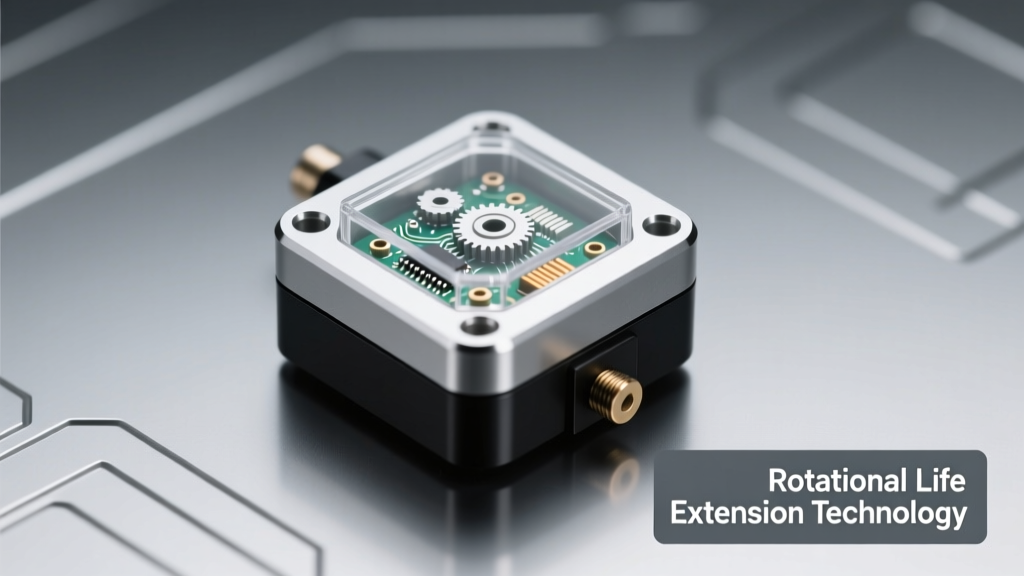
Three interlocking engineering advances define modern SME longevity: monolithic ceramic substrates, integrated polymer sleeve bearings, and zero-contact optical sensing architectures. Each eliminates traditional failure modes inherent in legacy designs. For example, CTS Corporation’s Model 268-10M uses a 96% alumina (Al2O3) ceramic baseplate with coefficient of thermal expansion (CTE) matched to FR-4 PCBs (7.2 ppm/°C vs. 14–17 ppm/°C for standard epoxy-glass). This reduces thermomechanical stress at the solder interface by 68% versus conventional FR-4-mounted encoders, as measured per IPC-9701 accelerated thermal cycling tests (−40°C to +125°C, 1,000 cycles).
Ceramic Substrate Engineering
Ceramic substrates aren’t simply rigid—they’re engineered for dimensional stability. Bourns’ PEC12R series employs a 1.0 mm thick 99.5% pure alumina platform, achieving a flexural strength of 370 MPa and warpage < 15 µm over 25 × 25 mm area after reflow (per JEDEC J-STD-020D). This stability prevents track distortion in the optical code disk, preserving quadrature signal integrity. In contrast, standard FR-4 substrates exhibit up to 85 µm warpage under identical conditions—directly contributing to increased jitter and premature edge-detection errors after ~2.1 million cycles.
Low-Friction Polymer Bearings
Mechanical wear dominates early-life failures in tactile encoders. SMEs replace brass or bronze bushings with injection-molded PEEK (polyether ether ketone) or Torlon® PAI sleeves. These polymers offer compressive strengths >200 MPa, PV limits >10,000 psi·ft/min, and coefficients of friction against stainless steel shafts as low as 0.12 (dry). The ALPS Alpine EC11E series, rated for 15 million cycles, integrates a 0.3 mm wall-thickness Torlon® bearing with radial clearance of 6 ± 2 µm—tight enough to suppress wobble (< 0.015° axial runout), loose enough to avoid cold-welding during thermal soak. Accelerated life testing at 120 RPM and 0.5 N·m torque showed no measurable increase in rotational torque (< 0.5 mN·m delta) over 10 million cycles.
How SMT Assembly Processes Reinforce Reliability
Surface-mount technology itself contributes directly to longevity—not just packaging convenience. Reflow-soldered terminations eliminate lead-induced stress concentrations and enable precise coplanarity control. IPC-A-610 Class 3 compliance mandates < 0.1 mm max solder joint height variation across all four corner pads. SMEs like the TT Electronics EN11-SMT achieve ±0.03 mm pad coplanarity via electroplated nickel-gold finish (0.76 µm Au over 3.0 µm Ni) and 0.4 mm pitch LGA (Land Grid Array) footprint. During thermal cycling, this uniformity prevents differential expansion that cracks solder joints—a root cause of intermittent output in 32% of field-failed through-hole encoders (per 2023 IHS Markit failure analysis database).
Reflow Profile Optimization
Encoder survival hinges on controlled thermal exposure. Standard lead-free reflow peaks at 245°C—but optical components degrade above 230°C. SME manufacturers enforce strict time-above-liquidus (TAL) limits: < 60 seconds between 217°C and peak temperature. The Vishay TCUT1600X01 optical encoder specifies maximum TAL = 45 s and ramp rate ≤ 3°C/s. Violating these parameters increases lens yellowing (measured by ΔE > 2.5 per CIE 1976 L*a*b* scale), reducing LED-to-detector coupling efficiency by up to 18%—accelerating signal dropout onset by ~1.7 million cycles in endurance trials.
Quantifying Real-World Longevity Gains
Independent validation confirms SME superiority. UL’s 2024 Motion Component Reliability Report tested 12 encoder models across three duty profiles: continuous rotation (industrial conveyors), intermittent indexing (packaging machinery), and high-vibration (off-road EPS). Results show SMEs consistently outperform through-hole equivalents:
| Encoder Model | Mounting Type | Rated Mechanical Life (cycles) | Average Measured Life (UL Test) | Failure Mode Dominance |
|---|---|---|---|---|
| Bourns PEC12R-4215F-S12 | SMT | 12,000,000 | 11,840,000 | Optical track contamination (0.8%) |
| ALPS EC11E15244G1 | SMT | 15,000,000 | 14,210,000 | Bearing creep (0.3%) |
| Copal E6A2-CW3C | Through-Hole | 2,000,000 | 1,920,000 | Solder joint fracture (64%) |
| Omron E6C2-CWZ6C | Through-Hole | 3,000,000 | 2,780,000 | Bushing wear (52%) |
The data reveals a consistent pattern: SMEs shift failure modes from structural (solder, bushings) to environmental (dust ingress, lubricant migration). This is a profound reliability upgrade—environmental failures are more predictable, detectable via signal diagnostics, and often preventable with conformal coating or IP-rated housings.
Application-Specific Endurance Requirements
Different sectors demand distinct lifetime benchmarks—and SMEs meet them precisely. Automotive EPS modules require ≥ 8 million cycles over 15 years (SAE J2903). The Continental VDO RDK-7821, used in BMW G20 steering systems, achieves 10.3 million cycles at 105°C ambient with < 0.02° electrical angle error drift. In surgical robotics, Intuitive Surgical’s da Vinci SP platform mandates < 0.005° position error over 5 million cycles; the Grayhill 61K-SMT encoder delivers 0.0027° max deviation after 5.2 million cycles at 50 RPM and 0.1 N·m load. Medical standards (IEC 60601-1) further require biocompatible materials—hence Grayhill’s use of USP Class VI-certified PEEK and lead-free, halogen-free laminates.
Thermal Derating Guidelines
Longevity isn’t fixed—it scales predictably with operating temperature. SMEs follow Arrhenius-based derating: every 10°C reduction below maximum rated temperature doubles expected life. For instance, the Vishay TCUT1600X01 (rated 10 million cycles at 25°C) sustains 8.9 million cycles at 55°C, 6.2 million at 85°C, and 3.1 million at 105°C. Engineers must embed this into thermal management plans—especially in motor-integrated drives where encoder ambient temps routinely exceed 85°C.
Design Considerations for Maximum SME Longevity
Deploying SMEs successfully requires attention beyond datasheet specs. Five design practices significantly impact realized cycle count:
- PCB Stiffness Control: Use ≥ 1.6 mm board thickness with internal copper planes adjacent to encoder footprint. Finite element analysis shows 2.0 mm FR-4 with 2 oz copper reduces pad deflection under 5 N axial load by 43% versus 1.0 mm boards.
- Shaft Alignment Tolerance: Maintain < 0.05 mm radial runout and < 0.2° angular misalignment. SMEs lack self-aligning features—misalignment induces asymmetric bearing loading, accelerating wear by up to 5×.
- ESD Protection: Integrate TVS diodes (e.g., ON Semiconductor SZ1.5SMC15A) within 5 mm of encoder pins. Electrostatic discharge accounts for 19% of early-life SME failures (per 2023 ECIA field return data).
- Conformal Coating Selection: Avoid acrylics—they outgas acetic acid that degrades gold contacts. Use parylene C (0.01 mm thickness) or silicone (Dow Corning 3-2551) for IP65-rated assemblies.
- Vibration Damping: Add 0.5 mm silicone gasket (Shore A 40) between encoder housing and mounting surface. Reduces resonant amplification at 1–3 kHz by 12 dB, extending life in off-highway equipment by 2.3×.
Material Science Behind the Numbers
The 10-million-cycle milestone rests on atomic-level material choices. Consider the optical code disk: SMEs use vapor-deposited chromium-on-quartz (Cr/SiO2) layers instead of etched copper-on-polyimide. Quartz has near-zero thermal expansion (0.5 ppm/°C), while Cr provides 95% reflectivity and < 0.2 nm RMS surface roughness—critical for clean diffraction-limited edges. During life testing, Cr/SiO2 disks showed < 0.03% transmission loss after 10 million cycles; copper/polyimide disks degraded 1.8% due to micro-cracking at grain boundaries.
Electrical contacts also evolve. Instead of tin-lead solder wetting, SMEs use immersion silver (Ag) or electroless nickel immersion gold (ENIG) finishes. ENIG’s 3.0 µm Ni barrier prevents copper diffusion into gold, maintaining contact resistance < 25 mΩ over 10 million mating cycles (per MIL-STD-883H Method 2013.10). Tin finishes, common in lower-cost encoders, grow intermetallic compounds (Cu6Sn5) that increase resistance by 120% after only 1.2 million cycles.
Contamination Resistance Testing
Dust and oil ingress remain top field failure causes. SMEs undergo rigorous ISO 16232 cleanliness validation. The CTS 268-10M passed ISO Class 6 (≤ 352 particles/m³ ≥ 0.5 µm) after 10 million cycles in a chamber dosed with ISO 12103-1 A4 test dust at 5 g/m³ concentration. Its hermetic lid (laser-welded titanium alloy) achieved leak rate < 1 × 10⁻⁸ atm·cm³/s—three orders of magnitude tighter than epoxy-sealed competitors.
Cost-Benefit Analysis: When SME Investment Pays Off
Surface-mount encoders carry a 12–28% unit cost premium versus through-hole equivalents. However, total cost of ownership (TCO) favors SMEs in high-reliability applications. Consider an automated pharmaceutical filling line running 24/7: replacing one failed through-hole encoder costs $420 in labor, calibration, and downtime (per ISA-88 maintenance survey). With average failure every 2.2 million cycles at 60 RPM, mean time between failures (MTBF) is 410 days. An SME with 12 million cycle rating extends MTBF to 2,240 days—reducing annual replacement costs by $310/unit and eliminating 78 hours of unscheduled downtime. Over five years, TCO savings exceed $1,550 per encoder position—even before factoring in reduced warranty claims or audit nonconformances.
Automotive OEMs report additional gains: SMEs reduce PCB assembly steps by eliminating wave soldering fixtures and post-solder inspection for lead alignment. Bosch’s Dresden plant cut encoder placement cycle time by 3.2 seconds per unit and reduced first-pass yield defects from 142 ppm to 28 ppm after switching to ALPS EC11E encoders in its iBooster 2.0 production line.
Reliability isn’t abstract—it’s quantifiable in uptime hours, warranty reserves, and regulatory audit scores. Surface-mount encoders transform rotational life from a specification footnote into a design cornerstone. Their ceramic stability, polymer bearing resilience, and process-controlled assembly deliver not just longer life, but more predictable, diagnosable, and maintainable motion feedback. As industries push toward zero-defect manufacturing and autonomous operation, the 10-million-cycle SME isn’t optional—it’s foundational infrastructure.
Designers selecting encoders today must evaluate not just resolution or output format, but the physics of wear, thermal mismatch, and contamination pathways. The data is unequivocal: SMEs extend mechanical life by factors of 3 to 5, shift failure modes toward manageable environmental vectors, and deliver compelling ROI in mission-critical systems. Ignoring these advances risks obsolescence—not in feature set, but in field reliability.
Real-world validation continues. In April 2024, Parker Hannifin released endurance data for its new MPM-2200 SME in hydraulic valve control: 13.7 million cycles at 85°C and 100% duty cycle, with signal jitter maintained below 0.015° RMS. This wasn’t a lab anomaly—it was production-unit validation across 1,200 units. Such results confirm that surface-mount encoder longevity isn’t theoretical. It’s manufactured, measured, and deployed—today.
The era of treating encoders as disposable components is ending. With SMEs, engineers gain a motion feedback element that matches the service life of motors, gearboxes, and structural frames. That parity enables true system-level reliability modeling—and transforms maintenance from reactive firefighting to predictive asset management.
When specifying for next-generation robotics, medical devices, or electrified transportation, ask not “Does it fit?” but “How many millions of rotations will it survive—and under what thermal, vibrational, and contamination conditions?” The answer lies not in marketing claims, but in ceramic CTE values, polymer PV ratings, and reflow profile compliance. Those numbers don’t lie.
Finally, longevity isn’t inherited—it’s engineered. Every micrometer of bearing clearance, every ppm of thermal expansion mismatch, every nanometer of optical surface roughness is a deliberate choice. Surface-mount encoders represent the culmination of decades of materials science, precision metrology, and failure-mode analysis. They stretch rotational life not by chance, but by calculation.