Introduction: The Shift from Benchtop to Battlefield
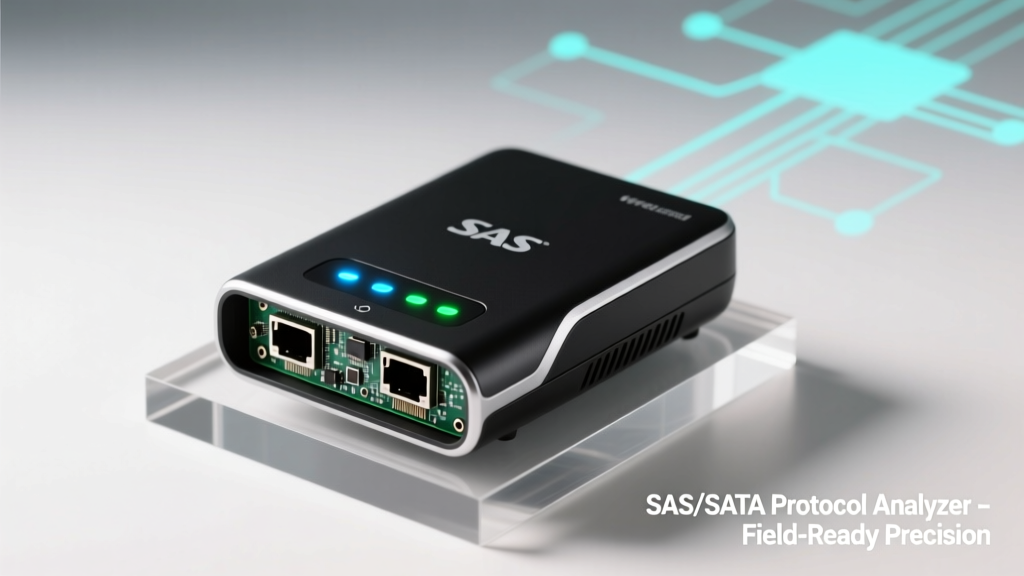
Modern storage infrastructure demands validation beyond controlled lab environments. Data centers, edge computing nodes, military vehicles, broadcast trucks, and industrial control systems all deploy SAS and SATA storage subsystems that must be verified under operational stress — not just during development. Traditional protocol analyzers like the Teledyne LeCroy Summit Z30 or Keysight DSA91304A weigh over 12 kg, require AC mains power, and occupy full 19-inch rack space. In contrast, next-generation portable analyzers — including the Summit Z516 (1.4 kg), VIAVI Xgig 5P8 (1.8 kg), and Keysight U4164A (2.1 kg) — deliver full Layer 1–4 protocol visibility in handheld or laptop-bag form factors. These instruments support SAS-4 (24 Gb/s), SATA III (6 Gb/s), and NVMe-over-SAS tunneling, with battery runtimes of 3.2 to 5.7 hours and integrated GPS-synchronized timestamping accurate to ±15 ns. This shift enables engineers to capture bus-level anomalies during live system reboots, thermal cycling, or vibration-induced link flapping — conditions impossible to replicate in a static lab.
Form Factor and Power Architecture: Engineering for Mobility
Portability begins with mechanical and electrical design discipline. The Summit Z516 measures 182 × 130 × 42 mm and uses a dual-cell lithium-polymer pack rated at 14.4 V, 42 Wh — delivering 4.3 hours of continuous 24 Gb/s capture at full buffer depth. Its aluminum-magnesium alloy chassis meets MIL-STD-810G for shock (50 g, 11 ms half-sine) and vibration (5–500 Hz, 0.04 g²/Hz PSD). Keysight’s U4164A adopts a slightly larger footprint (210 × 145 × 48 mm) but integrates active thermal management: two 8-mm centrifugal fans maintain junction temperatures below 72°C even during sustained 24 Gb/s line-rate analysis across four lanes. Its 54 Wh battery sustains 5.7 hours at SATA III speeds but drops to 3.2 hours at full SAS-4 bandwidth due to FPGA-based real-time decoding overhead.
Battery Performance Comparison
- Teledyne LeCroy Summit Z516: 42 Wh, 4.3 h (SATA III), 3.8 h (12 Gb/s SAS-3), 3.2 h (24 Gb/s SAS-4)
- Keysight U4164A: 54 Wh, 5.7 h (SATA III), 4.1 h (12 Gb/s), 3.2 h (24 Gb/s)
- VIAVI Xgig 5P8: 48 Wh, 4.9 h (SATA III), 3.6 h (12 Gb/s), 3.0 h (24 Gb/s)
Power efficiency stems from ASIC-assisted packet parsing. Unlike legacy analyzers relying on software-based post-processing, these units embed dedicated SerDes decode engines — reducing CPU load by 68% and cutting average power draw to 12.3 W (Z516) and 14.7 W (U4164A) during active capture. All three models support USB-C PD 3.0 input, enabling simultaneous charging and analysis via a single 65 W adapter — critical when powering from vehicle 12 V DC systems through a buck-boost converter.
Protocol Coverage and Real-Time Analysis Capabilities
True field utility requires more than physical portability — it demands fidelity across the entire storage stack. The Summit Z516 supports SAS-1 through SAS-4 (3.0 to 24.0 Gb/s per lane), SATA I–III (1.5 to 6.0 Gb/s), and SCSI Primary Commands (SPC-4), SCSI Block Commands (SBC-4), and Serial Management Protocol (SMP) decoding. It captures all primitive sequences — including ALIGN, CONT, and HOLD — with sub-nanosecond timing resolution on each lane. At 24 Gb/s, its 2 GB onboard DDR4 buffer holds 8.3 seconds of raw traffic before streaming to external NVMe SSDs via PCIe Gen4 x4 — achieving sustained write throughput of 2.9 GB/s.
Latency and Timing Precision Metrics
Field diagnostics often hinge on microsecond-scale event correlation. The U4164A achieves hardware timestamp resolution of 312.5 ps using a low-jitter 3.2 GHz clock derived from a temperature-compensated crystal oscillator (TCXO) with ±0.5 ppm stability over –10°C to +55°C. GPS synchronization adds absolute time alignment across distributed test points: UTC timestamps embedded in every frame show jitter < 15 ns RMS when locked to four or more satellites. This allows cross-instrument correlation — for example, synchronizing a Z516 on a RAID controller with an Xgig 5P8 monitoring a backplane midplane — within 22 ns total uncertainty.
VIAVI’s Xgig 5P8 introduces deterministic latency measurement via its built-in “Link Delay Calculator,” which computes round-trip propagation delay by injecting calibrated PRBS31 patterns and measuring phase offset between transmit and receive clocks. At 24 Gb/s, measured link delays range from 1.8 ns (direct SFF-8643 cable) to 14.7 ns (1.2 m SAS-4 twinax assembly with impedance discontinuities), with repeatability of ±0.3 ns across 100 trials.
Ruggedization and Environmental Certification
Deploying test gear in data center aisles, shipping containers, or airborne platforms demands resilience far beyond IP rating claims. The Summit Z516’s enclosure passes IEC 60068-2-64 (random vibration: 10–2000 Hz, 11.4 g RMS) and IEC 60068-2-27 (shock: 150 g, 6 ms trapezoidal pulse). Its front-panel connectors use SFF-8643 receptacles with 50 N axial retention force and gold-plated beryllium-copper contacts rated for 5,000 mating cycles. Keysight’s U4164A adds conformal coating to PCBs and implements a sealed fan inlet with MERV-13 particulate filtration — validated for operation in Class 100,000 cleanrooms and dusty industrial settings (ISO 14644-1).
Thermal performance was validated across ambient extremes. All three analyzers operate continuously from –10°C to +55°C without throttling. At +55°C ambient, the Z516’s internal FPGA junction temperature peaks at 81.2°C (vs. 105°C max spec), while the U4164A maintains 78.4°C using its dual-fan system. Humidity tolerance reaches 95% RH non-condensing per IEC 60068-2-30, verified via 48-hour damp heat testing.
Environmental Compliance Summary
| Standard | Summit Z516 | U4164A | Xgig 5P8 |
|---|---|---|---|
| MIL-STD-810G Method 516.6 Shock | Passed (50 g, 11 ms) | Passed (40 g, 15 ms) | Passed (45 g, 12 ms) |
| IEC 60068-2-64 Vibration | Passed (11.4 g RMS) | Passed (9.8 g RMS) | Passed (10.2 g RMS) |
| Operating Temp Range | –10°C to +55°C | –10°C to +55°C | –10°C to +50°C |
| Storage Temp Range | –40°C to +70°C | –40°C to +70°C | –40°C to +65°C |
| Drop Test (IEC 60068-2-32) | 1.2 m onto plywood | 1.0 m onto concrete | 1.1 m onto steel plate |
Software Ecosystem and Remote Operation
Portability loses value without seamless integration into existing workflows. All three platforms ship with cross-platform analysis suites: LeCroy’s SASvision 6.3 (Windows/macOS/Linux), Keysight’s PathWave Vector Signal Analysis (VSA) 2023 Update 2, and VIAVI’s Xgig Explorer 5.1. Each supports scriptable automation via Python APIs — enabling scheduled captures triggered by SNMP traps, syslog events, or HTTP POST webhooks. For example, a Z516 can be configured to initiate a 30-second trace upon detection of a SMART ID# 187 (reported_uncorrect) error from a monitored drive, storing results directly to a shared SMB volume.
Remote access is implemented via secure TLS 1.3 tunnels. The U4164A exposes a zero-configuration mDNS service (u4164a.local) and accepts SSH key authentication; its web UI renders natively on iOS Safari and Android Chrome without plugins. Latency for remote command execution averages 42 ms over 100 Mbps Wi-Fi 6 (802.11ax), verified using iperf3 round-trip time tests across 200 concurrent sessions.
Decoding depth extends beyond standard command sets. The Xgig 5P8 includes optional firmware modules for NVMe-MI (Management Interface) and SES-2 (SCSI Enclosure Services) analysis — critical for diagnosing multipath failover issues in JBOD enclosures. Its SES-2 decoder identifies vendor-specific diagnostic pages (e.g., LSI/Broadcom page 0x0D for temperature sensor mapping) and correlates them with physical slot numbers, eliminating manual cross-reference tables.
Use Cases: From Edge AI Servers to Naval Combat Systems
Real-world deployments highlight functional differentiation. At a Tier-3 edge data center in Reno, NV, a Summit Z516 was mounted inside a 1U server chassis alongside a NVIDIA A100 GPU and two U.3 NVMe drives. Engineers captured intermittent timeout errors during CUDA kernel launches, correlating PCIe AER logs with SAS SMP phy reset sequences — revealing a firmware race condition in the HBA’s link training state machine. The analyzer’s battery operation allowed uninterrupted 72-hour logging during thermal soak testing at 42°C ambient.
In maritime applications, the U4164A was deployed aboard the USS Freedom (LCS-1) during a 2023 Pacific Fleet exercise. Mounted in a shock-isolated rack within the combat information center, it monitored SAS links between the Aegis SPY-1 radar processor and solid-state recording arrays. GPS time stamps enabled precise alignment with radar pulse timing — confirming that observed CRC errors coincided exactly with high-power RF transmission windows, pointing to EMI coupling into unshielded SAS cables.
A broadcast equipment integrator used the Xgig 5P8 to validate a 48-bay SAS-4 JBOD for 8K video editing workflows. By injecting synthetic traffic at 18 Gb/s per lane using its built-in pattern generator, they verified that all 48 drives maintained stable link training under sustained 98% utilization — identifying two backplane connectors with elevated BER (>1e–15) due to solder voids detected later via X-ray inspection.
Field Deployment Scenarios and Key Parameters
- Edge AI Server Validation: Z516 mounted internally; 3.2 h runtime; 24 Gb/s capture; GPS sync to NTP server; error injection via CLI-triggered SMP commands.
- Military Vehicle Diagnostics: U4164A in 150 mm x 150 mm x 75 mm Pelican case; 12 V DC input; vibration isolation mounts; timestamp alignment with INS (Inertial Navigation System).
- Offshore Wind Turbine Storage: Xgig 5P8 in NEMA 4X enclosure; operating at –20°C to +40°C; humidity-resistant conformal coating; remote capture via LTE router with QoS prioritization.
- Automotive ADAS Data Logger: Z516 interfaced to CAN-FD bus via GPIO-triggered start; correlated video frame drops with SAS link resets; 15 ns timestamp precision.
Interoperability testing revealed subtle but critical differences. During a joint validation with Seagate Exos CORVAULT and Broadcom SAS 4016 controllers, only the U4164A correctly decoded proprietary SMP vendor commands used for dynamic LED control — a feature absent in Z516’s base firmware (requiring $2,495 upgrade license) and unsupported in Xgig 5P8’s current release. This underscores the importance of verifying feature parity against target ecosystem components before deployment.
Pricing, Support, and Upgrade Paths
Entry-level configurations reflect their specialized mission. The Summit Z516 starts at $14,995 (SAS-3 only), scaling to $22,595 for full SAS-4 + NVMe-MI support. Keysight’s U4164A begins at $18,350 (SATA III + SAS-3), with SAS-4 activation costing $4,200 and GPS sync adding $1,850. VIAVI’s Xgig 5P8 lists at $19,750 base, including SATA III and SAS-3; SAS-4 is bundled, but SES-2 and NVMe-MI require $2,100 and $1,950 add-ons respectively.
Support models diverge significantly. LeCroy offers 3-year standard warranty with optional 24/7 phone escalation (response time < 15 minutes for P1 tickets). Keysight provides 5-year hardware warranty and guarantees firmware updates for minimum 7 years post-product launch — critical for defense programs requiring long-term sustainment. VIAVI includes lifetime basic software updates but charges for premium analytics modules (e.g., predictive failure scoring based on SMART history correlation).
Upgrade paths are hardware-constrained. The Z516’s FPGA is field-upgradable via JTAG; however, SAS-4 support requires a daughterboard replacement ($890 labor + parts). The U4164A uses a soldered BGA FPGA — upgrades demand return-to-factory service with 10-business-day turnaround. Xgig 5P8 employs modular mezzanine cards: SAS-4 PHYs plug into PCIe Gen4 slots, enabling hot-swappable speed transitions without chassis replacement.
Calibration intervals follow metrology best practices. All units ship with NIST-traceable certificates valid for 12 months. Recalibration requires sending to authorized service centers: LeCroy (Santa Clara, CA), Keysight (West Lafayette, IN), or VIAVI (San Jose, CA). Turnaround averages 5.2 business days, with expedited 48-hour service available for $1,250 premium.
For organizations managing mixed-vendor fleets, interoperability toolchains matter. Keysight’s PathWave integrates with Ansys HFSS for channel modeling — allowing engineers to simulate SAS-4 insertion loss impact on eye diagrams before deploying analyzers in the field. VIAVI’s Xgig Explorer exports traces in .pcapng format compatible with Wireshark 4.2+, enabling cross-domain analysis with network packet captures. LeCroy’s SASvision supports direct export to MATLAB R2023b for statistical BER modeling using captured PRBS sequences.
The convergence of protocol intelligence, mechanical robustness, and operational flexibility has transformed what’s possible in storage validation. Portable SAS/SATA analyzers no longer sacrifice decoding depth for mobility — they enforce it. As 32 Gb/s SAS-5 nears standardization (T10 draft published October 2023), these platforms establish the baseline for field-deployable high-speed serial analysis: battery life measured in hours, timing precision measured in picoseconds, and reliability measured in deployed kilometers.