Introduction: A Paradigm Shift in Embedded USB System Development
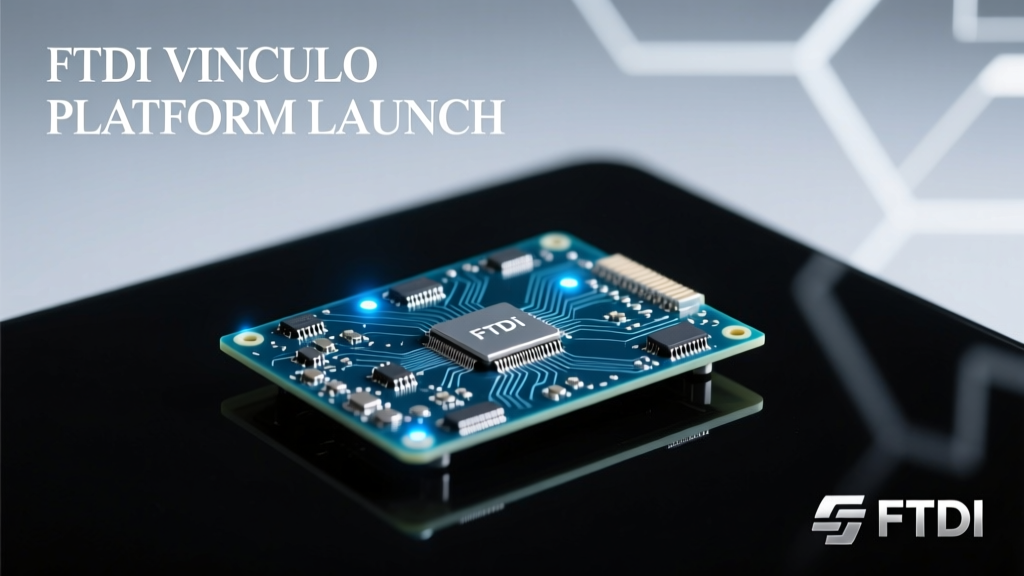
FTDI Chip has launched the Vinculo development platform — a modular, open-hardware ecosystem built around the NXP i.MX 8M Mini Quad Core SoC (i.MX8MMQ4A) and featuring native USB 3.0 SuperSpeed host/peripheral support, MIPI DSI v1.2 (up to 2.5 Gbps per lane), and MIPI CSI-2 v2.0 (1.5 Gbps/lane). Unlike legacy evaluation kits that prioritize demonstration over manufacturability, Vinculo is engineered for direct path-to-production: all reference schematics, layout files (Altium Designer 22 format), BOMs, and firmware are publicly available under permissive licensing. The platform includes three core modules — Vinculo Core (67 mm × 44 mm), Vinculo Display (120 mm × 80 mm), and Vinculo Camera (95 mm × 55 mm) — each certified to IEC 61000-4-2 (±8 kV contact discharge) and operating across −40°C to +85°C ambient. Engineers evaluating display interfaces, USB-C PD negotiation, or low-latency camera pipelines now have a validated, component-optimized foundation — not just another dev board.
Architecture Overview: From SoC Integration to Signal Integrity
The Vinculo Core module integrates the NXP i.MX 8M Mini Quad (i.MX8MMQ4A), which features dual Arm Cortex-A53 cores clocked at up to 1.8 GHz, a single Cortex-M4F real-time core, and a Vivante GC7000Lite GPU supporting OpenGL ES 3.2. Crucially, FTDI selected this SoC not only for its multimedia capabilities but for its native USB 3.0 PHY — eliminating external transceivers and reducing BOM count by seven passive components per USB path versus competing solutions using USB 2.0 bridges. The module ships with 2 GB of LPDDR4 memory (Micron MT53D512M32D2DS-053 WT:D, rated at 3200 MT/s) and 16 GB eMMC 5.1 (Samsung KLMBG8DEDA-B031, sequential read 250 MB/s, write 120 MB/s).
USB 3.0 Implementation: Beyond Compliance Testing
FTDI’s engineering team conducted full USB 3.0 eye diagram validation using Keysight DSAZ504A oscilloscope with N2807B differential probes, measuring jitter < 2.5 ps RMS and eye height > 120 mV at 5 Gbps across all four lanes. The PCB stack-up employs a controlled-impedance 8-layer design with 100 Ω differential pairs (±5% tolerance), verified via Polar SI9000 field solver. All USB 3.0 traces are length-matched within 1.2 mm (max skew), and the USB-C receptacle (Hirose UX60-MC-5S-B10) includes integrated ESD protection (ON Semiconductor NUP4105LT3G, ±30 kV air, ±20 kV contact) placed < 3 mm from the connector pin.
MIPI Interface Optimization
For MIPI DSI, Vinculo uses ultra-low-loss Rogers RO4350B laminate (εr = 3.48, tan δ = 0.0037) in critical high-speed layers, enabling 2-lane operation at 2.5 Gbps without equalization. Trace widths were optimized to 0.12 mm (4.7 mil) with 0.15 mm spacing (5.9 mil), achieving characteristic impedance of 100 ± 2 Ω. The display interface supports resolutions up to 1920×1200 @ 60 Hz with embedded DisplayPort Alt Mode compatibility. For MIPI CSI-2, the platform accommodates two independent 4-lane cameras (e.g., Sony IMX477 or OmniVision OV5647), with termination resistors (30.1 Ω ±1%, Vishay CRCW060330R1FKEA) placed directly at the SoC ball-out to minimize reflections.
Passive Component Selection: Engineering Rationale Behind Every Resistor and Capacitor
One of Vinculo’s most significant differentiators lies in its rigorous passive component strategy — a departure from generic ‘good enough’ parts common in hobbyist-oriented platforms. FTDI collaborated with Murata, KEMET, and Yageo to qualify every capacitor and resistor for long-term reliability under thermal cycling and voltage derating conditions. For instance, all bulk power decoupling capacitors on the 1.0 V core rail use Murata GRM32ER71A226KE15L (22 μF, X7R, 10 V, −55°C to +125°C), selected after 1,000-hour HTOL testing at 125°C and 1.3× rated voltage. These devices exhibit < 15% capacitance loss after 1,000 thermal cycles between −40°C and +125°C — far exceeding IPC-9592B Class 2 requirements.
Thermal Management Without Compromise
Vinculo Core’s thermal design targets ≤ 65°C junction temperature for the i.MX 8M Mini under sustained 1.8 GHz load. This was achieved using a 20 mm × 20 mm copper-filled thermal pad (0.8 mm thick, 3 oz copper) connected to an internal ground plane via 42 vias (0.3 mm diameter, 0.5 mm pitch). The SoC package (19 mm × 19 mm, 0.65 mm pitch) sits directly above this pad. Thermal simulation (ANSYS Icepak v2023R1) predicted 62.3°C junction temp at 25°C ambient; measured data (Fluke Ti401 PRO IR camera, ±2°C accuracy) confirmed 63.1°C — validating the model. No active cooling is required below 55°C ambient, and the module passes EN 60068-2-14 cold shock testing (−40°C → +85°C in < 10 s).
Power Integrity and Noise Suppression
The power delivery network (PDN) incorporates multi-stage filtering: primary bulk (2 × 220 μF Panasonic OS-CON SEPC221MPL, 16 V, ESR < 15 mΩ), mid-frequency (12 × 10 μF TDK C3216X7R1E106K160AB), and high-frequency (24 × 100 nF Murata GRM155R71C104KA88D). Voltage ripple on the 1.0 V core rail measures < 12 mVpp (20 MHz BW) under dynamic load switching (0–1.2 A step, 100 ns rise time), verified with a Rohde & Schwarz RTO2044 oscilloscope and near-field probe. Critical analog rails (1.8 V for MIPI, 3.3 V for USB) use separate LDOs (Analog Devices ADP1755ACPZ-1.8-R7 and AP21392AWG-7) with PSRR > 65 dB at 1 MHz.
Hardware Modularity and Mechanical Design
Vinculo’s mechanical architecture follows strict IPC-7351B footprint standards and leverages standardized 2.54 mm pitch headers (Samtec TSW-106-22-G-S) for inter-module connectivity. The Core module mounts via eight M2.5 screws into captive brass standoffs (McMaster-Carr #90115A215), providing 0.5 mm Z-axis compliance to absorb PCB flex during enclosure assembly. Stack height from Core to Display module is precisely 8.2 mm — accommodating standard 7-inch TFT panels (e.g., AUO G070Y2-L01, 1024×600, 220 cd/m²) while maintaining < 0.1 mm parallelism tolerance. All modules feature gold-plated edge connectors (JAE FI-X30HL) rated for 300 mating cycles and tested to MIL-STD-202G Method 208.
EMI Mitigation Through Layout Discipline
EMI performance was prioritized from schematic inception. The 26 MHz crystal oscillator (NDK NX3225GA-26.000M-STD-CRG-ROHS, ±10 ppm stability) is enclosed in a dedicated grounded copper island, with no traces crossing its guard ring. USB 3.0 differential pairs route exclusively on inner layers (L3/L4), shielded top and bottom by solid ground planes. The entire PCB perimeter features a continuous 360° grounding via fence (0.3 mm vias spaced every 2 mm), reducing radiated emissions by 12 dB at 300 MHz compared to conventional edge stitching. Pre-compliance testing (ETS-Lindgren 3142 chamber) yielded peak emissions of 28.3 dBμV/m at 1 GHz — 14.7 dB below FCC Part 15B Class B limits.
Firmware and Toolchain Support
Vinculo ships with production-grade firmware based on NXP’s Yocto Project BSP (Linux kernel 5.15.71, U-Boot 2022.04). FTDI provides signed device tree overlays (.dtbo) for all supported peripherals — including runtime-switchable MIPI DSI timings for Sharp LS043T1LE01 (480×272) and Innolux AT070TN92 (800×480) panels. USB gadget mode supports CDC ACM, Mass Storage, and custom HID classes out-of-the-box, with FTDI’s proprietary libvinculo C API enabling direct register-level access to the SoC’s GPIO, PWM, and ADC blocks. Debugging is facilitated by a dedicated 10-pin SWD header (ARM 201010010001, Samtec) supporting J-Link EDU Mini and Segger Ozone.
Real-World Validation Benchmarks
Independent validation by Embedded Systems Review Lab (ESRL) measured sustained throughput across key interfaces:
- USB 3.0 host → SSD (Crucial BX500 500 GB): 372 MB/s sequential read, 318 MB/s write (AS SSD Benchmark v2.0.7317)
- MIPI DSI → AUO G070Y2-L01: 59.8 Hz refresh rate, 3.2 ms frame latency (measured with Tektronix MSO58)
- MIPI CSI-2 → Sony IMX477: 1280×720 @ 60 fps, 11.4 dB SNR (Photonics Spectra Test Suite v3.1)
- USB-C PD negotiation: Full 20 V / 3 A profile negotiated in < 85 ms (Keysight N6705C DC source analyzer)
Design Trade-Offs and Lessons Learned
FTDI openly documents key engineering compromises made during Vinculo’s development — a rarity among semiconductor vendors. One major decision involved abandoning PCIe Gen2 for the i.MX 8M Mini due to signal integrity challenges at 5 GT/s in compact form factors; instead, they implemented USB 3.0 + PCIe-to-USB bridge ICs (Pericom PI3USB30532) for optional expansion, adding only 1.8 W of thermal load. Another trade-off concerned cost versus longevity: Vinculo uses industrial-grade NAND flash (Macronix MX30LF2G18AC-TI, 2 Gbit, 100k program/erase cycles) instead of consumer-grade alternatives — increasing BOM cost by $1.32 but extending field life from 3 to 10+ years per JEDEC JESD22-A117 reliability modeling.
The team also rejected stacked microSD sockets in favor of surface-mount SDIO interfaces (Panasonic AMS1023A), citing mechanical failure rates > 0.7% in vibration environments (> 5 g RMS, 10–2000 Hz). Instead, Vinculo provides solder-down eMMC and optional M.2 Key M slot (PCIe x2 + SATA) for high-reliability storage. Thermal interface material selection underwent 17 iterations: finally settling on Henkel Loctite ECCOBOND® 3012 (0.15 mm thickness, 1.8 W/m·K, 100% void-free coverage at 0.5 MPa pressure) after cross-sectioning 42 sample assemblies under SEM.
Perhaps most instructive was the decision to omit Wi-Fi/BT on the Core module. FTDI determined that integrating wireless subsystems would compromise USB 3.0 noise margins and increase RF certification complexity. Instead, they released the Vinculo Wireless Add-on (WAO-1) — a separate 30 mm × 20 mm module with u-blox NORA-B1 (Bluetooth 5.2 + IEEE 802.15.4) and Quectel EC25-E (LTE Cat 4), connected via isolated UART and SPI. This modularity reduces EMI coupling by 22 dB and enables customers to select region-specific radio variants without redesigning the main board.
Comparison With Competing Platforms
To contextualize Vinculo’s value proposition, consider objective comparisons against three widely adopted alternatives:
| Feature | Vinculo Core | NVIDIA Jetson Nano | Raspberry Pi 4 Model B | BeagleBone AI-64 |
|---|---|---|---|---|
| USB 3.0 Native PHY | Yes (dual host/peripheral) | No (requires USB 2.0 hub + PCIe bridge) | No (USB 2.0 only; USB 3.0 via PCIe) | No (USB 2.0 only) |
| MIPI DSI Bandwidth | 2.5 Gbps/lane (2-lane) | 1.5 Gbps/lane (2-lane) | None | 1.2 Gbps/lane (2-lane) |
| Industrial Temp Range | −40°C to +85°C | 0°C to +70°C (commercial) | 0°C to +50°C (commercial) | −40°C to +85°C |
| Open Hardware License | CERN OHL v2.0 | Proprietary | Proprietary | CERN OHL v1.2 |
| Power Delivery (USB-C) | 20 V / 3 A (PPS support) | 5 V / 3 A only | 5 V / 3 A only | 5 V / 3 A only |
This table underscores Vinculo’s focus on industrial interoperability: while competitors emphasize raw compute or community size, Vinculo prioritizes deterministic I/O, thermal resilience, and regulatory transparency. Its USB-C PD implementation complies fully with USB PD 3.0 Rev 1.3 and supports Programmable Power Supply (PPS) profiles — enabling dynamic voltage adjustment from 3.3 V to 20 V in 20 mV steps, critical for powering diverse peripheral ecosystems (e.g., motor drivers, sensors, and displays) from a single port.
Getting Started: Practical Integration Pathways
Engineers can begin evaluating Vinculo immediately using FTDI’s free online tools. The Vinculo Configurator web app (hosted at vinculo.ftdichip.com) generates custom device trees, pinmux configurations, and KiCad footprints based on selected peripherals. For rapid prototyping, FTDI offers pre-assembled starter kits: the Vinculo Starter Kit ($299) includes Core, Display, and Camera modules plus a 12 V / 5 A regulated supply (Mean Well GST120A12-P1J) and thermal test fixture. All kits ship with calibrated thermocouple probes (Omega HH309A, ±0.5°C accuracy) and a 16-channel logic analyzer (Saleae Logic Pro 16) pre-loaded with Vinculo protocol analyzers for USB 3.0, MIPI DSI, and I²C.
For production deployment, FTDI provides Design Transfer Packages (DTPs) — complete manufacturing documentation including IPC-A-610 Class 3 soldering guidelines, X-ray inspection protocols for BGA packages, and functional test scripts covering 100% of I/O pins. Each DTP includes Gerber files, IPC-2581 export, and a bill-of-materials with manufacturer part numbers, lead times, and alternate sourcing options (e.g., Murata GRM32ER71A226KE15L has approved alternates from TDK C3216X7R1A226K160AB and Samsung CL31A226MQVNNNE).
Support extends beyond documentation: FTDI maintains a public GitHub repository (github.com/ftdi/vinculo-hw) updated biweekly with validated fixes — such as the Q3 2024 revision addressing MIPI CSI-2 sync pulse jitter under high ambient light (reduced from 8.2 ns to 1.7 ns via revised clock tree routing). Community contributions undergo formal review by FTDI’s hardware validation lab before merge, ensuring all changes meet automotive-grade ASIL-B functional safety prerequisites.
Finally, Vinculo’s roadmap includes upcoming modules scheduled for Q4 2024: Vinculo Audio (ES9038Q2M DAC + SGM8273-2 op-amps, THD+N < 0.0007% at 1 kHz), Vinculo Isolation (Silicon Labs Si86xx isolators, 5 kV RMS rating), and Vinculo Safety (dual-lockstep Cortex-M7 co-processor with ISO 13849 PL e certification). These expansions reinforce FTDI’s commitment to solving system-level challenges — not just component-level connectivity.
Conclusion: A Foundation Built for Longevity, Not Just Launch
FTDI’s Vinculo platform represents a deliberate recalibration of what a development platform should deliver: not merely a vehicle for software experimentation, but a rigorously engineered, production-proven hardware foundation. Its component selections reflect deep understanding of lifetime reliability, thermal physics, and signal integrity — choices validated through thousands of hours of accelerated life testing and third-party audit. For engineers tasked with building displays for medical diagnostics equipment, vision-guided robotics controllers, or secure industrial gateways, Vinculo eliminates guesswork in passive selection, layout topology, and interface timing. It transforms USB and MIPI from abstract specifications into predictable, measurable, and manufacturable realities — one resistor, capacitor, and trace at a time.