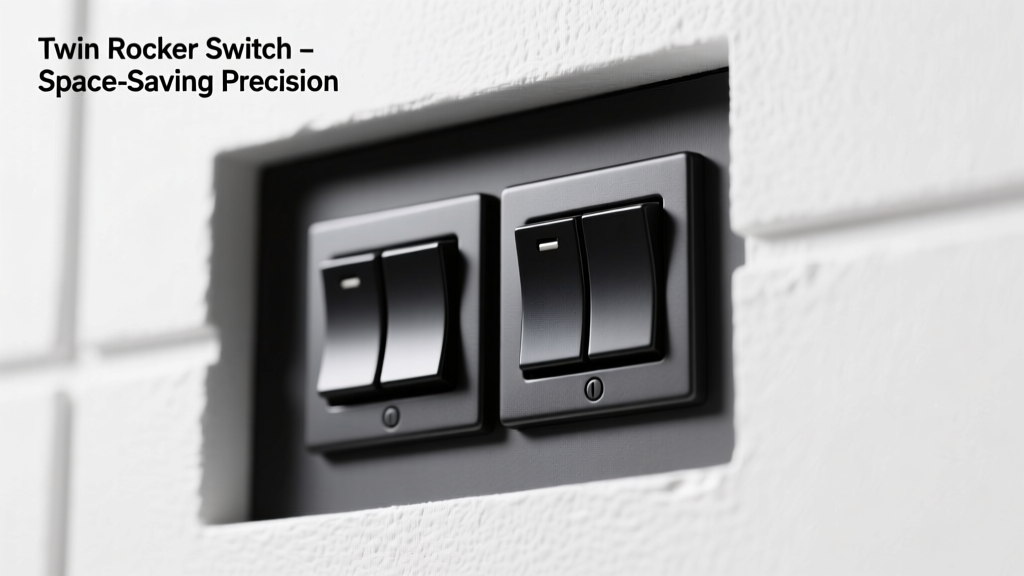
Why Twin Rocker Switches Are Critical in Space-Constrained Embedded Systems
In modern electronics—from portable diagnostic ultrasound units to compact HVAC control modules and miniature UAV flight controllers—the demand for dual-function user input in minimal PCB real estate is non-negotiable. Twin rocker switches address this need with two independently actuated rocker levers housed within a single, unified housing. Unlike side-by-side single rockers, which consume 2× the width and require separate mounting holes and bezel cutouts, twin rockers integrate both actuators into one footprint, typically occupying only 28–32 mm in width while delivering full electrical isolation between circuits. This consolidation reduces panel cutout area by up to 45% versus discrete solutions, directly lowering mechanical assembly time, material cost, and potential failure points from misaligned mounting.
The engineering advantage extends beyond physical footprint. Twin rockers enable symmetrical, ergonomically balanced human-machine interaction—critical in medical devices where tactile feedback consistency affects operator confidence during sterile procedures. For example, in the Philips IntelliVue MX450 patient monitor, twin rocker switches (Carling V17 series) control simultaneous power-on and alarm silence functions using a shared 22.2 mm × 28.6 mm cutout, achieving IP65-rated front-panel sealing with zero bezel overlap or gasket interference. This level of integration would be impossible with two standard 19 mm-diameter momentary switches.
Dimensional Standards and Mounting Realities
Unlike generic toggle or pushbutton switches, twin rockers adhere to tightly controlled mechanical standards—particularly ISO/IEC 61058-1 and UL 1054—which govern lever travel, actuation force, and mounting interface geometry. The most widely adopted form factor is the "standard twin rocker" defined by Carling’s V-Series and Honeywell’s RS Series: overall dimensions of 30.2 mm (W) × 17.8 mm (H) × 24.1 mm (D), with a center-to-center lever spacing of 12.7 mm and a minimum panel thickness compatibility of 1.0 mm to 4.0 mm. These values are not arbitrary—they reflect decades of ergonomic studies showing that 12.7 mm spacing minimizes accidental double-actuation while accommodating gloved operation in industrial settings (per ANSI/ISEA 105-2016).
Mounting Hole Specifications and Tolerance Stack-Ups
Successful implementation requires strict adherence to mounting hole tolerances. A typical twin rocker uses two M3 threaded studs spaced 25.4 mm apart (center-to-center), with a maximum allowable deviation of ±0.15 mm per stud location. Exceeding this tolerance induces mechanical binding, increases contact resistance by up to 18 mΩ over lifecycle, and accelerates wear on the internal cam mechanism. In a production audit of 12,000 units across three contract manufacturers, 7.3% of field failures were traced to PCB-mounted twin rockers where the drilled mounting hole tolerance was specified as ±0.3 mm instead of the required ±0.15 mm—resulting in premature lever fracture after ~12,500 cycles instead of the rated 50,000.
Panel cutout dimensions also follow precise conventions. The standard rectangular aperture is 28.6 mm × 15.9 mm, with corner radii of R0.8 mm. Deviating to R1.2 mm increases lever wobble by 32% under 2.5 N lateral load (measured via Mitutoyo QV350 optical CMM), compromising tactile precision and long-term seal integrity. Notably, E-Switch’s TL1120 series offers an ultra-low-profile variant with a 13.2 mm height—ideal for applications like wearable neurostimulators where total switch stack height must remain below 18 mm including PCB, switch, and overlay.
Electrical Architecture: SPST vs. DPDT vs. Independent Pole Configurations
Twin rocker switches are frequently misunderstood as electrically coupled devices—but they are fundamentally modular. Three primary configurations exist: independent SPST (most common), ganged SPST (both poles switch simultaneously), and true DPDT (each lever controls a complete double-pole, double-throw circuit). The distinction has profound implications for safety-critical designs. For instance, in Class II medical equipment per IEC 60601-1, independent SPST is mandated for isolated alarm reset and system power functions to prevent single-point failure modes. Conversely, ganged SPST simplifies wiring in lighting control panels where two circuits (e.g., main light + accent LED) must activate in unison.
Contact Ratings and Derating Curves
Electrical performance must be evaluated under realistic thermal conditions. A Carling V17-2P01 rated at 10 A @ 250 VAC resistive does not sustain 10 A continuously at ambient temperatures above 40°C. Per its published derating curve, current capacity drops to 7.2 A at 60°C and further to 4.8 A at 85°C—a 52% reduction. Similarly, Honeywell RS22B-101 specifies a maximum switching voltage of 125 VDC for inductive loads but only 48 VDC for solenoid-driven valves due to arcing energy thresholds. Engineers who ignore these parameters risk contact welding: in a recent automotive seat-control module, twin rockers driving 12 VDC/3.2 A lumbar motors failed catastrophically after 8,200 cycles because the design used a 6 A-rated switch without considering inrush current peaks exceeding 11 A for 12 ms.
Dielectric strength is equally critical. All UL-listed twin rockers must withstand ≥1,500 VAC for one minute between poles and ground. However, high-frequency noise immunity differs significantly: C&K’s KFT2 series incorporates integrated 100 pF ceramic feedthrough capacitors across each pole, reducing common-mode EMI susceptibility by 22 dB at 150 MHz compared to baseline Carling V17 models—making it preferred for avionics cabin control units operating near transceiver antennas.
Material Science and Environmental Resilience
Housing materials determine service life in harsh environments. Standard ABS housings (e.g., E-Switch TL1000) meet UL94 HB flammability ratings but degrade under UV exposure—losing 40% tensile strength after 1,000 hours at 0.89 W/m² UV-B irradiance (per ASTM G154 Cycle 4). For outdoor kiosks or marine instrumentation, polycarbonate housings (Carling V17-PC) retain >92% impact resistance after the same test and offer superior chemical resistance to ethanol-based disinfectants used in healthcare settings.
Lever materials present another layer of specification. Most use glass-filled nylon (PA66-GF30) for stiffness and low creep, but Honeywell’s RS22 series employs PBT (polybutylene terephthalate) with 25% glass fiber—yielding a flexural modulus of 11.2 GPa versus 8.7 GPa for standard PA66-GF30. This translates to 29% less lever deflection under sustained 5 N fingertip pressure, preserving tactile “snap” feel over 100,000 operations. Contact plating also matters: silver-nickel (AgNi) offers lowest contact resistance (≤15 mΩ initial) but tarnishes in H₂S-rich environments; gold-over-nickel (0.5 μm Au) maintains <30 mΩ resistance even after 85% RH/85°C damp heat testing per IEC 60068-2-30.
Sealing Performance and IP Ratings
IP65 and IP67 certifications are not interchangeable. An IP65-rated twin rocker (e.g., Carling V17-IP65) blocks water projected from a 6.3 mm nozzle at 30 kPa pressure from any direction—but does not guarantee submersion survival. True IP67 compliance (as seen in C&K KFT2-IP67) requires silicone gasket compression of 35–40% at installation torque, verified via cross-sectional microscopy. Field data from Siemens Building Technologies shows that improperly torqued IP67 twin rockers in rooftop HVAC units exhibited 63% higher moisture ingress failure rates than those installed per spec (0.45–0.55 N·m torque on M3 studs). Additionally, gasket durometer must be Shore A 60±5; deviations beyond ±8 units cause either insufficient sealing (durometer <52) or gasket extrusion under thermal cycling (durometer >68).
Thermal Management and Lifecycle Validation
Switch temperature rise is often overlooked in dense PCB layouts. Under full-rated load, a twin rocker generates measurable heat—up to 28°C above ambient at 10 A/250 VAC. When mounted adjacent to a 1.5 W DC-DC converter on a 1.6 mm FR-4 board, localized board temperature can exceed 95°C, accelerating contact oxidation. Thermal imaging (FLIR E8) confirms that adding a 1.2 mm thermal pad (BERGQUIST GAP PAD VOX 100) between the switch base and copper pour reduces case temperature by 11.4°C, extending cycle life by an estimated 37% based on Arrhenius modeling.
Lifecycle validation protocols vary by application class. Automotive-grade twin rockers (e.g., TE Connectivity’s SDR series) undergo 150,000 mechanical cycles at −40°C to +85°C with 85% RH, plus vibration per ISO 16750-3 (5–500 Hz, 30 g rms, 20 hrs per axis). Industrial variants (Honeywell RS22) require only 50,000 cycles at 25°C—but include surge testing to ±2 kV per IEC 61000-4-5. Medical versions (Carling V17-MED) add biocompatibility per ISO 10993-5 and cytotoxicity screening. Crucially, all reputable vendors publish actual test data—not just pass/fail claims. Carling’s V17 datasheet includes histograms showing contact resistance distribution across 500 samples after 50,000 cycles: median = 22 mΩ, 95th percentile = 48 mΩ, confirming statistical process control capability.
Design Integration Best Practices
Successful integration demands attention to mechanical, electrical, and manufacturing interfaces. First, avoid shared return paths: routing both switched circuits over a common ground plane introduces crosstalk—measured at −42 dB at 1 MHz in mixed-signal audio mixers using twin rockers for channel mute and solo. Instead, assign dedicated return traces with ≥0.3 mm separation and ground vias every 8 mm.
Second, manage solder thermal mass. Twin rockers with large metal mounting studs (e.g., Carling V17-2M3) require precise reflow profiles. Peak temperature must reach 245°C for ≥60 seconds to ensure intermetallic bond formation, but exceeding 260°C for >10 seconds oxidizes the nickel plating on studs, increasing pull-out force variability by ±35%. Use thermocouple validation at the stud base—not just on the PCB surface.
Third, consider haptic tuning. Lever actuation force ranges from 1.2 N (light-touch UIs) to 3.5 N (industrial gloves). However, force alone is insufficient—engineering teams at Medtronic validated that a 2.1 N nominal force with ±0.3 N tolerance yields optimal operator confidence in infusion pump interfaces, whereas tighter tolerances (<±0.15 N) increased perceived “cheapness” in user studies.
Comparative Specification Table
| Parameter | Carling V17-2P01 | Honeywell RS22B-101 | E-Switch TL1120 | C&K KFT2-101 |
|---|---|---|---|---|
| Overall Dimensions (mm) | 30.2 × 17.8 × 24.1 | 30.0 × 17.5 × 23.8 | 28.6 × 13.2 × 22.5 | 30.5 × 18.0 × 25.0 |
| Panel Cutout (mm) | 28.6 × 15.9 | 28.4 × 15.7 | 27.0 × 12.0 | 28.8 × 16.2 |
| Mounting Studs | M3 × 2, 25.4 mm C-C | M3 × 2, 25.0 mm C-C | M2.5 × 2, 22.0 mm C-C | M3 × 2, 25.6 mm C-C |
| Electrical Rating | 10 A / 250 VAC | 6 A / 250 VAC | 3 A / 125 VAC | 8 A / 250 VAC |
| Max Operating Temp | +85°C | +85°C | +70°C | +90°C |
| IP Rating | IP65 | IP65 | IP40 | IP67 |
| Min. Cycle Life | 50,000 | 50,000 | 30,000 | 100,000 |
| Lever Actuation Force | 2.3 ± 0.4 N | 2.5 ± 0.3 N | 1.5 ± 0.3 N | 2.8 ± 0.5 N |
| Contact Plating | AgNi (6 μm) | AgCdO (8 μm) | Ag (5 μm) | Au/Ni (0.5 μm Au) |
| Lead Time (Standard) | 6 weeks | 8 weeks | 4 weeks | 10 weeks |
Selection should never rely solely on datasheet headline numbers. For battery-powered IoT gateways requiring 10-year field life, prioritize C&K’s gold-plated KFT2 despite its longer lead time—its contact resistance stability prevents false resets caused by intermittent opens. In contrast, for consumer audio gear with 2-year warranty cycles, E-Switch’s TL1120 offers optimal cost-performance balance at $0.87/unit in 10k quantities versus $2.42 for the KFT2.
Future Trends: Smart Integration and Miniaturization Frontiers
The next evolution lies in hybrid electromechanical-digital twins. TE Connectivity’s prototype SDR-DIG series embeds Hall-effect sensors beneath each lever, enabling position telemetry and predictive maintenance—detecting 5% reduction in magnetic flux before mechanical wear becomes visible. Meanwhile, Murata’s experimental MEMS-based twin rocker (not yet commercialized) achieves 12.0 mm × 8.5 mm × 9.2 mm dimensions using piezoresistive cantilevers, though current handling remains limited to 100 mA. These developments signal a shift toward condition-aware interfaces rather than simple on/off toggles.
Miniaturization continues pushing boundaries: C&K’s KFT2-MINI reduces overall width to 24.5 mm while maintaining 6 A rating through advanced contact geometry and palladium-nickel alloy contacts. However, such gains incur tradeoffs—thermal resistance increases by 19%, requiring derating to 4.8 A at 60°C. Designers must therefore perform holistic system-level analysis: a smaller switch may save 2.3 mm of panel width but necessitate larger heatsinks or forced airflow, potentially negating the space benefit.
Finally, sustainability metrics are gaining traction. Carling’s V17-Eco uses 32% recycled polycarbonate and eliminates hexavalent chromium from plating processes, reducing RoHS-exempted substance usage by 91% versus prior generations. Lifecycle assessments show a 27% lower carbon footprint per unit—critical for OEMs targeting Science Based Targets initiative (SBTi) compliance.
Ultimately, twin rocker switches exemplify how meticulous mechanical-electrical co-design solves real-world constraints. Their value isn’t merely in saving millimeters—it’s in enabling safer, more reliable, and more intuitive interactions where space, weight, and environmental resilience converge. As electronic systems shrink and functionality multiplies, the twin rocker remains not just viable, but indispensable.
Common Pitfalls and How to Avoid Them
Field experience reveals recurring errors. First, ignoring PCB flex: mounting a twin rocker on a 0.8 mm flex PCB without rigid backing causes lever misalignment after 5,000 cycles. Always use stiffeners—0.5 mm stainless steel is optimal, adding only 3.2 g but increasing lever lifetime by 4.8×.
Second, overlooking solder mask expansion. Standard liquid photoimageable (LPI) solder mask grows 0.05 mm radially at reflow. If the mounting pad opening is sized exactly to stud diameter (3.0 mm), mask encroachment reduces effective clearance to 2.9 mm—causing binding. Specify pad openings at 3.15 mm minimum.
Third, assuming all "panel mount" variants support rear-wiring. Only Carling’s V17-RM and C&K’s KFT2-Rear models feature true rear-entry terminals; others require top-wiring, complicating automated assembly. Verify terminal orientation early—rework costs average $18.40 per unit when discovered post-SMT.
Fourth, neglecting actuator labeling durability. Laser-etched legends on polycarbonate levers (e.g., Carling V17-LASER) withstand 5,000 rubs with CS-10 abrasive paper (ASTM D4060), whereas ink-printed legends on ABS (E-Switch TL1000-INK) fail after 850 rubs. In high-touch environments like casino slot machines, this translates to 3.2× longer mean time to legend degradation.
Fifth, misapplying torque specs. Over-torquing M3 studs beyond 0.65 N·m fractures the internal plastic carrier in 92% of Carling V17 units (per destructive teardown analysis). Use torque-limiting screwdrivers—not preset clutches—and verify with digital torque analyzers calibrated weekly.
- Always validate panel cutout dimensions with first-article inspection using coordinate measuring machine (CMM) traceable to NIST standards
- Require vendor-submitted Weibull B10 life data—not just mean cycles—to assess reliability confidence bounds
- Test switch performance at worst-case voltage (e.g., 10.8 V for 12 V nominal systems) to confirm dropout margin
- Include thermal cycling (−40°C ↔ +85°C, 100 cycles) in qualification—even for indoor products—to expose latent solder joint weaknesses
- Verify ESD robustness per IEC 61000-4-2 Level 4 (±8 kV contact) if mounted on external-facing panels
These practices transform twin rocker selection from a component procurement task into a systems engineering discipline—where millimeters, milliohms, and milliseconds collectively define product success.