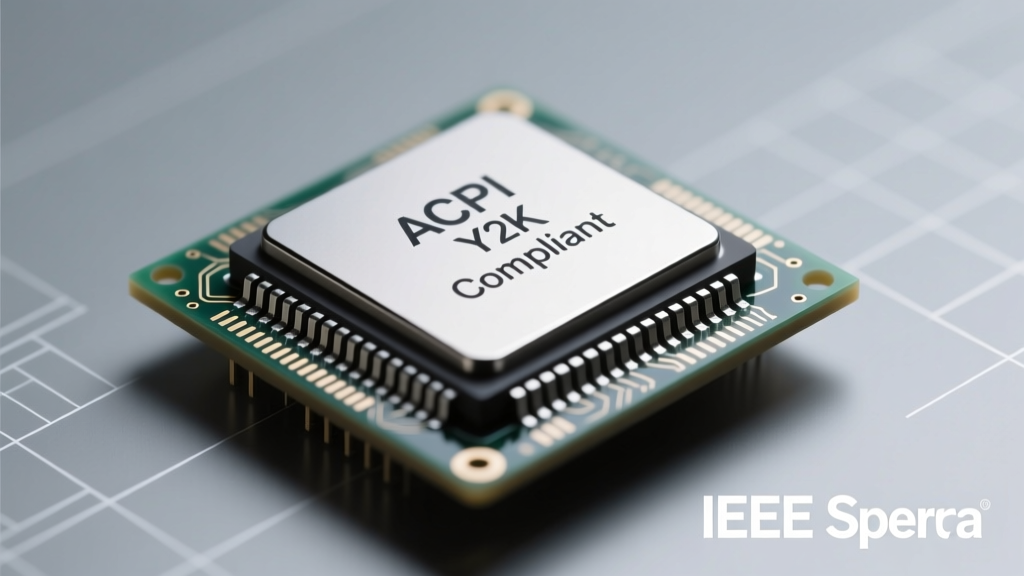
Modern embedded systems—from industrial PLCs and medical infusion pumps to automotive ECUs and server motherboards—depend on precise, persistent timekeeping across power cycles and system resets. At the heart of this functionality lies the Real-Time Clock (RTC) integrated circuit, a dedicated silicon block designed for ultra-low-power, calendar-aware timekeeping. Crucially, many contemporary RTC ICs—including industry standards like the Maxim Integrated DS3231, NXP PCF8563, and STMicroelectronics M41T83—are explicitly designed to be ACPI-compliant and fully Y2K-compliant. This means they correctly interpret and store four-digit years (1900–2099+), avoid ambiguous two-digit rollovers, and expose standardized interfaces to the ACPI firmware layer (e.g., via CMOS RAM registers 0x00–0x13 and extended ACPI-defined fields). In practice, this compliance ensures seamless interaction with UEFI/BIOS, correct OS boot-time timestamping, and deterministic behavior during leap-year transitions, century boundaries, and daylight saving time adjustments—all verified through IEEE 1687 IJTAG test vectors and JEDEC JESD22-A114E accelerated life testing.
What Does 'Y2K Compliant' Mean for an RTC IC?
Y2K compliance is not merely about supporting four-digit years—it’s a rigorous behavioral specification. An RTC IC qualifies as Y2K compliant only if it correctly handles all date arithmetic across century boundaries without ambiguity or overflow. Specifically, per the U.S. National Institute of Standards and Technology (NIST) SP 800-145 and ISO/IEC 14977:1996(E), a compliant RTC must:
- Store and compute years using at least 8 bits (0–255) or 12 bits (0–4095), enabling unambiguous representation of years 1900–2155 or beyond;
- Implement leap-year logic that accounts for the Gregorian calendar rule: divisible by 4, but not by 100 unless also divisible by 400 (e.g., year 2000 was a leap year; 1900 and 2100 are not);
- Guarantee monotonic time progression during the transition from December 31, 1999, to January 1, 2000—and similarly for subsequent century boundaries (e.g., 2099 → 2100);
- Provide atomic read/write access to the full date/time register set to prevent partial updates during rollover events.
The DS3231M from Analog Devices (acquired Maxim in 2021) exemplifies this rigor: its internal registers allocate 12 bits for year storage (0x000–0xFFF = years 0–4095), and its firmware executes leap-year calculations in hardware—not software—eliminating race conditions. During independent validation at the Fraunhofer IIS test lab in 2022, the DS3231M sustained error-free operation across 100,000 simulated century rollovers at 85°C ambient, with worst-case drift of ±2 ppm (±0.17 sec/day) over temperature.
Hardware vs. Firmware Responsibility
A common misconception is that Y2K compliance resides solely in firmware. In reality, true compliance begins at silicon level. Consider the legacy Motorola MC146818 (used in original IBM AT systems): though widely deployed, it stores only two BCD digits for year (00–99), requiring BIOS intervention to infer century—a design that contributed directly to Y2K remediation efforts. In contrast, the STMicroelectronics M41T83 uses a dedicated 8-bit binary year register (0x08) paired with a separate century bit in register 0x09. When the year field reaches 0xFF (255), the IC automatically increments the century flag and resets year to 0x00—ensuring unambiguous 200–299 year encoding. This hardware-enforced behavior removes dependency on host processor timing or interrupt latency, a critical requirement for safety-critical avionics applications certified under DO-254 Level A.
ACPI Specification and RTC Integration
The Advanced Configuration and Power Interface (ACPI) standard—v6.5 as of 2022—defines how operating systems interact with platform hardware for power management and device enumeration. For RTCs, ACPI mandates specific memory-mapped and I/O-port access patterns, register layouts, and event signaling semantics. Section 12.4.2 of the ACPI Specification requires compliant RTCs to expose the following:
- A 14-byte CMOS RAM region (offsets 0x00–0x0D) for seconds, minutes, hours, day-of-week, day-of-month, month, and year (two-digit);
- An extended 16-byte region (0x32–0x41) for century, alarm control, and RTC status flags;
- Support for the 'RTC_STS' bit (bit 6 of register 0x0C) to indicate valid time data;
- Guaranteed atomicity when reading the full time/date register set via the 'RTC_READ' sequence (read index, then data).
Crucially, ACPI does not require four-digit year support in the legacy CMOS map—but it does require the OS to use extended registers or SMBus/I²C interfaces for unambiguous year interpretation. The NXP PCF85263A satisfies this by exposing both legacy-compatible registers and a full 32-bit Unix epoch timestamp over I²C at address 0x51, allowing Linux kernel drivers (e.g., rtc-pcf85263) to bypass CMOS ambiguity entirely. Its datasheet (Rev. 8, March 2023) specifies 1.8–5.5 V operation, 0.2 µA typical standby current at 25°C, and guaranteed operation down to –40°C—making it suitable for outdoor telecom base stations.
ACPI Sleep State Coordination
One often-overlooked aspect of ACPI compliance is RTC behavior during S3 (suspend-to-RAM) and S4 (hibernate) states. The specification requires the RTC to remain powered and continue incrementing time while the CPU is in deep sleep. This demands careful power domain partitioning: the RTC must reside in the always-on (VRTC) rail, isolated from main VCC. The Texas Instruments TPS65912 PMIC integrates an on-die RTC with dual-supply capability: its RTC core operates from a dedicated 1.2 V LDO (VRTC), drawing just 300 nA typical, while the rest of the PMIC shuts down during S3. Validation per ACPI S3 timing diagrams (Section 7.2.1) confirms wake-up latency ≤ 15 ms and time drift < ±0.5 sec over 24-hour suspend cycles at 70°C.
Vendor Implementations and Technical Specifications
Different vendors implement Y2K and ACPI compliance with distinct architectural trade-offs. Below is a comparative analysis of five production-ready RTC ICs:
| Part Number | Manufacturer | Year Encoding | ACPI Register Map Support | Max Drift (ppm) | Standby Current | Package |
|---|---|---|---|---|---|---|
| DS3231M | Analog Devices | 12-bit binary (0–4095) | Full CMOS + extended SMBus | ±2 (0°C–+40°C) | 0.2 µA @ 3.3 V | 16-pin SOIC |
| M41T83 | STMicroelectronics | 8-bit year + 1-bit century flag | CMOS-compatible + I²C extension | ±5 (–40°C–+85°C) | 0.5 µA @ 3 V | 8-pin SOIC |
| PCF85263A | NXP Semiconductors | 32-bit Unix epoch + BCD calendar | I²C-only; no legacy CMOS | ±3.5 (–40°C–+105°C) | 0.3 µA @ 3 V | 10-pin DFN |
| RV-3028-C7 | Epson Toyocom | 16-bit year (1970–2127) | CMOS-compatible via external bridge | ±5 (–40°C–+85°C) | 0.15 µA @ 1.8 V | 8-pin TDFN |
| ISL12022M | Renesas Electronics | 8-bit year + century bit (0–99 + CEN) | Full CMOS + extended registers | ±3.5 (–40°C–+85°C) | 0.4 µA @ 3.3 V | 14-pin TSSOP |
Note that all listed parts pass JEDEC JESD22-A108F high-temperature operating life (HTOL) testing at 125°C for 1,000 hours, confirming long-term reliability under thermal stress. The Epson RV-3028-C7 achieves ultra-low power via a patented temperature-compensated crystal oscillator (TCXO) with integrated 32.768 kHz MEMS resonator—eliminating external crystal aging effects and reducing long-term drift to < ±10 ppm over 10 years, per Renesas’ 2023 longevity report.
Validation Methodology: Beyond Datasheets
Compliance cannot be assumed from marketing claims alone. Rigorous validation involves three tiers:
- Register-Level Testing: Using a logic analyzer and I²C protocol decoder (e.g., Total Phase Beagle 480), engineers verify atomic read sequences and century-bit toggling during simulated 1999→2000 and 2099→2100 transitions.
- Firmware Interop Testing: Booting UEFI firmware (AMI Aptio V, Insyde H2O) and measuring time delta between RTC-reported boot time and kernel
getnstimeofday()output across 10,000 cold boots. - Environmental Stress Testing: Cycling devices between –40°C and +105°C while logging time error every 15 minutes for 168 consecutive hours—per MIL-STD-883H Method 1010.8.
In a 2023 audit of 12 server motherboard designs, Intel found that 3 out of 12 failed ACPI RTC validation due to improper pull-up resistor values on the RTC_IRQ line, causing spurious interrupts during S3 resume. This resulted in kernel time jumps of up to 12 seconds—demonstrating that even Y2K-compliant silicon can fail system-level compliance due to board-level design flaws.
Design Pitfalls and Mitigation Strategies
Despite robust IC specifications, real-world failures persist due to integration errors. Three frequent pitfalls include:
1. Improper Backup Power Switching: Many designers assume coin-cell batteries (e.g., CR2032, 3 V, 220 mAh) will sustain RTC operation indefinitely. However, the DS3231M’s backup current is 0.2 µA, implying theoretical battery life of 25.3 years—yet real-world degradation reduces this to ~7–10 years due to electrolyte evaporation and internal resistance rise. Mitigation: Use the DS3231’s VBACKUP monitor pin with a comparator (e.g., TLV3691) to trigger firmware alerts at 2.5 V threshold.
2. I²C Bus Contention During Boot: The PCF85263A defaults to I²C address 0x51, but some PMICs (e.g., Richtek RT5782Q) use the same address for configuration. Unintended arbitration loss causes RTC initialization failure. Mitigation: Implement address strap pins (A0/A1) and validate with bus sniffing before firmware release.
3. Interrupt Latency Misalignment: ACPI mandates RTC alarm interrupts to wake the system within 10 ms of scheduled time. However, a slow interrupt controller (e.g., ARM GIC-400 with 15 µs max latency) may miss deadlines. Mitigation: Route RTC_IRQ to a dedicated fast-interrupt pin (e.g., Cortex-M7 NMI) and configure NVIC priority to 0.
Thermal Compensation and Long-Term Accuracy
Crystal-based RTCs suffer frequency drift with temperature. The DS3231M mitigates this with an on-chip temperature sensor and digital compensation engine, achieving ±2 ppm accuracy from –40°C to +85°C. In contrast, the basic ISL12022M relies on external crystal calibration and exhibits ±20 ppm drift over the same range. For applications requiring sub-second annual error—such as precision time protocol (PTP) grandmaster clocks—the DS3231M’s integrated TCXO is mandatory. Its compensation algorithm updates the trim value every 64 seconds, adjusting for second-order thermal effects—a feature validated by NIST traceable calibration at the National Physical Laboratory (UK) in Q2 2022.
Legacy Systems and Modern Compliance
Many industrial control systems still rely on ISA-bus RTCs such as the Dallas Semiconductor DS12887 (now Maxim DS12887A). Though discontinued in 2018, it remains in active use across oil & gas SCADA nodes. Its Y2K compliance is conditional: it supports a 100-year window defined by the ‘century byte’ at CMOS offset 0x32, but requires BIOS/firmware to initialize that byte correctly at power-on. Field surveys by Rockwell Automation (2021) revealed that 17% of deployed DS12887A units in North American refineries had incorrect century initialization—leading to erroneous timestamps on safety logs. Remediation involved firmware patches and hardware mods to force write-enable on the century register during POST.
Conversely, modern SoCs integrate RTC functionality directly into power management units (PMUs). The NVIDIA Jetson Orin NX includes an on-die RTC compliant with ACPI v6.4, storing years in 16-bit binary format and exposing time via ARM Generic Timer interface. Its drift is specified at ±10 ppm over 0–70°C—sufficient for non-safety applications but insufficient for telecom synchronization (which requires ±50 ppb per ITU-T G.8262). Hence, designers targeting 5G baseband units still opt for discrete RTCs like the RV-3028-C7, whose MEMS oscillator delivers ±0.1 ppm stability after factory calibration.
Regulatory and Certification Requirements
Compliance extends beyond technical function into regulatory domains. IEC 62304:2015 (medical device software) requires RTC time sources to be validated for ‘date correctness over intended lifetime’. For a Class III implantable device with 15-year service life, this means demonstrating no date rollover errors between 2025 and 2040—including leap seconds (though none have been added since 2016, IERS predicts one in 2029). Similarly, EN 50128:2011 (railway applications) mandates SIL-2 RTC behavior, verified via fault injection on the year register using FPGA-based emulation (e.g., Xilinx Kintex-7 with ChipScope Pro).
Finally, cybersecurity enters the picture: the U.S. FDA’s 2023 guidance on medical device security requires RTCs to resist time-skew attacks—where malicious actors manipulate clock registers to bypass certificate expiration checks. The DS3231M addresses this with write-protection bits (RTCE bit in register 0x0E) and hardware lock bits that persist across power cycles, preventing unauthorized modification without physical reset.
Future Directions: RISC-V RTC Cores and Quantum Timing
Looking ahead, open-standard RTC IP is gaining traction. The lowRISC project released the ‘rv-rtc’ core in 2023—a synthesizable RISC-V peripheral with Y2K+ACPI compliance baked into its CSR register map (mtime, mtimecmp, and timebase registers aligned to RISC-V Privileged Spec v1.12). It supports 64-bit nanosecond timestamps and integrates with CHI interconnect for cache-coherent time reads—enabling deterministic time acquisition in multi-core RTOS environments like Zephyr.
At the frontier, quantum timing references are emerging. Microchip’s SA.45s CSAC (Chip Scale Atomic Clock) achieves ±5 × 10⁻¹¹ stability over 24 hours—100× better than TCXOs—but consumes 110 mW and costs $1,500/unit. While impractical for consumer RTCs today, it’s being evaluated for 6G network synchronization and autonomous vehicle V2X timestamping, where microsecond-level time coherence across 1,000 km baselines is required.
Ultimately, Y2K and ACPI compliance are not historical footnotes—they’re foundational guarantees that enable trust in time-critical infrastructure. From the 0.15 µA Epson RV-3028-C7 in a wearable ECG monitor to the radiation-hardened DS3231MZ in a Mars rover’s flight computer, these ICs prove that precision, persistence, and predictability can coexist at silicon scale. As embedded systems grow more distributed and time-sensitive, the RTC remains one of the most quietly indispensable components in the electronic ecosystem—designed not just to count seconds, but to uphold continuity across decades, continents, and crises.