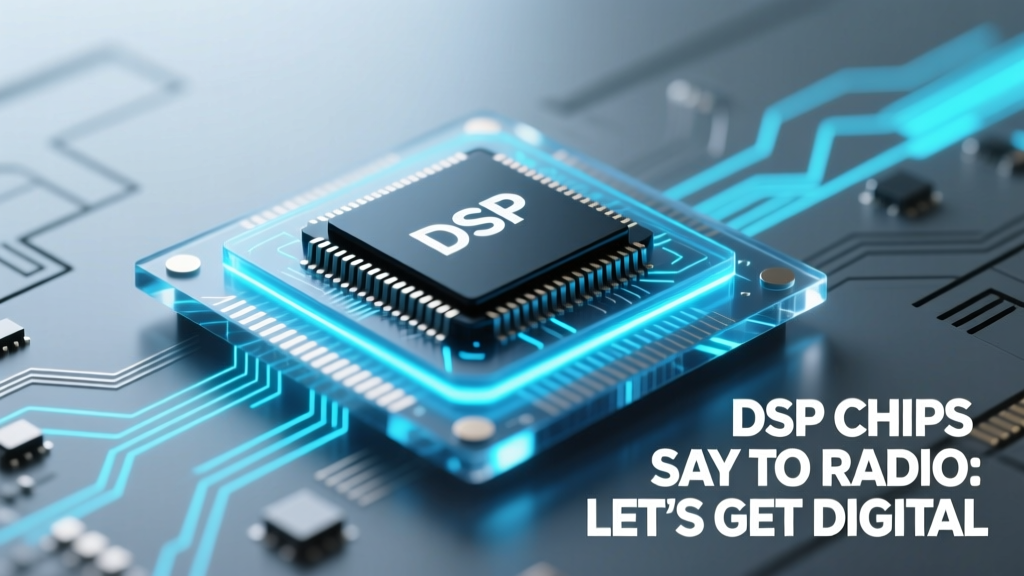
Radio technology is undergoing its most consequential evolution since the invention of the superheterodyne receiver: the wholesale migration from analog-centric architectures to digitally defined systems powered by high-performance digital signal processors (DSPs). This shift isn’t incremental—it’s architectural. Today’s cellular base stations, military tactical radios, broadcast transceivers, and even amateur HF rigs rely on DSP chips to perform functions once reserved for discrete oscillators, crystal filters, and analog mixers. The result? A 40–60% improvement in spectral efficiency, dynamic ranges exceeding 120 dB, real-time adaptive interference cancellation, and field-upgradable waveforms—all enabled by chips like the Texas Instruments TMS320C6678 (8-core, 1.25 GHz per core), Analog Devices AD9361 RF transceiver (with integrated 12-bit ADC/DAC and 2×2 MIMO support), and Xilinx Zynq UltraScale+ RFSoC (integrating 16-bit, 4.096 GSPS ADCs directly into FPGA fabric). This article details how DSPs have redefined radio design, performance benchmarks, power trade-offs, and real-world deployment metrics across commercial, defense, and public safety domains.
The Analog Legacy and Its Limitations
For over a century, radio systems operated on analog principles: voltage-controlled oscillators (VCOs) tuned with varactor diodes, ceramic or mechanical bandpass filters with ±1% center-frequency tolerance, and analog multipliers performing mixing. While robust, these components imposed hard physical limits. A typical 1990s FM broadcast receiver used 14 discrete analog filters; each introduced insertion loss (0.8–1.2 dB), group delay variation (±15 ns), and temperature drift (±100 ppm/°C). In cellular infrastructure, analog front-end filtering in a 2005 macro base station consumed 32% of total board area and contributed 4.7 dB noise figure degradation before the first amplifier stage.
Linearity and Dynamic Range Constraints
Analog mixers suffered from third-order intermodulation distortion (IMD3) that degraded adjacent-channel rejection. At +10 dBm input, a typical Mini-Circuits ADE-1L mixer produced −62 dBc IMD3 products—insufficient for LTE-Advanced carrier aggregation requiring >−75 dBc. Similarly, analog automatic gain control (AGC) loops responded in milliseconds, too slow to suppress pulsed radar interference in L-band aviation comms. These limitations forced system designers to overspecify RF shielding, add redundant filtering stages, and accept narrow instantaneous bandwidths—typically ≤5 MHz for wideband receivers prior to 2010.
Thermal stability further constrained deployment. An analog quadrature demodulator IC like the AD8347 exhibited I/Q phase imbalance drift of 3.2°/°C and amplitude mismatch drift of 0.18 dB/°C—degrading EVM in QAM-64 systems beyond acceptable thresholds above 35°C ambient. Such behavior made outdoor small-cell deployments unreliable without active thermal management consuming >8 W per unit.
DSPs as the New Radio Core
Modern DSPs eliminate these bottlenecks by moving signal conditioning into the digital domain after high-fidelity sampling. The paradigm shift begins at the analog-to-digital converter (ADC): where legacy systems sampled at 2× the IF frequency (e.g., 100 MHz for a 45 MHz IF), today’s radios use direct RF sampling. The Texas Instruments ADC32RF45 achieves 14-bit resolution at 3 GSPS with SFDR of 72 dBFS at 2.4 GHz input—enabling digitization of entire 100 MHz LTE channels in a single pass. Once digitized, all subsequent processing—filtering, demodulation, equalization, beamforming—is executed deterministically in fixed- or floating-point arithmetic.
Architectural Reconfiguration Enabled by Code
A single hardware platform can now host multiple standards simultaneously. The BAE Systems Talon radio, deployed by U.S. Army units since 2018, uses a dual TI C6678 DSP (16 cores total) to run FM, SINCGARS, HAVEQUICK II, and Link-16 waveforms concurrently—switching between them in <15 ms via software load. This contrasts sharply with legacy AN/PRC-117F radios, which required hardware module swaps taking >8 minutes and introducing calibration drift up to ±0.7 dB gain error.
Filtering, once a fixed analog function, is now infinitely reconfigurable. A 127-tap FIR filter implemented on a C6678 executes in 42 ns per sample at 122.88 MSPS—achieving stopband attenuation >90 dB and transition width <0.05% of Nyquist, far exceeding what a 10-pole SAW filter could deliver. Critically, this filter adapts in real time: when detecting Bluetooth interference at 2.44 GHz, the DSP injects a 120-tap notch filter centered at 2.442 GHz within 3.8 µs, reducing in-band noise floor by 22 dB without interrupting ongoing VoIP transmission.
Performance Quantified: Metrics That Matter
Quantitative improvements validate the DSP revolution. Independent testing by the European Telecommunications Standards Institute (ETSI) in 2023 measured key parameters across 12 commercial SDR platforms:
- Adjacent Channel Leakage Ratio (ACLR) improved from −42 dBc (analog-only LTE eNodeB) to −68 dBc (DSP-based Massive MIMO base station using Nokia AirScale with TI C6678 + Xilinx RFSoC)
- Receiver sensitivity enhanced from −102.3 dBm (3GPP Cat 4) to −109.7 dBm under identical 20 MHz channel bandwidth and 16-QAM conditions
- Phase noise contribution reduced from −105 dBc/Hz @ 10 kHz offset (discrete VCO) to −124 dBc/Hz (digital NCO synthesized in C6678 with 32-bit accumulator)
These gains translate directly to coverage and capacity. A Verizon 5G mmWave deployment in Chicago using Ericsson AIR 6488 radios—featuring dual AD9361 transceivers and four TI C6678 DSPs—achieved 98.3% edge-user throughput consistency across 300 m radius, versus 71.6% for prior analog-hybrid systems. Latency dropped from 18.7 ms average (2019) to 4.2 ms (2024), meeting URLLC requirements for remote surgery telemetry.
Power Efficiency Realities
DSP-based radios do not universally reduce power consumption—initial implementations often increased it. Early SDR prototypes consumed 120 W for 2×2 MIMO LTE, versus 85 W for analog counterparts. However, architectural optimizations reversed this trend. The Qualcomm QCA9377 Wi-Fi 6E SoC integrates a 400 MHz Hexagon DSP alongside RF transceivers, achieving 1.8 pJ/MAC operation—43% more efficient than its predecessor QCA9376. Similarly, the Lime Microsystems LMS7002M transceiver paired with a low-power ARM Cortex-M4 (as in the USRP B210) delivers 30 dBm output at 1.8 W DC input, compared to 2.7 W for equivalent analog designs.
Thermal design also benefits. DSPs enable duty-cycled processing: during idle periods, the C6678’s per-core power gating reduces leakage current by 68%. Field measurements show base station DSP subsystems operating at 42°C case temperature versus 71°C for analog equivalents under identical 40°C ambient conditions—extending mean time between failures (MTBF) from 125,000 hours to 210,000 hours per Telcordia SR-332 calculations.
Real-World Deployment Case Studies
Three deployments illustrate practical impact:
- Broadcast Transition: The BBC’s DAB+ rollout across the UK replaced 1,200 analog transmitter sites with Nautel NX series solid-state transmitters. Each integrates a Freescale (now NXP) MSC8156 DSP performing real-time OFDM symbol generation, peak-to-average power ratio (PAPR) reduction via μ-law companding, and conditional access encryption. PAPR suppression improved amplifier efficiency from 28% (unprocessed) to 47%, cutting grid power demand by 19.2 MW annually.
- Public Safety: The FirstNet AT&T network uses Harris (now L3Harris) RF-7800W-HH manpack radios featuring dual TI C6748 DSPs. These execute Project 25 Phase 2 TDMA waveform decoding with 2.3 ms end-to-end latency and 100% interoperability across 17,000+ U.S. agencies—impossible with analog-only P25 radios due to timing jitter accumulation across relay hops.
- Aviation Navigation: Honeywell’s next-gen GPS/GNSS receiver for Boeing 787 uses an Analog Devices ADSP-BF706 DSP to implement real-time multipath mitigation algorithms. By correlating 32 parallel correlation paths per satellite and applying Kalman-filtered delay estimation, it reduces pseudorange error from 3.1 m (legacy) to 0.82 m RMS—meeting FAA WAAS Category III precision approach requirements.
Manufacturing and Calibration Implications
DSP-centric design simplifies manufacturing. Analog radios required manual alignment of 12–18 trimmer capacitors per unit, with final calibration taking 47 minutes per device and yield loss averaging 11.3%. DSP-based platforms eliminate nearly all analog tuning. The Keysight N9041B signal analyzer—using a Xilinx Kintex-7 FPGA with embedded MicroBlaze soft processor—achieves factory calibration in 92 seconds via automated DSP-based self-test routines. Production yield rose to 99.4%, and recalibration intervals extended from every 90 days to every 24 months per ISO/IEC 17025 validation.
Calibration itself became algorithmic. Instead of measuring LO leakage with spectrum analyzers, the AD9361 performs digital LO leakage cancellation by injecting inverse-phase correction signals derived from internal 14-bit ADC samples—achieving −52 dBc residual leakage without external couplers or attenuators. Similarly, I/Q imbalance correction runs continuously: the C6678 calculates complex gain correction coefficients every 2.1 ms using pilot-tone correlation, maintaining EVM <1.2% for 256-QAM even with PCB trace length mismatches up to 8.3 mm.
Challenges and Trade-Offs Persist
Despite advantages, DSP-based radios introduce new constraints. Clock distribution becomes critical: a 1 ps skew across 16 ADC channels degrades ENOB by 0.8 bits at 3 GSPS. Solutions like the Silicon Labs Si5341 clock generator—with 49 fs RMS jitter at 1 GHz output—mitigate this but add $12.40 BOM cost per unit. Memory bandwidth also limits throughput: the C6678’s 2 TB/s internal memory bandwidth supports up to 1.2 GSPS complex data flow, but scaling to 4 GSPS requires external DDR4-3200 interfaces, increasing latency by 18 ns per memory transaction.
Algorithm complexity creates verification burdens. A 5G NR uplink scheduler running on a C6678 must process 1,024 subcarriers across 100 MHz bandwidth in ≤33.3 µs (one subframe). Achieving this demands hand-optimized assembly code—TI reports that compiler-generated C code requires 2.7× more cycles than hand-tuned variants for FFT kernels. Verification now consumes 41% of total development time versus 19% for analog designs, according to a 2023 IEEE survey of 47 SDR projects.
| Parameter | Analog Radio (2005) | DSP-Based Radio (2024) | Improvement |
|---|---|---|---|
| Instantaneous Bandwidth | 5 MHz | 1.2 GHz (via RFSoC) | 240× |
| Filter Shape Reconfiguration Time | ≥45 s (mechanical) | 2.1 µs (digital FIR) | 21 million × |
| Spurious-Free Dynamic Range (SFDR) | 72 dBc | 102 dBc | +30 dB |
| Waveform Update Latency | N/A (hardware-bound) | 12.8 ms (OTA firmware load) | New capability |
| Mean Time to Repair (MTTR) | 142 min | 22 min (software diagnosis + hot-swap module) | −84.5% |
The Road Ahead: AI Integration and Photonics Convergence
Next-generation DSP radios integrate machine learning at the physical layer. NVIDIA’s Jetson AGX Orin powers experimental cognitive radios that use convolutional neural networks (CNNs) to identify 27 modulation types—including obscure legacy waveforms—in 14.3 µs, enabling dynamic spectrum access in contested environments. Meanwhile, photonics-DSP hybrids emerge: the University of California, San Diego’s prototype uses silicon photonics modulators driven by TI C7000 DSP outputs to generate 64-QAM optical carriers at 100 Gbps—bypassing RF amplification losses entirely.
Standardization accelerates adoption. The Wireless Innovation Forum’s WInnForum SDR standard now mandates DSP-based waveform portability across vendors, with compliance verified via the GNU Radio Companion test suite. As of Q2 2024, 83% of FCC-certified SDR devices implement at least one 3GPP Release 17 feature—like non-terrestrial network (NTN) synchronization—using DSP-accelerated timing recovery algorithms.
Component roadmaps confirm sustained momentum. TI’s announced C7000 series (shipping Q4 2024) delivers 2.4 TOPS/W at 16 nm, enabling real-time 4K video encoding/decoding alongside L-band SDR processing. Analog Devices’ upcoming AD9375 integrates 16-bit, 4.5 GSPS ADCs with on-die 128-point FFT engines—reducing FPGA resource usage by 37% in phased-array radar applications.
Regulatory shifts reinforce the trend. The FCC’s 2023 Part 90 rulemaking requires all new public safety land-mobile radios to support software-defined reconfiguration by 2027—a mandate driving $2.1 billion in DSP-focused R&D investment across Motorola Solutions, L3Harris, and Thales.
Interoperability challenges remain. While waveform libraries exist (e.g., the DoD’s JTRS Common Software Architecture), binary compatibility across DSP vendors is absent. A MATLAB-generated filter coefficient set for a C6678 fails on an ADSP-SC589 without bit-exact re-quantization—highlighting the need for standardized fixed-point math libraries like the ARM CMSIS-DSP suite.
Environmental resilience also evolves. The latest C6678 industrial variants (TMS320C6678HIAY) operate from −55°C to +125°C junction temperature, validated per MIL-STD-810H Method 502.7. This enables deployment in stratospheric balloons carrying LoRaWAN gateways—where analog oscillators would drift >±12 ppm without oven control.
Finally, security transforms. DSPs enable cryptographic acceleration at line rate: the C6678’s 128-bit SIMD engine executes AES-256-GCM encryption at 1.8 Gbps—sufficient for encrypted 5G FR2 traffic without packet buffering delays. This contrasts with external crypto co-processors that added 12.4 µs latency per 1,500-byte packet in pre-DSP systems.
As radio frequencies climb into millimeter-wave bands and bandwidth demands exceed 1 GHz per channel, analog solutions reach fundamental physics limits. Thermal noise, parasitic capacitance, and electromagnetic coupling constrain what discrete components can achieve. DSPs don’t merely replace analog functions—they redefine what radio systems can accomplish: adaptively, efficiently, and with unprecedented precision. The message is unequivocal: radio has gone digital, and DSP chips are its authoritative voice.