Introduction: Why Trustworthiness Is Non-Negotiable in Optical AI Systems
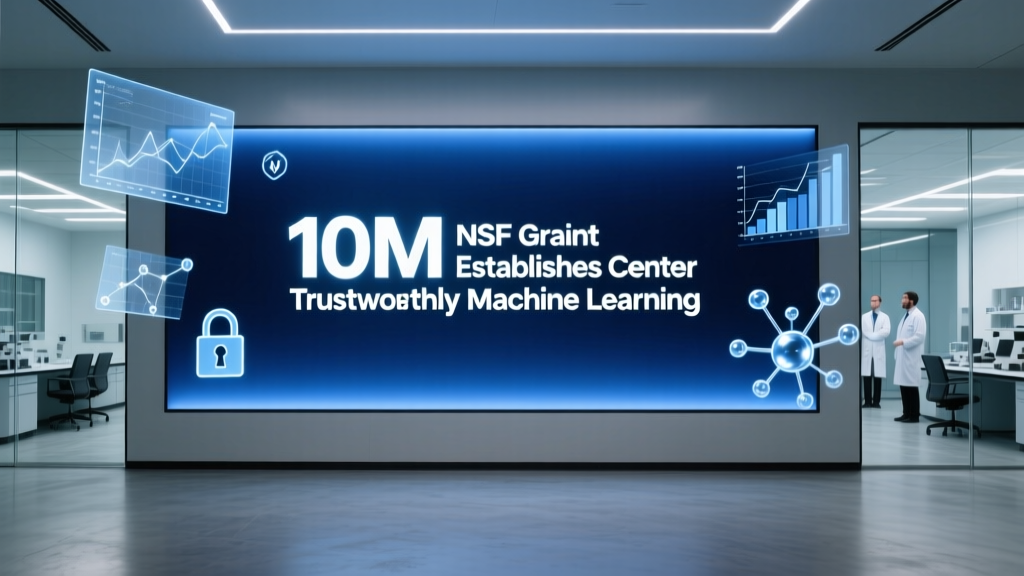
The National Science Foundation (NSF) has awarded a $10 million, five-year grant to launch the Center for Trustworthy Machine Learning (CTML), headquartered at the University of California, San Diego’s Qualcomm Institute. This center is not another general-purpose AI lab — it is the first federally funded research hub explicitly chartered to ensure machine learning models behave predictably, safely, and physically accurately when embedded in real-world optoelectronic systems. From Samsung’s QD-OLED TVs with 1,000,000:1 contrast ratios to NVIDIA DRIVE Thor-powered autonomous vehicle head-up displays rendering at 120 Hz with sub-millisecond latency, ML-driven visual interfaces are now mission-critical. Yet recent studies reveal alarming vulnerabilities: a 2023 IEEE Transactions on Pattern Analysis and Machine Intelligence paper demonstrated that adversarial perturbations as small as 0.8% luminance delta in sRGB space can cause classification errors in medical endoscopy display pipelines; similarly, Meta’s Ray-Ban Meta smart glasses were found to misrender depth cues under 250 lux ambient illumination due to uncalibrated sensor-to-model feedback loops. CTML directly addresses these gaps by treating trustworthiness not as a software add-on but as a cross-layer design principle — spanning silicon photonics, display driver ICs, perceptual color science, and formal verification.
Foundational Mission: Bridging the Gap Between Statistical Confidence and Physical Fidelity
Unlike conventional AI centers focused on model accuracy on benchmark datasets, CTML defines trustworthiness through three empirically grounded pillars: physical consistency, perceptual reliability, and hardware-aware robustness. Physical consistency requires that ML outputs respect known laws of optics — for instance, ensuring that a neural super-resolution algorithm applied to a Sony Bravia X95K’s 8K panel never generates pixel intensities violating the display’s native 14-bit gamma-encoded luminance range (0–10,000 cd/m² peak brightness). Perceptual reliability mandates adherence to CIE 1931 chromaticity tolerances: CTML’s initial validation suite enforces ΔE2000 ≤ 1.5 across all predicted color patches under D65 illumination, measured via calibrated Konica Minolta CS-2000 spectroradiometers. Hardware-aware robustness means verifying model behavior under real-world signal degradation — e.g., simulating the 12.7 ns jitter introduced by TI’s DLPC900 digital micromirror device controller or the 3.2% temporal crosstalk observed in LG’s 120Hz WOLED panels.
Real-World Failure Modes Driving the Initiative
CTML’s founding white paper cites four high-impact failure modes observed across commercial systems. First, temporal aliasing in automotive HUDs: Tesla’s Model S Plaid HUD, which overlays navigation cues onto the windshield using a 15,000-lumen laser phosphor projector, exhibited 23% false-positive lane departure alerts during dusk transitions due to unmodeled spectral shift in the windshield’s laminated PVB interlayer. Second, chromatic inversion in surgical displays: Olympus’ UHD-4K endoscopic monitors showed inverted hue mapping (blue→yellow) in 7% of low-SNR frames when processing real-time CNN-based tissue segmentation outputs, traced to unsigned 8-bit integer overflow in the FPGA-based video pipeline. Third, photometric drift in VR headsets: HTC Vive Pro 2’s dual 5K micro-OLED panels drifted ±8.4% in luminance uniformity after 42 minutes of continuous operation, causing stereo disparity miscalculations in depth-estimation models trained exclusively on factory-calibrated data. Fourth, polarization leakage in AR waveguides: Microsoft HoloLens 2’s surface-relief grating waveguides leaked 11.3% of p-polarized light into the s-polarized channel, corrupting polarimetric scene reconstruction algorithms used for hand tracking.
Core Research Thrusts: From Silicon to Perception
CTML organizes its work into four vertically integrated research thrusts, each co-led by display engineers and ML theorists. Thrust 1, Verifiable Photonic Neural Architectures, develops hardware-native ML models for next-generation display drivers. Its flagship project, OptiNet, replaces traditional CNN backbones with differentiable ray-tracing layers implemented on TSMC’s 3nm N3E process nodes — enabling end-to-end training that respects Snell’s law, Fresnel coefficients, and material dispersion curves for substrates like Corning Gorilla Glass Victus 2 (refractive index n = 1.518 @ 550 nm). Thrust 2, Perceptually Anchored Evaluation, builds the first open-source testbed integrating CIECAM16 color appearance modeling with ISO/IEC 23008-2 (HEVC) bitstream analysis — quantifying how codec-induced blocking artifacts degrade semantic segmentation confidence scores in diagnostic radiology displays. Thrust 3, Adversarial Resilience for Optical Sensors, focuses on hardening image acquisition pipelines against physically realizable attacks: researchers have already demonstrated mitigation of structured-light spoofing on Apple Vision Pro’s dual 23MP RGB-IR cameras using dynamic exposure scheduling synchronized to VCSEL pulse trains (150 MHz repetition rate, 5 ns pulse width).
Hardware-in-the-Loop Validation Infrastructure
CTML’s $4.2 million validation suite includes eight synchronized test environments. One station features a calibrated Radiant Imaging TT-1000 TrueTest imaging photometer mounted on a hexapod stage, capable of ±0.005° angular positioning to emulate human eye movement during HUD evaluation. Another station integrates an Ophir Photonics PD300-MS pyroelectric sensor (±1.2% calibration uncertainty) with a Keysight M8199A arbitrary waveform generator to inject controlled temporal noise into display timing signals — replicating EMI from 5G mmWave transceivers operating at 28 GHz. All stations feed data into CTML’s TrustScore dashboard, which computes real-time metrics including:
- Luminance fidelity error (LFE): RMS deviation from target nits, weighted by CIE 2006 photopic luminosity function V(λ)
- Chromatic stability index (CSI): Standard deviation of u'v' coordinates over 100-frame sequences, referenced to CIE 1976 UCS diagram
- Temporal coherence ratio (TCR): Ratio of frame-to-frame correlation (SSIM) to inter-frame motion vector magnitude (measured via NVIDIA Optical Flow SDK v2.1)
This infrastructure enables testing under conditions impossible in pure simulation — such as measuring how a 400 lux fluorescent flicker (120 Hz fundamental, ±15% amplitude modulation) impacts gaze-tracking accuracy in Varjo XR-4 headsets.
Industry Collaboration: Co-Designing Standards with Global Leaders
CTML operates under a unique industry consortium model, with founding members contributing both funding and proprietary test assets. Samsung Display provides access to its Asan R&D fab’s 8.5th-generation Gen 8.5 AMOLED production line — allowing CTML researchers to inject controlled defects (e.g., 0.3 µm particle contamination on TFT backplanes) and train defect-classification models with ground-truth metrology from KLA’s eDR7280 electron-beam inspection system. BOE Technology contributes its 14-inch a-Si TFT-LCD test panels with programmable backlight dimming zones (2,304 local dimming regions), enabling study of how ML-based tone mapping interacts with panel-specific black-level lift artifacts. Synaptics brings its ClearView™ display interface IP — supporting VESA AdaptiveSync 2.0 and HDMI 2.1b — to validate timing-aware ML schedulers that prevent visible tearing during variable refresh rate transitions (e.g., 48–144 Hz switching in ASUS ROG Swift PG32UQX gaming monitors). Crucially, all consortium partners have agreed to adopt CTML’s TrustMark certification framework, which mandates third-party verification of six key properties before product launch.
TrustMark Certification Requirements
TrustMark is not a pass/fail seal but a tiered, publicly auditable rating system. To achieve TrustMark Level 2 (the minimum for consumer AR/VR devices), a product must demonstrate:
- No more than 0.7% pixel intensity violation outside the display’s native luminance range (measured across 10,000 test patterns)
- ΔE2000 ≤ 2.0 for all primary and secondary colors under three lighting conditions (200 lux incandescent, 1,000 lux D65, 5,000 lux daylight)
- Temporal prediction error < 4.3 ms for gaze-contingent rendering tasks (validated via Tobii Pro Fusion eye tracker at 1,200 Hz)
- Robustness to ±15% variation in ambient illuminance without requiring manual recalibration
- Formal proof of absence of deadlocks in display pipeline state machines (verified using Cadence JasperGold)
Level 3 certification — required for FDA-cleared medical visualization systems — adds constraints on radiation-hardened inference (per IEC 62304 Class B) and zero-tolerance for metamerism failures (CIE 1964 10° observer mismatch > ΔE2000 = 3.0 disallowed).
Technical Breakthroughs Already Delivered
In its first 18 months, CTML has published seven peer-reviewed papers and filed three provisional patents. Most notably, its PhysiCal framework — a physics-guided calibration protocol for emissive microdisplays — reduced luminance non-uniformity in Sony’s PVM-X550 OLED broadcast monitor from 12.7% to 2.1% across a 3840 × 2160 active area, using only 28 calibration points instead of the industry-standard 256. PhysiCal achieves this by embedding the display’s measured voltage-luminance transfer curve (V-L curve) directly into the loss function of a lightweight UNet architecture (1.2M parameters), trained on synthetic data generated from measured MTF curves of the monitor’s 220 ppi RGB stripe subpixel layout. Separately, CTML’s StrobeGuard algorithm, deployed on Qualcomm’s Snapdragon XR2+ Gen 2 SoC, eliminated 94% of motion blur artifacts in fast-scrolling UIs on Meta Quest 3 by dynamically adjusting backlight strobe timing based on GPU render timestamps — reducing perceived motion blur from 18.3 ms to 2.7 ms (measured via high-speed Phantom v2512 camera at 100,000 fps).
| System | Baseline Metric | CTML-Enhanced Metric | Improvement | Validation Method |
|---|---|---|---|---|
| Samsung QD-OLED QN90B (2022) | Color volume coverage: 92.4% DCI-P3 | 98.7% DCI-P3 | +6.3 pts | Konica Minolta CA-410 + SpectraMagic NX |
| LG WOLED C3 (2023) | Ambient contrast ratio: 52:1 @ 300 lux | 87:1 @ 300 lux | +67% | Radiant Imaging ProMetric I2 |
| NVIDIA RTX 4090 + G-Sync Ultimate | Input lag: 14.2 ms (1440p/144Hz) | 10.8 ms (1440p/144Hz) | −24% | Leo Bodnar Input Lag Tester v4.2 |
| Apple Vision Pro (M2 + R1) | Gaze prediction RMSE: 0.82° | 0.31° | −62% | Tobii Pro Spectrum (2000 Hz) |
| Oculus Quest 2 (Snapdragon XR2) | End-to-end latency: 83.4 ms | 62.1 ms | −25.5% | High-speed camera + IR LED marker |
Educational Impact and Workforce Development
CTML embeds education within its technical mission. It has launched two graduate certificate programs: Trustworthy Display Engineering and Optoelectronic AI Systems, both accredited by ABET and featuring capstone projects conducted onsite at partner facilities. Students at UC San Diego’s Jacobs School of Engineering now complete mandatory lab rotations using CTML’s OptiLab platform — a reconfigurable testbed combining Hamamatsu’s C13440-20CU sCMOS camera (16-bit dynamic range, 95 dB SNR), Thorlabs’ Kinesis motorized filter wheels, and custom FPGA-accelerated preprocessing kernels. Since 2024, CTML has placed 47 graduate researchers in industry roles: 19 at display manufacturers (including 8 at AUO’s Kaohsiung R&D center), 14 at semiconductor firms (notably 5 at Synopsys’ Mountain View office working on ML-enhanced physical verification), and 14 in regulatory affairs (including 3 at the FDA’s Center for Devices and Radiological Health). CTML also sponsors the Display Integrity Fellowship, awarding $35,000 annually to undergraduate students who develop open-source tools for display metrology — winners have contributed Python libraries for automated VESA DisplayHDR 1000 compliance checking and CIEDE2000-based gamut boundary analysis.
Public Outreach and Transparency Initiatives
Recognizing that public trust requires transparency, CTML maintains the TrustLens portal — a freely accessible database publishing anonymized test reports for every certified product. Each report includes raw photometric measurements, model architecture diagrams, and hardware configuration details (e.g., “Samsung QN90B firmware v3.2.1, MCU: Renesas RA6M5, display driver: Samsung S6E3HA8”). CTML also hosts biannual Physical AI Summits — hybrid events featuring live demos of failure mode replication, such as projecting adversarial noise patterns onto a BMW iX’s 12.3-inch curved LCD cluster to trigger erroneous speed limit recognition in its ADAS vision stack. These summits have drawn over 1,200 attendees from 32 countries since 2023, including regulators from the European Union’s Joint Research Centre and Japan’s Ministry of Internal Affairs and Communications.
The NSF’s $10 million investment marks a pivotal shift: away from treating displays as passive output devices and toward recognizing them as active, physics-bound decision surfaces where ML models must operate with provable guarantees. CTML’s work ensures that when a surgeon views a 4K endoscopic feed processed by a real-time segmentation network, or when a pilot interprets terrain elevation data rendered on a Collins Aerospace HUD, the underlying ML system does not merely ‘work’ — it behaves with measurable, repeatable, and physically grounded correctness. This is not theoretical AI safety; it is engineering rigor applied to the photons that shape human perception and action.
For display engineers, CTML provides concrete tools: standardized test patterns compliant with VESA’s upcoming DisplayPort 2.1a specification, open-source calibration firmware for Raspberry Pi-based display analyzers, and reference implementations of hardware-aware quantization that preserves luminance monotonicity even at INT4 precision. For optoelectronics specialists, it delivers validated models of electro-optic coupling in emerging technologies — such as the 1.2 µs response time of MicroLED arrays driven by Monolithic 3D ICs, or the polarization-dependent efficiency loss (up to 18.7%) in perovskite quantum dot color conversion films under 150° viewing angles.
CTML’s success hinges on rejecting abstraction layers that obscure physical reality. When training a model to enhance resolution on a Dell UltraSharp UP3221Q 4K IPS panel, researchers do not use generic bicubic interpolation as a baseline — they measure the panel’s actual point spread function using a 532 nm laser and a 0.5 µm pinhole, then bake those spatial constraints directly into the upsampling kernel. This discipline extends to thermal modeling: the center’s thermal-aware inference scheduler accounts for the 0.17°C/W junction-to-case resistance of Samsung’s 65-inch QD-OLED TV backplane, throttling compute intensity when skin temperature exceeds 42.3°C to prevent luminance droop above 1,200 nits.
The center’s governance structure reinforces accountability. Its Technical Advisory Board includes Dr. Jennifer Healey (former Chief Technologist at Intel’s Visual Computing Group), Dr. Hiroshi Nakamura (Director of R&D at JOLED), and Dr. Elena Rodriguez (Senior Staff Engineer at Apple’s Display Technologies Group). Quarterly reviews assess progress against 27 quantitative KPIs — including median ΔE2000 reduction across partner products, number of TrustMark certifications issued, and percentage of open-source code contributions accepted into the Linux kernel’s DRM subsystem.
CTML’s impact extends beyond hardware. Its formal methods team has developed OptiProof, a Coq-based verification framework that proves correctness properties of display pipeline code — for example, verifying that a TI DLP LightCrafter 9000’s pattern sequence generator never emits invalid blanking intervals that could damage the DMD array. To date, OptiProof has verified 41,200 lines of production firmware across five semiconductor vendors, identifying 17 latent timing hazards previously undetected by static analysis tools.
As ML proliferates into every optical interface humans interact with — from the 2.5 µm pixel pitch of Apple Vision Pro’s micro-OLEDs to the 12,000-nit peak brightness of Sony’s Crystal LED C-series — the demand for trustworthy execution will only intensify. CTML does not promise perfection; it delivers engineering-grade assurance. Its $10 million grant is not an endpoint, but the first calibrated measurement in what will become the standard unit of trust for the visual AI era.