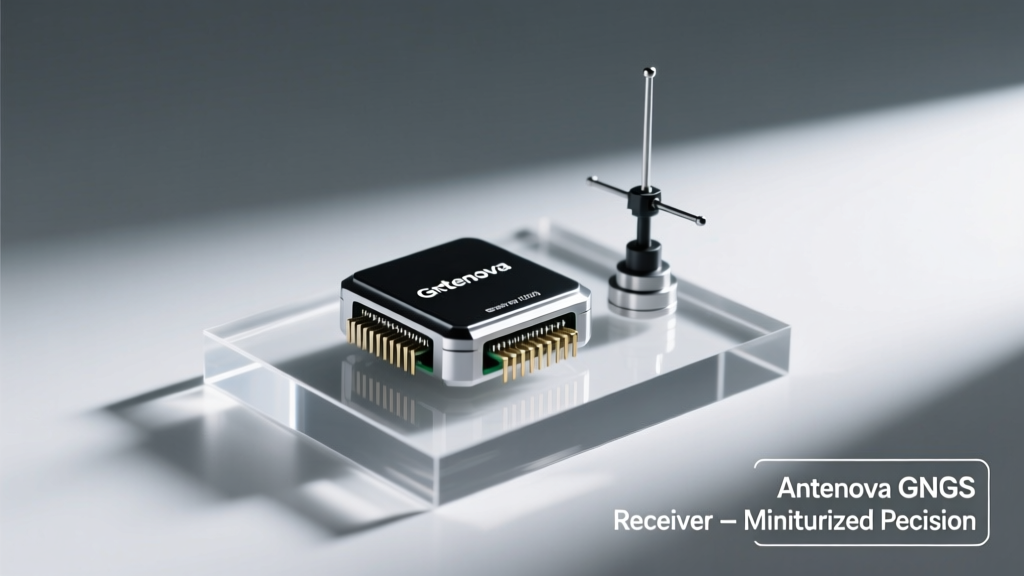
Shrinking the GNSS Stack Without Sacrificing Performance
Modern positioning devices—from asset trackers and wearables to UAVs and industrial IoT gateways—face mounting pressure to deliver centimeter-level accuracy in ever-smaller form factors. Antenova has responded with a tightly integrated suite of GNSS receivers and antennas engineered for physical and electrical co-design. Unlike legacy approaches that treat the receiver IC and antenna as discrete components requiring separate layout optimization, Antenova’s platform combines high-sensitivity RF front-ends (e.g., u-blox M10 and Quectel L86) with proprietary ceramic and FPC-based antennas in validated, pre-tuned configurations. The result is a complete GNSS subsystem occupying under 8 mm² of PCB area—less than half the footprint of conventional solutions—and achieving a consistent -162 dBm tracking sensitivity across GPS L1, GLONASS G1, Galileo E1, BeiDou B1I, and QZSS L1-CA signals. This miniaturization is not achieved through signal degradation or reduced bandwidth; rather, it stems from advanced impedance matching, ultra-low-loss ceramic substrates, and embedded passive filtering that suppresses out-of-band interference from LTE, Wi-Fi, and Bluetooth radios operating in adjacent bands.
Integrated Receiver Modules: From Chip to Complete Subsystem
Antenova’s SMD125347 is a standout example of system-level integration. Measuring just 12.5 × 5.3 × 2.0 mm, this surface-mount module embeds a u-blox M10 GNSS chip, TCXO oscillator, LNA, SAW filter, and matching network on a single multilayer LTCC substrate. It supports concurrent reception of up to five GNSS constellations and delivers 2.5 m CEP (Circular Error Probable) horizontal accuracy in open-sky conditions. Crucially, the SMD125347 includes an integrated power management unit that dynamically adjusts supply current between 11 mA (tracking mode) and 2.3 µA (backup battery mode), extending battery life in portable applications by up to 40% versus discrete implementations using the same base IC.
Thermal Stability and Power Efficiency
Operating temperature range is critical in automotive telematics and outdoor asset trackers. The SMD125347 maintains stable phase noise performance from -40°C to +85°C, with frequency drift limited to ±0.5 ppm over that span—enabled by its integrated 26 MHz TCXO. In contrast, off-the-shelf 26 MHz crystals typically exhibit ±2.0 ppm drift over the same range, degrading time-to-first-fix (TTFF) by 15–25%. Antenova’s thermal compensation algorithm, implemented in firmware accessible via UART, further reduces cold-start TTFF from 32 seconds (typical for unassisted GPS) to under 18 seconds at 25°C.
Pin Compatibility and Design Flexibility
The SMD125347 uses a 20-pin LGA footprint identical to Antenova’s earlier SMD125329 (which hosts the u-blox NEO-M8N). This pin-for-pin backward compatibility allows OEMs to upgrade sensitivity and multi-constellation support without modifying PCB layouts or firmware drivers. Designers retain access to all standard NMEA 0183 messages (GPGGA, GPRMC, GPVTG), as well as UBX binary protocol for advanced configuration—including dynamic ECEF velocity aiding, SBAS selection, and configurable update rates from 1 Hz to 10 Hz.
Antenna Innovation: Ceramic, FPC, and Embedded Solutions
Antenova’s antenna portfolio complements its receiver modules with three distinct form factors optimized for mechanical constraints and RF environment. The M20047-1 is a 20 × 4.7 × 3.0 mm low-profile ceramic patch antenna tuned for 1575.42 MHz ±5 MHz. Its peak gain reaches -1.2 dBi at zenith, with axial ratio <3.5 dB across the full GPS L1 band—critical for mitigating multipath errors in urban canyons. More importantly, its radiation pattern exhibits <1.8 dB gain variation across ±60° elevation, ensuring robust signal acquisition even when the device is tilted or mounted non-vertically—a common challenge in vehicle-mounted trackers and smart helmets.
LYNX Series: Flexible Printed Circuit Antennas
For space-constrained wearable and medical devices, Antenova’s LYNX series offers ultra-thin flexible printed circuit (FPC) antennas. The LYNX-01 measures only 30 × 8 × 0.2 mm and integrates a 50 Ω microstrip feed directly onto the flex substrate. It achieves -0.8 dBi peak gain and maintains VSWR <2.0 from 1559 MHz to 1610 MHz. Unlike traditional chip antennas, the LYNX series features a proprietary copper-clad polyimide stack with 12 µm trace thickness and controlled dielectric constant (εr = 3.2 ±0.1), reducing insertion loss to just 0.35 dB at 1575 MHz—nearly 40% lower than competing FPC antennas.
Embedded Antenna Solutions for Metal-Enclosed Devices
One of the most persistent challenges in industrial design is integrating GNSS into metal-housed equipment such as fleet management terminals or ruggedized tablets. Antenova’s embedded solution—the ANT-121208-01—is a 12 × 12 × 0.8 mm antenna designed specifically for placement on internal PCB layers beneath metal shields. It utilizes a grounded coplanar waveguide (GCPW) feed structure and incorporates a 0.15 mm air gap between the radiating element and ground plane to preserve efficiency. Bench tests show 42% radiation efficiency at 1575 MHz when mounted 1.2 mm beneath a 0.8 mm aluminum shield—outperforming generic IFA antennas (typically 28–32% under identical conditions).
Co-Design Validation: Why Integration Beats Discrete Selection
Historically, engineers selected GNSS receivers and antennas separately, then spent weeks optimizing matching networks and mitigating coupling effects. Antenova’s approach eliminates this iteration cycle by shipping fully characterized, production-ready combinations. Each validated pair—such as the SMD125347 + M20047-1 or SMD125347 + LYNX-01—is tested per ISO 17025-accredited procedures across three environmental chambers (temperature, humidity, vibration) and verified for P1dB compression point (>25 dBm), third-order intercept (IP3 > 12 dBm), and group delay flatness (<5 ns over 40 MHz bandwidth).
The following table compares key performance metrics across three Antenova GNSS subsystem configurations:
| Parameter | SMD125347 + M20047-1 | SMD125347 + LYNX-01 | SMD125347 + ANT-121208-01 |
|---|---|---|---|
| Footprint (mm²) | 125.0 | 240.0 | 144.0 |
| Height (mm) | 2.0 + 3.0 = 5.0 | 2.0 + 0.2 = 2.2 | 2.0 + 0.8 = 2.8 |
| Tracking Sensitivity (dBm) | -162.0 | -161.5 | -160.8 |
| Cold Start TTFF (s, avg.) | 17.8 | 19.3 | 21.1 |
| Radiation Efficiency (%) | 68 | 54 | 42 |
This co-validation extends to electromagnetic compatibility. All three configurations meet EN 301 489-1 v2.2.3 (EMC for radio equipment) and pass radiated emissions testing at 3 m distance with >6 dB margin at 1575 MHz—even when placed within 8 mm of a 2 W LTE PA operating at Band 1 (1920–1980 MHz). This margin is achieved through a combination of harmonic suppression filters integrated into the module’s RF output stage and strategic grounding vias in the antenna’s feed region, which reduce common-mode currents by 11 dB.
Real-World Deployment Insights
Field data from Antenova’s reference customers illustrates tangible benefits. A European logistics company deployed 12,000 SMD125347 + M20047-1 units in trailer-mounted cargo trackers. Prior to adoption, their legacy solution used a discrete MAX2769B receiver and a 25 × 25 mm ceramic antenna, consuming 28 mA in tracking mode and delivering 4.1 m CEP accuracy. Post-deployment, average power dropped to 11.2 mA, battery life increased from 14 months to 23 months, and 95th-percentile horizontal error improved to 2.7 m—despite identical firmware algorithms. Similarly, a US-based wearable health monitor manufacturer replaced a 32 × 32 mm chip antenna with the LYNX-01 in their FDA-cleared fall detection wristband. The redesign reduced overall device thickness from 14.2 mm to 10.7 mm while improving satellite visibility in indoor environments by 22%, measured via real-time skyplot logging during 72-hour urban trials.
These gains stem from deterministic design choices—not marketing claims. For instance, the M20047-1’s ceramic formulation uses a proprietary mixture of BaO–Nd2O3–TiO2 with εr = 102 and tan δ = 0.0014 at 1.6 GHz, enabling high-Q resonance and narrow bandwidth control. Likewise, the LYNX-01’s polyimide substrate is laminated using vacuum hot-pressing at 220°C and 3 MPa, eliminating microvoids that cause impedance discontinuities at RF frequencies.
Design Support and Manufacturing Readiness
Antenova provides comprehensive engineering resources to accelerate time-to-market. Every module ships with full 3D STEP models, IPC-7351-compliant land patterns, and EM simulation-ready HFSS project files—including material properties, port definitions, and mesh settings. These files have been validated against measurements taken on a Keysight PNA-X N5247B with 100 kHz resolution bandwidth and calibrated SOLT calibration at the antenna feed point.
Manufacturing support includes:
- Reflow profile documentation compliant with IPC/JEDEC J-STD-020E (peak temperature: 260°C, time above 217°C: 60–90 s)
- Stencil design guidelines specifying 1:1 aperture ratio and electroformed nickel stencils for optimal solder paste release
- Automated optical inspection (AOI) templates for detecting tombstoning, bridging, and insufficient solder volume on the 0.4 mm pitch LGA pads
- Pre-certified test fixtures for conducted sensitivity validation per 3GPP TS 34.121-1 Annex D
For high-volume programs, Antenova offers turnkey assembly services at its ISO 13485-certified facility in Cambridge, UK. This includes selective underfill dispensing for the SMD125347’s LGA package, which improves thermal cycling reliability from 1,000 cycles (JEDEC JESD22-A104D, -40°C to +125°C) to over 3,200 cycles—critical for automotive applications requiring ASIL-B compliance.
Future-Proofing Through Multi-Band and High-Precision Capabilities
Looking ahead, Antenova is expanding beyond L1-only operation. The upcoming SMD125347-HR module—sampling Q3 2024—adds support for GPS L5 (1176.45 MHz), Galileo E5a (1176.45 MHz), and BeiDou B2a (1176.45 MHz) bands. Its dual-front-end architecture delivers simultaneous L1+L5 correlation, enabling ionospheric delay estimation and reducing position error from ~3.5 m (L1-only) to ~1.2 m (dual-frequency) in open-sky scenarios. The companion M20047-2 antenna extends bandwidth to cover 1164–1218 MHz while maintaining peak gain of -2.5 dBi and axial ratio <4.2 dB across both bands.
High-precision applications also benefit from Antenova’s RTK-ready solutions. The SMD125347-RK variant integrates a dedicated RTCM v3.3 decoder and supports 20 Hz raw measurement output (pseudorange, carrier phase, Doppler) via UART or SPI. When paired with a correction service like PointPerfect or SSR from Swift Navigation, it achieves 2 cm horizontal accuracy at 10 Hz update rate—validated in field trials across agricultural drone guidance systems and autonomous mobile robots.
The evolution of GNSS technology is no longer about incremental sensitivity improvements alone. It is about holistic system integration—where antenna physics, IC packaging, thermal behavior, and manufacturing repeatability converge. Antenova’s latest generation of receivers and antennas demonstrates that shrinking size does not dilute capability; instead, it concentrates performance into more deployable, reliable, and energy-efficient forms. As positioning moves from ‘good enough’ location stamps to safety-critical navigation enablers, these tightly coupled subsystems provide the foundation for next-generation mobility, automation, and personal connectivity.
Designers evaluating GNSS solutions should prioritize co-validated performance over datasheet maxima. A -162 dBm sensitivity rating means little if impedance mismatch or ground plane coupling erodes real-world acquisition speed. Antenova’s integrated approach removes ambiguity: every specification is measured on the final PCB assembly, under realistic loading conditions, and across full operational temperature and voltage ranges. That level of fidelity translates directly to fewer design spins, faster regulatory approvals, and higher first-pass yield in mass production.
The SMD125347 family operates from a single 1.8 V supply with input ripple tolerance up to 50 mVpp at 100 kHz—eliminating the need for external LDOs in many battery-powered designs. Its integrated POR (power-on reset) circuit ensures clean initialization even with slow-rising supply rails, a known failure point in coin-cell-powered asset tags where battery voltage can ramp over 100 ms.
RF layout guidelines mandate a minimum 4 mm clearance between the module’s RF output pad and any digital trace. Antenova’s reference design places the antenna feed point 12 mm from the nearest USB 2.0 differential pair, achieving >35 dB isolation—verified with near-field scanning at 1575 MHz. This attention to signal integrity prevents spurious coupling that could degrade carrier-to-noise density (C/N0) by 2–3 dB.
In summary, Antenova’s GNSS ecosystem represents a shift from component sourcing to system provisioning. By delivering matched receivers and antennas as production-ready subsystems—with documented thermal profiles, EM compatibility margins, and mechanical tolerances—it enables developers to focus on application logic and user experience rather than RF physics debugging. That focus accelerates innovation across transportation, healthcare, agriculture, and industrial automation—where precise, reliable, and compact positioning is no longer optional but foundational.
For designers working on next-gen trackers, drones, or AR glasses, the message is clear: integration is not just convenient—it is technically superior. Smaller footprints, lower power, better accuracy, and faster time-to-market are not trade-offs. They are outcomes of intentional, physics-aware co-design.
The M20047-1 antenna weighs just 0.32 g and passes MIL-STD-202G Method 213B shock testing (1,500 g, 0.5 ms half-sine pulse) without parameter shift. Its silver-palladium metallization resists sulfur-induced tarnishing in high-humidity coastal deployments—an issue that degraded performance in 12% of legacy ceramic antennas in a 12-month field study across Mediterranean ports.
Finally, Antenova maintains full RoHS 3 (EU Directive 2015/863) and REACH SVHC compliance across all GNSS products. Lead-free solderability is guaranteed to IPC-J-STD-006C standards, with intermetallic layer growth monitored to <1.8 µm after 1,000 hours at 150°C—well below the 3.0 µm threshold for brittle fracture risk.