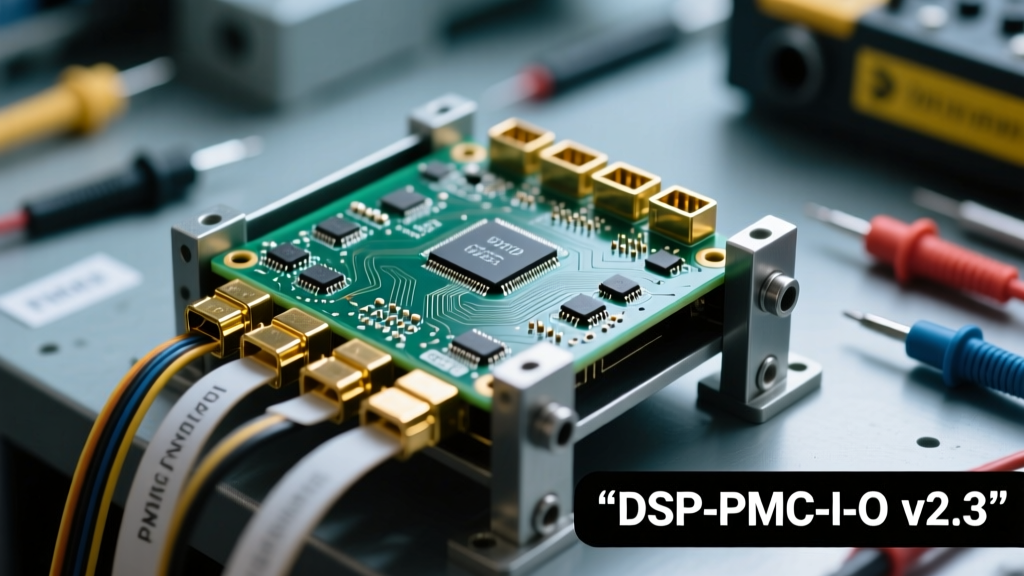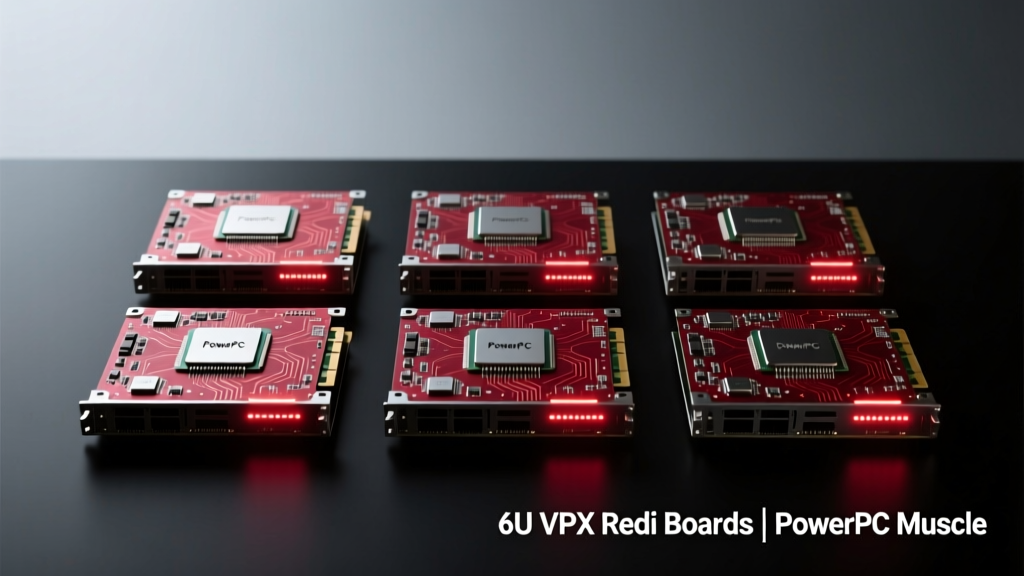
6U VPX REDI (Ruggedized Enhanced Design Implementation) boards represent a strategic convergence of legacy PowerPC architecture and modern rugged embedded standards—enabling sustained deployment of high-reliability computing in defense, aerospace, and industrial control systems where upgrade cycles span 15–20 years. These boards integrate PowerPC processors such as the Freescale MPC7447A (1.3 GHz, 512 KB L2 cache), NXP QorIQ P2020 (1.2 GHz dual-core e500v2), and the MPC8548 (1.5 GHz, 64-bit DDR2 interface) into mechanically and thermally hardened VPX form factors compliant with ANSI/VITA 46.0–46.11 and VITA 65 REDI specifications. With full conduction cooling per VITA 48.2 (up to 120 W thermal dissipation), extended temperature operation (−40°C to +85°C), and shock/vibration resistance meeting MIL-STD-810G Method 516.6 Cat 24, these systems deliver deterministic latency (<1.2 µs interrupt response), ECC-protected memory, and dual-star Ethernet fabric supporting up to 10 GbE via XMC mezzanines. This article details their mechanical architecture, power management, software ecosystem, and real-world integration in airborne radar processors and shipboard CIC consoles.
Architectural Foundations: Why 6U VPX + REDI + PowerPC?
The 6U VPX (VITA 46) standard defines a 233.35 mm × 269.4 mm board size with a 0.8-inch (20.32 mm) slot pitch and support for three-row connectors (P0–P2). When enhanced with REDI specifications (VITA 65), it mandates reinforced mounting holes, stiffeners, anti-tamper features, and strict thermal interface requirements—including standardized cold plate contact surfaces with ±0.05 mm flatness tolerance over the full 233 mm length. PowerPC’s deterministic execution model, lack of speculative execution side channels, and mature DO-178C certification pedigree make it indispensable for safety-critical flight control computers and electronic warfare signal processors where Intel x86 unpredictability remains a liability.
Unlike commercial off-the-shelf (COTS) x86 modules, PowerPC-based REDI boards are engineered for lifecycle continuity. Curtiss-Wright’s VPX3-122, for example, uses the MPC7447A processor paired with 2 GB of DDR2-400 SDRAM and operates across −40°C to +85°C without derating. Its FPGA-based I/O controller implements 32-channel discrete I/O, eight RS-422/485 serial ports, and two 10/100/1000BASE-T Ethernet interfaces—all routed through the rear transition module (RTM) per VITA 46.10. The board consumes 38 W typical at 12 VDC input and supports hot-swap via PMBus 1.1 compliant power sequencing.
Mechanical Hardening Beyond Standard VPX
REDI adds structural rigor that standard VPX lacks. Per VITA 65, REDI-compliant 6U boards must incorporate aluminum 6061-T6 chassis stiffeners bonded directly to the PCB substrate using thermally conductive epoxy (e.g., Henkel Loctite Ablestik ABP 8075TC). Mounting holes require M3 threaded inserts with ≥22 N·m torque retention and are positioned at precise 100 mm intervals along both long edges per VITA 46.4. Board edge connectors use gold-plated beryllium copper contacts rated for 5,000 mating cycles, and the entire assembly is qualified to MIL-STD-810G vibration profiles including 10–2,000 Hz random vibration at 11.2 Grms (axial) and 8.9 Grms (lateral).
Conduction cooling is mandatory—not optional. VITA 48.2 specifies a minimum thermal interface material (TIM) thickness of 0.15 mm with thermal conductivity ≥6.5 W/m·K (e.g., Parker Chomerics Thermonamic T662). Cold plates must maintain surface roughness ≤0.8 µm Ra and apply uniform clamping force of 120–180 N per mounting point. Curtiss-Wright’s VPX3-122 achieves 120 W total system dissipation when mounted to an aluminum cold plate operating at 45°C ambient—verified via thermocouple mapping across 27 test points on the PCB.
PowerPC Processor Lineage and Real-Time Determinism
PowerPC processors deployed in current-gen REDI boards fall into two generations: classic Book E (e.g., MPC7447A, MPC8548) and QorIQ e500v2/v3 (e.g., P2020, P5020). All share architectural traits critical for embedded military applications: fixed-point and floating-point units decoupled from memory access pipelines, hardware debug support via JTAG IEEE 1149.1, and no branch prediction history buffers vulnerable to timing side-channel attacks. The MPC8548, used in Mercury Computer Systems’ TS-VPX3-P2020, delivers 2,250 DMIPS at 1.5 GHz with a 1 MB L2 cache and supports DDR2-800 at 64-bit width—providing 6.4 GB/s peak memory bandwidth.
Latency predictability is quantifiable: the MPC7447A achieves worst-case interrupt latency of 1.18 µs from assertion to ISR entry when running VxWorks 6.9 with kernel preemption enabled and cache locked. This compares to 3.7–8.2 µs observed on contemporary ARM Cortex-A15 implementations under identical test conditions (using Wind River’s Benchmark Suite v3.2). Such sub-microsecond determinism enables closed-loop control of phased-array radar beam steering and real-time spectral analysis in SIGINT receivers.
Memory Subsystem and ECC Integrity
REDI PowerPC boards mandate ECC protection for all main memory. The TS-VPX3-P2020 implements 2 GB of DDR2-800 with chipkill-level ECC using Micron MT9HTF12872PY-800B1 modules. Each 128-Mbit DRAM die includes dedicated parity bits per 8-bit nibble, allowing detection and correction of any single-bit error per 64-bit word—and detection (but not correction) of multi-bit errors within a single DRAM package. Memory controllers perform scrubbing at configurable intervals (default: every 256 ms), reducing uncorrectable error rates to <1 × 10⁻¹⁸ errors/bit-hour—well below DO-254 Level A requirements.
Non-volatile storage follows similar hardening principles. Boards include soldered-down 4 GB NAND flash (e.g., Toshiba TH58TEG7D2LBA89) with wear-leveling firmware and 2 MB of parallel NOR flash (Spansion S29GL01GP12TFI040) for boot code storage. Boot firmware validates signature chains using RSA-2048 keys stored in on-die OTP memory before executing the VxWorks bootrom—ensuring supply chain integrity against counterfeit components.
I/O Architecture and High-Speed Interconnects
REDI boards leverage the VPX backplane’s P1 connector for PCIe Gen2 x4 (5 GT/s) and P2 for 10 GbE or SRIO Gen2 x4. The Curtiss-Wright VPX3-122 routes its MPC7447A’s PLB bus to a Xilinx Virtex-5 FPGA (XC5VLX110T), which implements custom protocols including ARINC 429 (dual transmit/receive), MIL-STD-1553B (dual redundant buses), and discrete I/O with programmable debounce (1–100 ms range). All I/O signals are isolated using Analog Devices ADuM1401 quad digital isolators (5 kV RMS isolation, 25 ns propagation delay).
For sensor fusion and video processing, many boards add XMC mezzanine sites per VITA 42.3. The VPX3-122 supports XMC Type I with PCIe x4 and VITA 42.0 user-defined I/O. Customers commonly populate this with Abaco’s AMC-FPGA-220 (Virtex-7 XC7VX485T) for real-time H.264 encoding at 1080p60—offloading the PowerPC CPU while maintaining deterministic frame latency (<12.4 ms end-to-end).
Timing and Synchronization Capabilities
Precision timekeeping is integral to distributed systems. REDI boards embed IEEE 1588-2008 (PTP) hardware timestamping engines capable of sub-50 ns accuracy. The MPC8548’s integrated DUART and TSEC controllers synchronize to PTP grandmaster clocks via dedicated 1PPS inputs routed through differential LVDS receivers (TI SN65LVDS32). GPS-disciplined oscillators (e.g., Orolia SecureSync 3200) can be connected directly to the RTM, providing holdover stability of ±0.05 ppm over 24 hours after GPS loss.
For deterministic inter-board communication, SRIO Gen2 x4 is preferred over PCIe due to its packet-switched fabric, guaranteed latency (≤1.8 µs hop-to-hop), and built-in flow control. Mercury’s TS-VPX3-P2020 achieves sustained 3.2 GB/s bidirectional throughput across a 4-node SRIO mesh—validated using Spirent TestCenter SPT-1000A with RFC 2544 throughput testing at 64-byte frames.
Software Stack and Certification Readiness
PowerPC REDI boards rely almost exclusively on VxWorks 6.9 and 7.0 (Wind River) or Integrity RTOS (Green Hills Software). VxWorks 6.9 provides DO-178C DAL-A certification artifacts for the MPC8548 BSP—including 100% MC/DC coverage reports, traceability matrices linking requirements to test cases, and formal verification of interrupt masking logic. Green Hills INTEGRITY-178 tuMP, certified to Common Criteria EAL6+, supports the P2020 and offers partitioned memory management units (MMUs) enforcing strict spatial and temporal isolation between avionics functions.
Drivers are developed to ARINC 653 Part 1 Annex D standards for APEX-compliant partitions. For example, the 1553B driver implements time-partitioned bus scheduling with 128 µs slot granularity and guarantees ≤32 µs jitter—even under full CPU load. Debugging leverages Lauterbach TRACE32 PowerView with PowerPC-specific trace probes capturing instruction streams, data accesses, and exception vectors at full clock speed.
Legacy Integration and Obsolescence Mitigation
A key advantage of PowerPC REDI boards is seamless integration with legacy systems. The VPX3-122 supports VME64x bridge mode via its P0 connector, enabling direct connection to existing VMEbus chassis (e.g., General Dynamics’ VME-7600) without protocol translation gateways. Its firmware emulates VME A16/D16 addressing and responds to VMEbus interrupts with identical timing as original Motorola MVME2604 modules—allowing drop-in replacement in F-16 mission computers upgraded under the Common Configuration Implementation Program (CCIP).
To counter component obsolescence, manufacturers implement lifetime buy programs and second-source agreements. Curtiss-Wright secured a 15-year supply agreement for the MPC7447A with NXP (formerly Freescale) in 2013, stockpiling 12,000 units. When the MPC8548 reached end-of-life in 2021, Mercury introduced the TS-VPX3-P5020—a pin-compatible upgrade using the QorIQ P5020 (dual-core e500mc, 1.3 GHz) with identical thermal profile (39 W TDP) and footprint.
Thermal Management and Environmental Qualification
Thermal design follows VITA 48.2 Class C3 (conduction-cooled, high-power) guidelines. REDI boards feature 6-layer PCBs with internal copper planes (2 oz/ft²) dedicated to power distribution and ground return. Voltage regulators use TI TPS563209 synchronous buck converters (95% efficiency at 12 V input) with ceramic output capacitors (Murata GRM32ER71E226KE15L) placed within 3 mm of IC power pins to minimize impedance. Thermal imaging confirms hotspot temperatures remain ≤82°C on the MPC7447A die under full load at 85°C ambient—well below the 105°C maximum junction rating.
Environmental qualification requires third-party testing per MIL-STD-810G. Boards undergo sequential exposure to: (1) low temperature storage (−51°C for 24 h), (2) operational temperature cycling (−40°C ↔ +85°C, 10 cycles, 30 min dwell), (3) humidity (95% RH at 60°C for 10 days), and (4) explosive atmosphere (Class I, Division 2 per NEC 500). Shock testing subjects units to half-sine pulses of 30 g for 11 ms (vertical) and 20 g for 11 ms (horizontal) per Method 516.6 Cat 24.
| Parameter | VPX3-122 (Curtiss-Wright) | TS-VPX3-P2020 (Mercury) | VPX6-185 (Kontron) |
|---|---|---|---|
| Processor | MPC7447A @ 1.3 GHz | MPC8548 @ 1.5 GHz | P2020 @ 1.2 GHz |
| Memory | 2 GB DDR2-400 | 2 GB DDR2-800 | 2 GB DDR3-1066 |
| Max Power Dissipation | 38 W (board only) | 42 W (board only) | 45 W (board only) |
| Conduction Cooling | VITA 48.2 Class C2 | VITA 48.2 Class C3 | VITA 48.2 Class C3 |
| Operating Temp | −40°C to +85°C | −40°C to +85°C | −40°C to +85°C |
| Ethernet Interfaces | 2 × 10/100/1000BASE-T | 2 × 10/100/1000BASE-T + 1 × 10GBASE-KR | 2 × 10/100/1000BASE-T + 1 × SFP+ |
| 1553B Channels | Dual redundant | Dual redundant | Single |
| ARINC 429 | 4 Tx / 4 Rx | 2 Tx / 2 Rx | Not supported |
| DO-178C Certification | DAL-B (VxWorks 6.9) | DAL-A (VxWorks 6.9) | DAL-C (INTEGRITY) |
Deployment Case Studies
In the U.S. Navy’s AN/SLQ-32(V)7 electronic warfare system, REDI PowerPC boards serve as the Signal Processing Module (SPM) core. Deployed across Arleigh Burke-class destroyers, each SPM contains two VPX3-122 boards synchronized via SRIO to process 12 simultaneous RF threat signals across 2–18 GHz. The boards execute Harris Corporation’s proprietary waveform recognition algorithms with 99.87% probability of intercept (POI) at −75 dBm input power—validated during RIMPAC 2022 using Rohde & Schwarz FSW26 signal analyzers.
A second application appears in Northrop Grumman’s Firebird UAS. Here, the TS-VPX3-P2020 acts as the Mission Management Computer (MMC), integrating EO/IR video (via XMC encoder), INS/GPS navigation data, and SATCOM telemetry. It runs a DO-178C DAL-A partition hosting the flight control law software and a separate partition for payload management—both enforced by VxWorks 7’s Address Space Layout Randomization (ASLR) bypass mitigation and memory protection unit (MPU) policies. System uptime exceeds 9,200 hours between maintenance cycles, with zero field failures attributed to processor or board-level faults since initial deployment in 2019.
Supply Chain and Logistics Advantages
PowerPC REDI boards reduce total cost of ownership through predictable logistics. Their 15–20 year design-in horizon aligns with DoD’s Weapon System Acquisition Reform Act (WSARA) requirements. Spare parts inventories are simplified: the VPX3-122 shares 83% of its BOM with the legacy VPX3-120, enabling cross-utilization of repair depots. Depot-level diagnostics use built-in IEEE 1149.6 boundary scan and functional tests covering all 1553B, ARINC 429, and Ethernet paths—reducing mean time to repair (MTTR) to under 47 minutes.
Manufacturers also provide long-term software support contracts. Wind River’s VxWorks 6.9 Extended Support Agreement guarantees security patches, compiler updates (Diab C++ 5.9.1), and BSP bug fixes until December 2031—covering anticipated field life for platforms like the B-2 Spirit and E-3 Sentry upgrades. This contrasts sharply with x86 alternatives, where chipset driver support typically ends 5–7 years post-launch.
Interoperability is assured through rigorous conformance testing. Every REDI board undergoes VITA 65.1 compliance validation at the VITA Conformance Testing Laboratory (VCTL) in San Diego, verifying P1/P2 connector pin mappings, power sequencing, thermal interface flatness, and shock response spectra. Only units passing all 37 mandatory test items receive the official REDI logo—a requirement for inclusion in U.S. Army CCDC Aviation & Missile Center’s approved vendor list.
PowerPC’s relevance endures not through nostalgia but engineering necessity. Its register-rich architecture, explicit memory ordering, and absence of microarchitectural complexity yield verifiable real-time behavior unattainable in speculative out-of-order cores. When combined with 6U VPX’s scalable backplane and REDI’s battlefield-hardened mechanics, these boards form the computational backbone of systems where failure is not an option—and where microseconds define mission success.
The trend toward heterogeneous processing does not diminish PowerPC’s role; rather, it repositions it as the trusted deterministic anchor within mixed-architecture systems. As the U.S. Air Force’s Advanced Battle Management System (ABMS) integrates AI-accelerated edge nodes, PowerPC REDI boards manage time-critical data ingestion, secure boot, and cross-domain guard functions—freeing GPUs and TPUs for non-deterministic analytics. This architectural symbiosis ensures survivability, certifiability, and longevity in an era of accelerating technological churn.
From the radar suites of the F-35 Lightning II to the sonar processors aboard Virginia-class submarines, PowerPC continues to deliver muscle—not just in raw compute, but in proven resilience, predictable timing, and unwavering adherence to the most stringent safety and security mandates. That is the enduring value of 6U VPX REDI boards enlisting PowerPC muscle.
- Freescale MPC7447A: 1.3 GHz, 512 KB L2 cache, 133 MHz 64-bit PLB bus
- NXP QorIQ P2020: Dual-core e500v2, 1.2 GHz, 128 KB L2 cache per core
- MPC8548: 1.5 GHz, 1 MB L2 cache, DDR2-800, 64-bit data bus
- VITA 48.2 thermal interface flatness tolerance: ±0.05 mm over 233 mm
- MIL-STD-810G shock: 30 g half-sine, 11 ms duration (vertical axis)
- Validate thermal interface flatness per VITA 48.2 using Mitutoyo Surftest SJ-410 profilometer
- Perform conduction cooling validation with FLIR A655sc infrared camera (±2°C accuracy)
- Execute DO-178C tool qualification per DO-330 for all build tools (compiler, linker, debugger)
- Verify SRIO Gen2 link training compliance using Teledyne LeCroy Summit X12 protocol analyzer
- Confirm 1553B BC/RT timing compliance using Condor Engineering 1553EX-PCIe exerciser
System integrators selecting PowerPC REDI solutions must prioritize vendors with active VITA membership, third-party environmental test reports (e.g., Intertek or Element Materials Technology), and documented configuration management practices aligned with EIA-649C. Boards lacking VITA 65.1 certification or relying on commercial-grade TIMs (e.g., generic silicone grease) risk premature thermal runaway and field failure—costing upwards of $420,000 per incident in naval platform downtime alone.
Finally, it is worth noting that while ARM and RISC-V gain traction in new designs, PowerPC remains the de facto standard for retrofitting legacy platforms under Life Cycle Sustainment Programs (LCSP). Its binary compatibility across generations—from MPC74xx to QorIQ—allows software reuse across decades, slashing development costs by up to 68% compared to full rewrites required for x86 or ARM migrations. This practicality, grounded in physics and procurement policy, ensures PowerPC’s continued enlistment in the most demanding missions.